





 Portuguese
  English
  Spanish
  4 min of reading
  0 comments


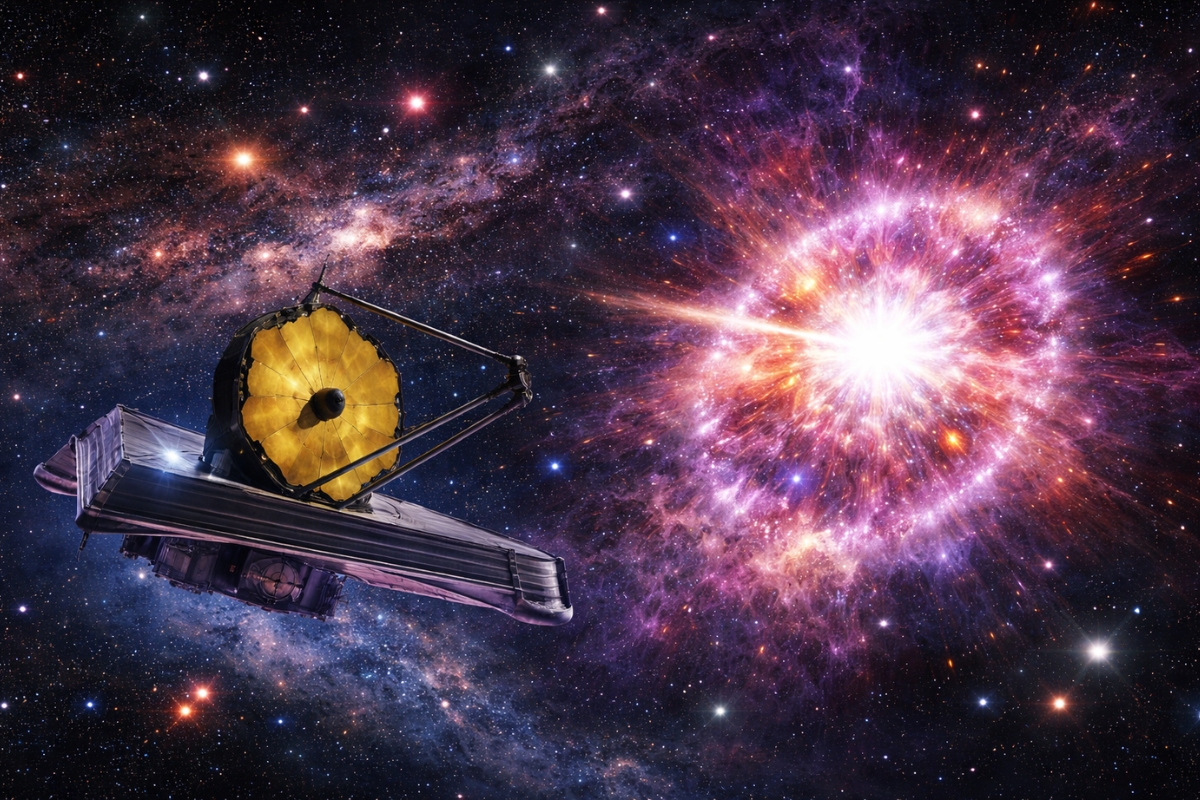
A Rare Signal in the Young Universe May Explain GRB 250314A and Open a New Window to Understand How the First Stars Exploded.
The search for extreme events in the cosmos has gained a possible milestone with the James Webb Space Telescope, which identified a light source in the primordial universe compatible with a very distant supernova.
The phenomenon may be linked to GRB 250314A, a gamma-ray burst observed in March, and helps investigate how stars and galaxies evolved when the universe was still very young.
The estimate points out that the explosion occurred about 730 million years after the Big Bang, a period in which this type of record is rare and valuable for astronomy.
-
While the world looks at oil, the war with Iran is already disrupting helium supply from Qatar, affecting car and iPhone chips, threatening AI expansion, and putting pressure on aluminum packaging at the highest value in four years.

-
Global warming will expose a treasure hidden under the ice of Antarctica and may spark an international dispute over gold and valuable minerals.

-
A street vendor from Praia Grande built a robot made of scrap from scooters and washing machines that pulls his popcorn cart on the beach, emits sounds, and interacts with customers, becoming an attraction on the coast of São Paulo.

-
The specifications of the Xiaomi 18 Pro Max have been leaked, and the highlight is a dual 200 MP camera with a new 22-nanometer technology that promises to consume less energy and capture details in shadows and bright areas using LOFIC HDR.


What Happened and Why It Caught Attention
The Webb detected a brightness associated with a very faint galaxy, with characteristics that may indicate the presence of a supernova at an extreme distance.
The possibility draws attention because it extends the telescope’s reach into fast and energetic phenomena, as well as bringing science closer to a time when the universe was only 730 million years old.
The event also connects to a type of explosion known for releasing energy on a large scale, the gamma-ray bursts, which are among the most powerful phenomena ever observed.
What Is GRB 250314A and How Was It Detected
The energy burst was named GRB 250314A and was identified by the Monitor of Space Variable Objects, a small X-ray telescope developed by China and France.
Just a few days after the initial alert, the origin of the flash was associated with an extremely distant object, existing only 730 million years after the Big Bang.
As there are few records of this type within the first billion years of the universe, the phenomenon became a rare chance to study the formation and death of the first stars.

Why the Duration of the Signal Is So Important
Short gamma-ray bursts, lasting less than two seconds, are usually linked to the merger of neutron stars, which are ultra-dense remnants of dead stars.
Long bursts, on the other hand, occur when massive stars collapse and may form a neutron star or a black hole, which fits better into supernova scenarios.
In the case of GRB 250314A, the initial peak lasted about 10 seconds, placing it in the long-duration category and reinforcing the hypothesis of a massive star explosion.
How Scientists Separate the Brightness of the Phenomenon
Even when a gamma-ray burst lasts a short time, it leaves a glow that fades away, emitting in X-rays, optical light, radio, and infrared for several days.
To understand the origin of the observed brightness, it was necessary to distinguish what came from the glow, from the possible supernova, and from the host galaxy.
The GRB 250314A generated infrared and X-ray glow, but this signal had already weakened when the Webb observed the region months later, indicating that another source was still contributing to the measured light.
What This Possible Supernova Says About the First Stars
The brightness of a supernova depends on the amount of radioactive material expelled, a factor influenced by the mass of the star’s core at the time of the explosion.
There is an expectation that stars in the primordial universe had more massive cores than those observed today, making this event a natural laboratory to study these initial conditions.
Despite this, the comparison with nearby supernovae showed a surprising similarity to modern stellar explosions, raising the possibility that the exploding stars in the young universe may not be as different as previously thought.
What May Happen From Now On
To confirm the nature of the event, it is still necessary to reevaluate how much of the observed light came from the supernova itself and how much may have come from the glow or the host galaxy.
There are plans for new observations next year, when the brightness of the supernova will have faded, which should facilitate the separation of the different contributions and strengthen the interpretation of the phenomenon.
If the reading is confirmed, the James Webb Telescope will have recorded a supernova at a time very close to the beginning of the cosmos, marked at 730 million years after the Big Bang.
In addition to clarifying the origin of GRB 250314A, the advancement may help understand how the first stars died and how this influenced the evolution of the first galaxies.








-

-

-

3 pessoas reagiram a isso.