





 Portuguese
  English
  Spanish
  7 min of reading
  0 comments


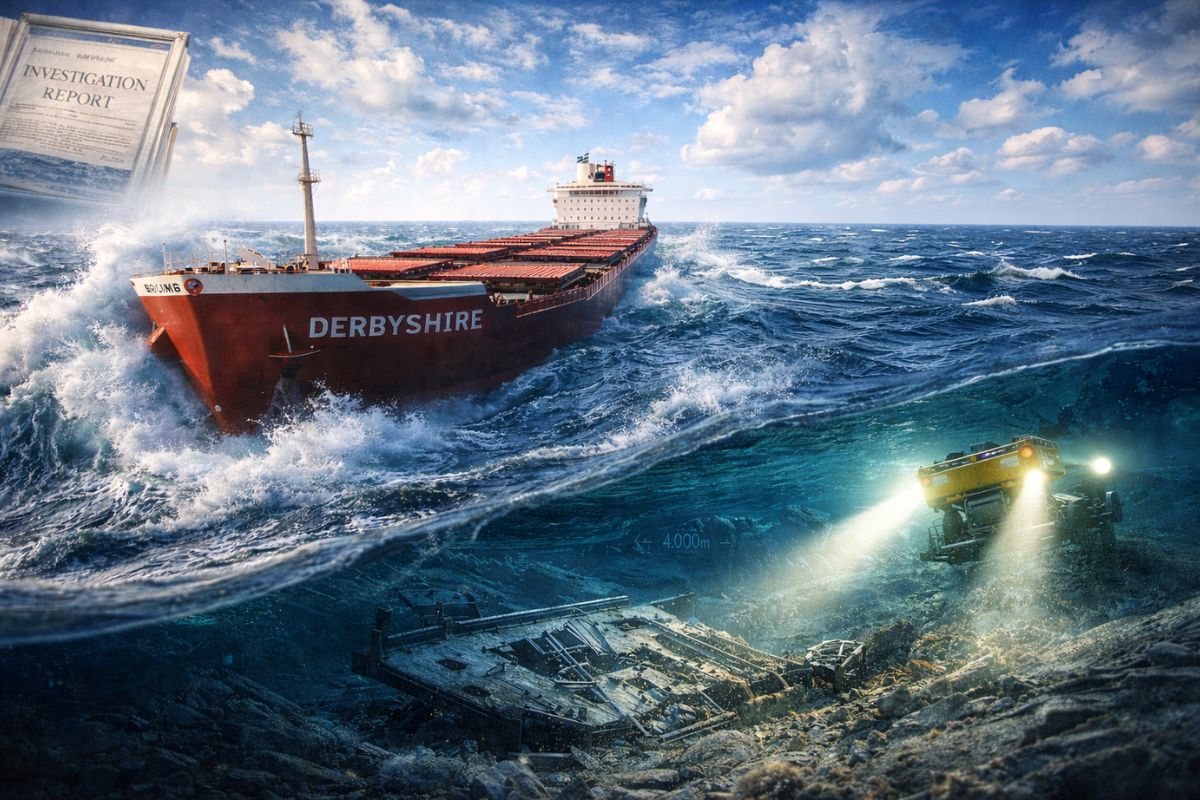
When The MV Derbyshire, The Largest British Cargo Ship, Disappeared In The Pacific, The Sinking Of The Derbyshire Amid Typhoon Orchid Exposed Design Flaws And Transformed Maritime Safety.
The sea has swallowed many ships, but few cases are as shocking as that of the MV Derbyshire. In September 1980, the largest British cargo ship of its time disappeared in the Pacific without sending an SOS, leaving no visible wreckage and giving no chance for the crew to respond. A colossus nearly 300 m long simply vanished amidst Typhoon Orchid, leaving families, engineers, and authorities with an uncomfortable question: how can a modern ship evaporate in the middle of the ocean.
In the following weeks, the official explanation tried to sum up the tragedy in three words: force of the sea. However, for those who lost parents, children, and companions in that sinking, that was never enough. The families’ struggle turned the disappearance of the largest British cargo ship into a historical investigation, which moved from the bureaucrats’ desks, descended to 4,000 m deep, and ultimately changed the rules of maritime safety worldwide.
When The Largest British Cargo Ship Evaporated In The Pacific

On the night of September 9, 1980, the MV Derbyshire was crossing the Pacific carrying about 150,000 tons of iron ore.
-
Friends have been building a small “town” for 30 years to grow old together, with compact houses, a common area, nature surrounding it, and a collective life project designed for friendship, coexistence, and simplicity.

-
This small town in Germany created its own currency 24 years ago, today it circulates millions per year, is accepted in over 300 stores, and the German government allowed all of this to happen under one condition.

-
Curitiba is shrinking and is expected to lose 97,000 residents by 2050, while inland cities in Paraná such as Sarandi, Araucária, and Toledo are experiencing accelerated growth that is changing the entire state’s map.

-
Tourists were poisoned on Everest in a million-dollar fraud scheme involving helicopters that diverted over $19 million and shocked international authorities.


After nearly two months since leaving Canada, the destination was Japan. Among officers, sailors, and engineers, 44 people trusted that the largest British cargo ship of the time had been designed to withstand any sea.
However, along the way, Typhoon Orchid was growing, a tropical cyclone increasingly violent. Captain Jeffrey Underhill, with over 20 years of experience, reduced speed, adjusted the bow to cut through the waves at an angle, and followed the standard plan for crossing severe storms.
During the night, waves of about 10 m hammered the hull like blows of steel, but the radio reports indicated no serious problems. Everything suggested that the ship was in control of the situation.
By dawn, silence. The Derbyshire stopped responding. No distress call, no emergency signal, no lifeboat located afterwards.
In a few days, an international operation combed the area but found nothing to explain how the largest British cargo ship could have disappeared like that. The official conclusion was short and uncomfortable: the ship had succumbed to the extreme force of the sea during the typhoon.
The First Clues In Other Shipwrecks
While the case of the MV Derbyshire was being pushed to the archives, other ships of the same series began to show signs that something was wrong.
The Derbyshire was part of the so-called Bridge Class, a family of six bulk carriers built with the same structural concept.
In 1982, the Tyne Bridge encountered a storm in the North Sea and showed severe cracks on the deck, always in the same structural area, in front of the superstructure. Subsequent inspections revealed similar damage on other ships in the series.
Even the Derbyshire itself, on previous voyages, had already shown signs of stress in that specific area of the hull.
Among those who clung to these clues was Peter Ridyard, the father of an engineer who disappeared in the wreck. Besides being in mourning, he was an experienced naval inspector.
Ridyard cross-referenced reports, photos, and assessments, and concluded that it was not a coincidence that so many ships appeared fragile at the same structural point. He took his conclusions to the British Department of Transport. The response was silence.
The suspicion grew even more in 1986, when another ship of the same class, the Kowloon Bridge, lost its rudder at sea, ran aground on the coast of Ireland, and ended up breaking in half in front of everyone.
This scene, public and undeniable, seemed a late mirror of what could have happened to the largest British cargo ship years before, far from any witness.
The Inquiry That Frustrated Families And Experts
With cracks, groundings, and a ship literally split in half, the British government could no longer ignore the issue.
In 1987, nearly seven years after the tragedy, an official inquiry into the disappearance of the MV Derbyshire was opened.
For the families, it finally seemed like the opportunity to understand why the largest British cargo ship had disappeared so quickly.
In practice, however, the inquiry turned into a great frustration. For months, engineers and representatives of the maritime industry were heard, but evidence of design flaws in the Bridge Class hardly came into play.
Peter Ridyard’s conclusions, which linked the pattern of cracks to the structural design, did not gain the weight they deserved.
The maritime court focused the explanation on the severity of Typhoon Orchid. The thesis was simple: the waves were so extreme that no ship could have withstood them.
The problem is that other smaller vessels went through the same system and survived, which weakened that justification.
Even so, in 1989 the official verdict was released: the Derbyshire had been “a victim of the force of the sea,” with no proven fault in design or construction.
For the families, it was like a second shipwreck. They had lost relatives at sea, and now they were losing the chance to see responsibilities discussed in depth.
In response, the Derbyshire Family Association, created in 1984, intensified pressure with unions, parliamentarians, and the press.
If the truth would not come to the surface through the courts, it would have to be sought 4,000 m deep, where the largest British cargo ship had rested in silence for nearly a decade and a half.
The Search At 4,000 M Depth
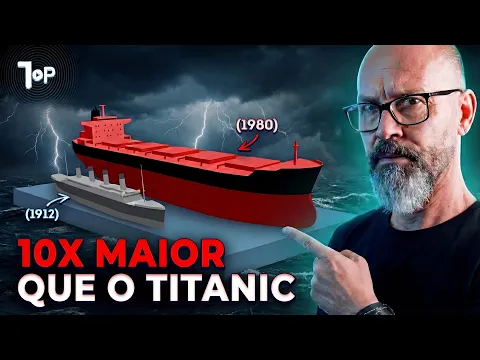

In 1994, the International Transport Workers’ Federation (ITF) decided to fund an independent expedition to the area where the MV Derbyshire had disappeared. Many experts considered the mission almost impossible. The region was remote, deep, and vast.
But within 24 hours of sonar scanning, the wreckage was located. For the first time since 1980, someone “saw” the largest British cargo ship again, now scattered across the bottom of the Pacific at about 4,000 m.
A remotely operated underwater vehicle traveled across the hull fragments, recorded detailed images, and left a plaque in honor of the 44 people who lost their lives in the wreck.
From this discovery, a thorough technical investigation reconstructed the sequence of events.
The analysis indicated that everything began at the bow, in a compartment known as the bosun store, which could not withstand the combination of wave pressure and structural stresses.
The entry of water in that area caused the ship to sink slightly at the front, increasing the impact of subsequent waves.
Then, the large hatches of the cargo holds, enormous like tennis courts, began to give way one by one.
Each failure opened the way for more water, increasing the weight at the front and accelerating the process. In no time, the hull was overloaded to the point that the Derbyshire broke apart and sank quickly.
The technical conclusion was clear: it was not just bad luck, but vulnerabilities in the design exposed by the repetitive force of the sea.
How The Tragedy Changed Maritime Safety
The images from the ocean floor and the reports derived from the 1994 expedition made unsustainable the version that everything came down to the force of the typhoon. Thanks to the continuous pressure from the Derbyshire Family Association, supported by maritime unions like the ITF and Nautilus, the case was reopened in 2000.
This time, the scenario changed. The new analysis recognized that the sailors had no blame and that the causes of the sinking were directly linked to the design and structural strength of the ship, especially in the areas of the bow and the hold hatches.
The disappearance of the largest British cargo ship ceased to be seen as an “inevitable fatality” and became a technical warning.
The impact on safety standards was profound. Hatches on bulk carriers began to be designed with greater strength, international regulations were reinforced, and inspections became more rigorous for similar vessels.
The tragedy of the MV Derbyshire helped create a new standard of requirement for large ships, increasing the safety margin for thousands of crew members crossing oceans every year.
Today, the name of the Derbyshire is inscribed in the history of navigation not only as the largest British cargo ship lost at sea but as the case that exposed hidden flaws and pushed an entire industry to rethink its standards.
A story of pain transformed into concrete change, thanks to the insistence of families who refused to accept silence as an answer.
And you, after learning what happened to the MV Derbyshire, do you believe that today’s large ships are really prepared to face the worst that the ocean can offer?









-

-

3 pessoas reagiram a isso.