





 Portuguese
  English
  Spanish
  5 min of reading
  0 comments



Launched in 2018, the Parker Solar Probe entered the solar crown, withstood over 1,300 °C, and revealed unprecedented data about solar wind and solar storms.
On December 14, 2021, humanity crossed a boundary that had seemed insurmountable for decades. The NASA, through the Parker Solar Probe mission, officially confirmed that a probe built by human hands entered the solar crown, the outer atmosphere of the Sun, something that had never been done before. The achievement was announced by NASA in Washington, United States, with data collected directly by the probe during an extreme approach to the Sun, conducted while the equipment orbited the star less than 9 million kilometers from its visible surface. The project is led by the Johns Hopkins Applied Physics Laboratory, responsible for the development and operation of the mission, in partnership with various international scientific centers.
This moment was not only symbolic. It marked the first time that scientific instruments measured on-site the magnetic fields, particles, and energy flows responsible for solar phenomena that directly influence Earth, such as geomagnetic storms, satellite blackouts, and failures in global electrical systems.
What Is the Solar Crown and Why Has It Always Been a Mystery
The solar crown is the outer layer of the atmosphere of the Sun. Viewed from Earth only during total eclipses, it extends for millions of kilometers into space and presents a paradox that has intrigued science for over 70 years: it is hundreds of times hotter than the surface of the Sun.
-
Motorola launched the Signature with a gold seal from DxOMark, tying with the iPhone 17 Pro in camera performance, Snapdragon 8 Gen 5 that surpassed 3 million in benchmarks, and a zoom that impresses even at night.

-
Satellites reveal beneath the Sahara a giant river buried for thousands of kilometers: study shows that the largest hot desert on the planet was once traversed by a river system comparable to the largest on Earth.

-
Scientists have captured something never seen in space: newly born stars are creating gigantic rings of light a thousand times larger than the distance between the Earth and the Sun, and this changes everything we knew about stellar birth.

-
Geologists find traces of a continent that disappeared 155 million years ago after separating from Australia and reveal that it did not sink, but broke into fragments scattered across Southeast Asia.


While the solar photosphere is about 5,500 °C, the crown can exceed 1 million degrees Celsius. Until the Parker Solar Probe, all explanations were based on theoretical models and indirect observations. No spacecraft had withstood the extreme conditions of heat, radiation, and energetic particles needed to traverse this region.
With the direct entry into the crown, the Parker finally allowed us to observe how magnetic fields reorganize, how solar wind is accelerated, and how energy explosions propagate through the Solar System.
The Parker Solar Probe: Engineering to Survive the Stellar Hell
Launched on August 12, 2018, the Parker Solar Probe was designed to face conditions that would destroy any conventional spacecraft. During its most extreme approaches, it withstands temperatures above 1,300 °C, while its instruments remain at about 30 °C, thanks to a carbon thermal shield 11.4 centimeters thick.

This shield, called the Thermal Protection System (TPS), is made up of carbon foam coated with a reflective white layer capable of blocking over 99.9% of incident solar heat. The spacecraft also moves at speeds exceeding 690,000 km/h, making it the fastest object ever built by humanity.
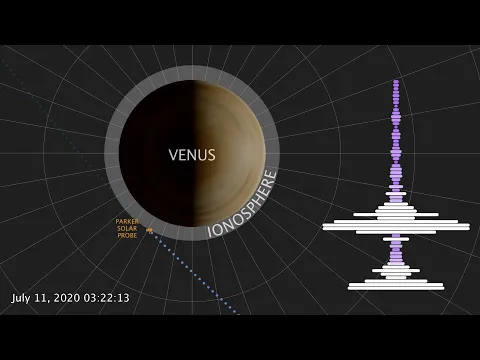
These features allowed the Parker to make multiple passes increasingly closer to the Sun, using Venus’s gravity to adjust its orbit and progressively reduce its approach distance.
The Historic Moment: When the Probe Really “Touched” the Sun
The confirmation of entry into the solar crown came after analyzing data collected on April 28, 2021, during the probe’s eighth approach. However, it was only on December 14, 2021 that scientists officially announced that the Parker had crossed the so-called Alfvén critical surface, the physical boundary that separates the solar atmosphere from the free solar wind.
This boundary is crucial because it marks the point where solar plasma ceases to be magnetically connected to the Sun and begins to expand into space. By crossing it, the Parker entered a region where solar wind is still being formed.
The probe’s instruments recorded abrupt changes in the direction of magnetic fields, variations in particle density, and structures known as switchbacks, magnetic folds that help explain how solar wind gains speed.
The Solar Wind and the Storms That Affect Earth
The solar wind is a continuous flow of charged particles spreading throughout the Solar System. When intensified by solar eruptions, it can cause geomagnetic storms capable of affecting satellites, GPS navigation systems, radio communications, and even terrestrial electrical grids.
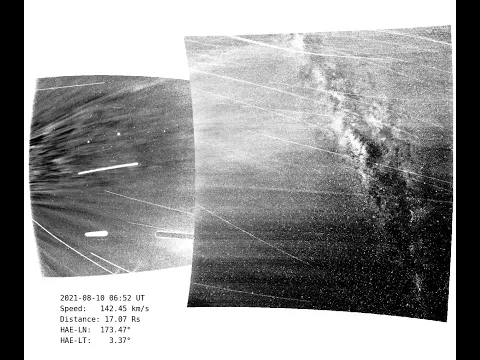

Before Parker, scientists knew these particles came from the Sun, but they did not fully understand where and how they were accelerated. Direct measurements showed that much of this acceleration occurs much closer to the Sun than previously thought, within the crown itself.
This significantly improves space weather prediction models, something strategic for a world increasingly dependent on satellites and sensitive electronic infrastructure.
Scientific Discoveries That Change Solar Physics
Among the most relevant discoveries made by the Parker Solar Probe are the identification of zig-zag magnetic structures, confirmation that solar wind is not uniform, and the observation of energy flows dissipating in a highly dynamic manner.
The data also indicate that small magnetic explosions, much more frequent than large visible eruptions, play a central role in heating the crown. This helps to solve the so-called “coronal heating problem”, one of the greatest mysteries of solar astrophysics.
Furthermore, the mission revealed that the Sun ejects energy in a more fragmented and chaotic manner than classical models predicted, forcing deep revisions in existing theories.
Why This Mission Is Crucial for the Future of Humanity
Understanding the Sun’s behavior is not just an academic issue. Severe solar storms have already caused historical blackouts, such as the Quebec event in 1989, and pose a real risk to satellites, astronauts, and critical energy systems.
With data from the Parker Solar Probe, space agencies and infrastructure operators can develop more accurate alerts, reduce risks, and protect essential technologies. In a scenario of increasing space exploration, this understanding becomes even more vital.
The mission remains active, with new approaches scheduled until the end of the decade, each taking the probe even deeper into the solar atmosphere.
A Definitive Milestone in Space Exploration
The Parker Solar Probe not only “touched” the Sun. It inaugurated a new era of solar science, where previously invisible phenomena are now measured directly.
By entering the solar crown, the mission transformed decades of hypotheses into concrete data and paved the way for a deeper understanding of the star that sustains all life on Earth.
It is an achievement that redefines the boundaries of engineering, physics, and human curiosity itself and will continue to generate discoveries for many years.







-

-

-

5 pessoas reagiram a isso.