





 Portuguese
  English
  Spanish
  5 min of reading
  0 comments


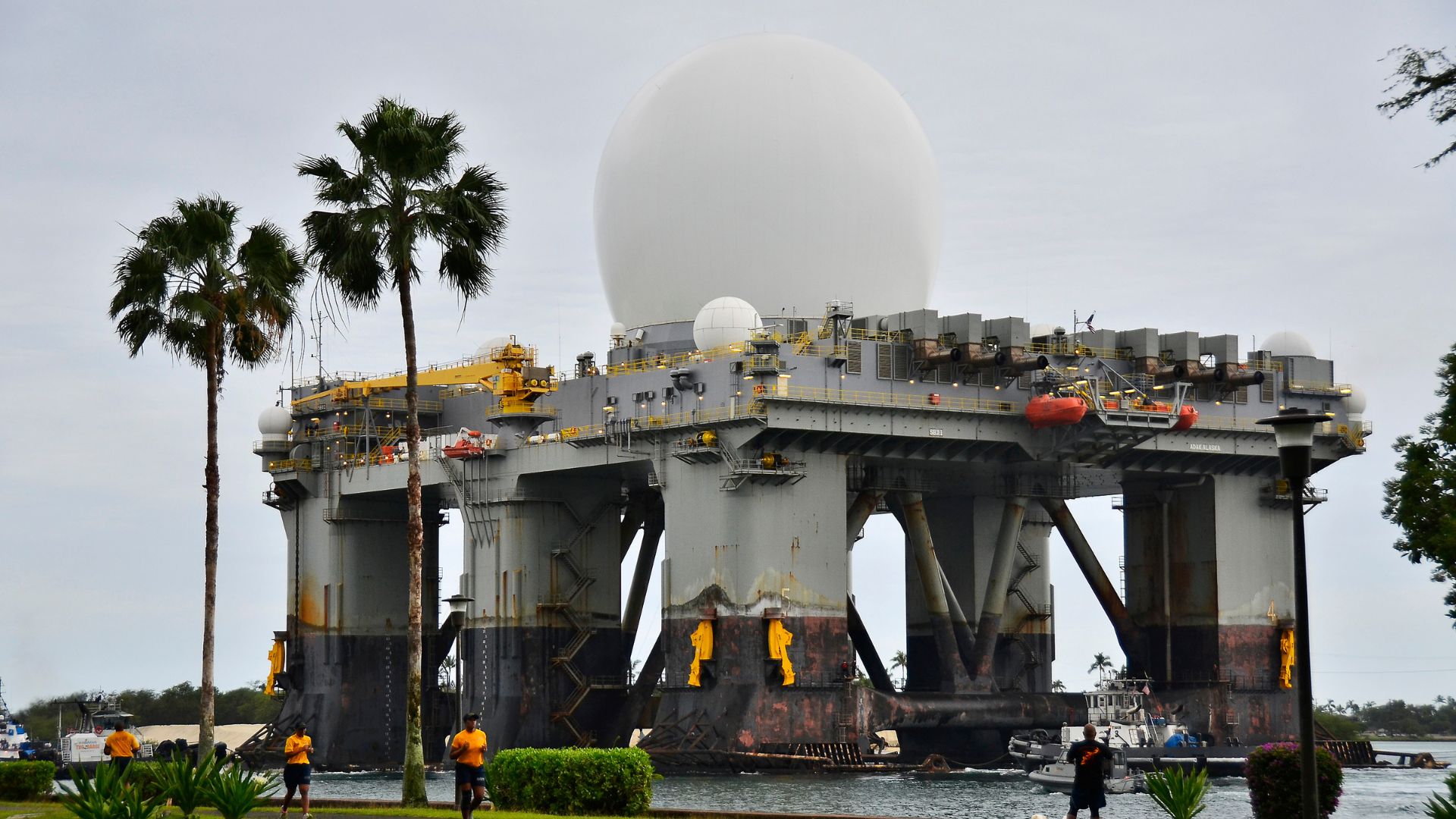
Little-Known Maritime Structure Integrates United States Anti-Missile Defense and Houses High-Precision Radar Used to Track Targets in Flight, Combining Advanced Military Technology with Design Inspired by the Offshore Industry, Whose Civilian Appearance Often Masks a Central Strategic Function.
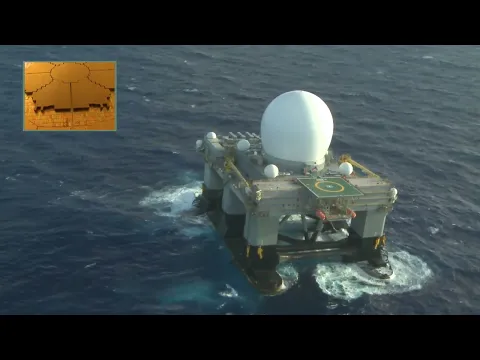
A structure resembling an oil platform, with a semi-submersible hull and a large white dome on top, integrates into the United States anti-missile defense network and often goes unnoticed outside specialized circles.
During a maintenance period at Pearl Harbor, Hawaii, the temporary removal of this dome revealed equipment that normally remains hidden, drawing attention for its scale and the technical complexity involved.
The exposed element was the Sea-Based X-Band Radar (SBX-1), a high-precision maritime radar designed to track and characterize airborne targets, with a specific focus on scenarios related to anti-missile defense.
-
Friends have been building a small “town” for 30 years to grow old together, with compact houses, a common area, nature surrounding it, and a collective life project designed for friendship, coexistence, and simplicity.

-
This small town in Germany created its own currency 24 years ago, today it circulates millions per year, is accepted in over 300 stores, and the German government allowed all of this to happen under one condition.

-
Curitiba is shrinking and is expected to lose 97,000 residents by 2050, while inland cities in Paraná such as Sarandi, Araucária, and Toledo are experiencing accelerated growth that is changing the entire state’s map.

-
Tourists were poisoned on Everest in a million-dollar fraud scheme involving helicopters that diverted over $19 million and shocked international authorities.


Despite its appearance associated with civilian structures, the SBX-1 is described by defense department entities as a strategic sensing asset, aimed at collecting critical data for the United States defense architecture.
It is neither a combat platform nor an armed vessel.
Its function is concentrated on gathering information that feeds decision-making processes and integrated interception systems.
SBX-1 Maritime Radar and Its Strategic Function
Behind the white sphere that has become its main visual hallmark, the SBX-1 houses a phased array X-band radar, designed to track objects with a high level of detail.

In institutional documents, the X-band is associated with higher resolution compared to lower frequencies, a characteristic that favors the separation of close elements in the same operational scenario.
This level of detail is considered relevant in anti-missile defense missions, where precise tracking of ballistic targets during flight is a central factor.
With the removal of the radome, the appearance of the vessel changes immediately.
The antenna takes center stage in the field of vision, making evident the scale of the system and its role as a mobile sensor in open sea.
Images and official records released during the maintenance drew attention precisely for revealing an internal structure that, for the most part, remains protected from the maritime environment.
Semi-Submersible Platform and Stability in Open Sea
Unlike conventional warships, the SBX-1 was designed based on a semi-submersible platform, a model widely used by the offshore industry.
This type of structure is known for providing greater stability in open sea, a fundamental characteristic for sensitive systems installed on the hull.
The choice meets a clear operational requirement.
Radares of this size depend on rigorous control of movements and vibrations, as excessive oscillations can compromise the sensor’s performance.
In this context, the semi-submersible design helps reduce the effects of the sea when the system is positioned to operate for extended periods.
In addition to stability, the concept ensures mobility.
As the coverage of a radar is influenced by factors such as distance and the curvature of the Earth, the ability to move enhances strategic positioning options.

This allows supporting tests and operational needs in different areas of the Pacific, according to public descriptions of the program.
Inflatable Radome and Maintenance in Hawaii
The white dome covering the radar serves an essential function.
It is a radome, designed to protect sensitive components from wind, salinity, rain, and other adverse maritime environmental conditions.
At the same time, this cover allows the radar to operate in the frequency range for which it was designed, without interfering with the system’s performance.
In the case of the SBX-1, the radome is described as inflatable and supported by internal pressure, which helps explain the complexity involved in its removal and reinstallation.
The replacement carried out at the end of 2025 was treated as planned maintenance, associated with the equipment’s lifecycle.
According to institutional material, the original radome had reached its usage limit after about 20 years of continuous operation.
The intervention marked the first time the dome was removed since the system came into service.
The work took place on Ford Island, a support area within the Pearl Harbor complex frequently used for logistical support of the SBX-1.
Sensors at the Center of Anti-Missile Defense
When the topic is anti-missile defense, public attention often focuses on interceptors and launch platforms.
Nevertheless, sensors occupy a central position in the system architecture because without a robust detection and tracking chain, the response capacity is limited.
In this context, institutional materials describe the SBX-1 as capable of obtaining detailed data during the flight of ballistic targets, contributing to the accurate identification and tracking of these objects.

This information supports the discrimination processes between warheads and possible countermeasures, a step considered critical for the system’s effectiveness.
The data collected by the maritime radar is integrated with other elements of anti-missile defense, including space sensors and ground radars.
This role helps explain why the vessel appears associated with Pacific scenarios, where tests and monitoring are frequently conducted.
More than engaging targets, the focus of the SBX-1 is to see, track, and characterize what moves in the airspace.
Operation, Management, and Hybrid Character of the Structure
The operation of the SBX-1 involves different entities of the United States government.
While the Missile Defense Agency is associated with the mission and integration of the radar, the management of the hull, security, and maintenance aspects was transferred to the Military Sealift Command in 2011.
This division of responsibilities reinforces the hybrid character of the asset, which combines an ocean platform with infrastructure profile to an advanced sensing mission.
In practice, this combination explains why the SBX-1 may appear, from a distance, as a common offshore facility, without obvious characteristics of a military asset.
The removal of the dome, by exposing the radar, temporarily breaks this neutral appearance and draws attention to the real function of the structure.
The episode transformed a technical component into an object of public curiosity, although it did not alter the mission of the system.
The radome replacement was presented as part of the normal maintenance cycle, with the stated goal of ensuring the availability and reliability of the sensor in the maritime environment.
If a structure visually associated with the oil industry can operate as a high-precision strategic sensor, how many other infrastructures at sea still fulfill critical roles without being recognized outside specialized circles?









-

Uma pessoa reagiu a isso.