





 Portuguese
  English
  Spanish
  6 min of reading
  4 comments


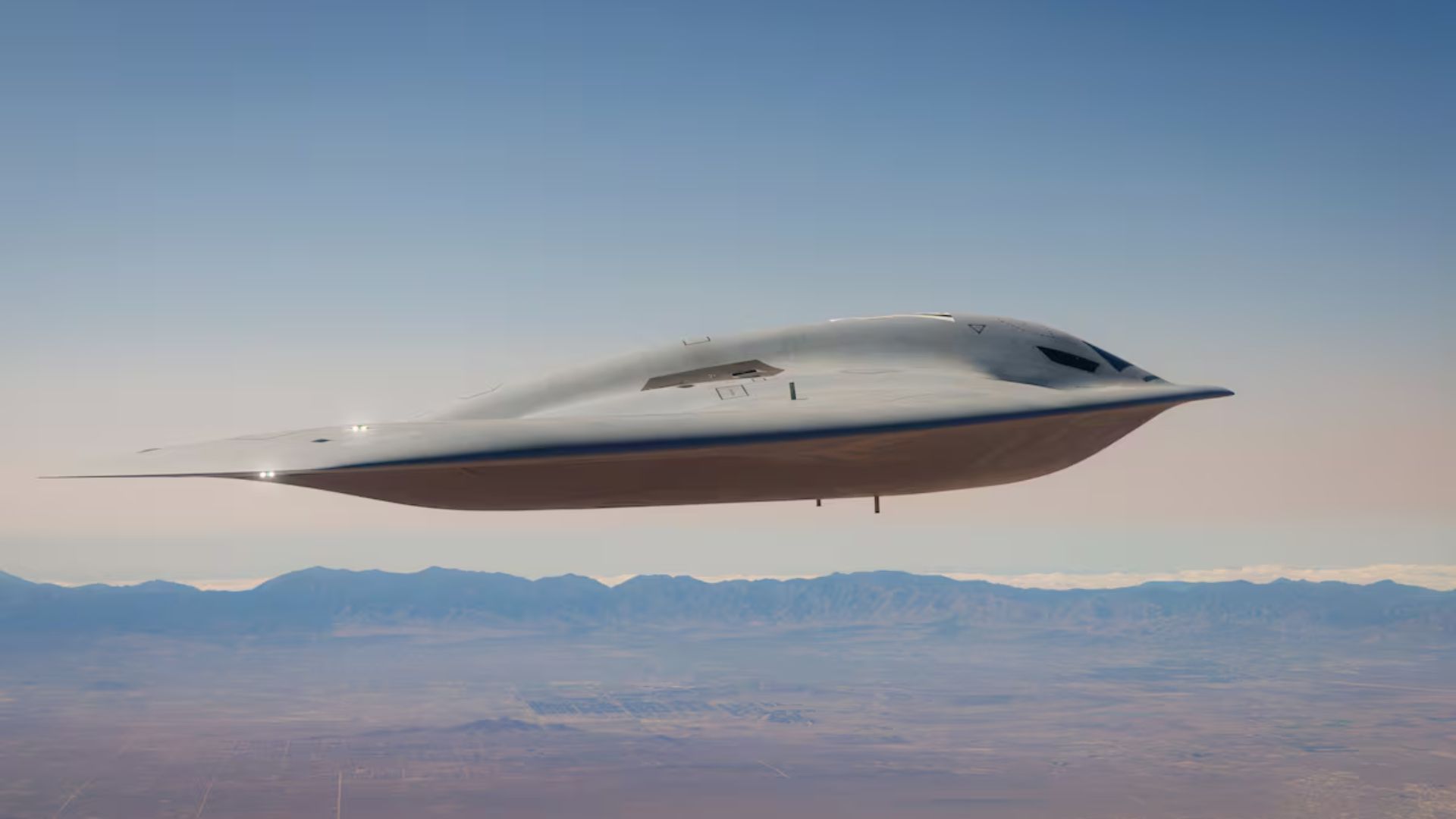

B-21 Raider Stealth Bomber Advances from Flight Testing to Industrial Expansion, Focusing on Global Reach, Survival in Defended Environments, and Increased Production Rates. Program Combines Secrecy, Engineering, and Billion-Dollar Investment as the Air Force Seeks to Accelerate Deliveries and Strengthen Strategic Deterrence.
The United States has moved into a new phase in its long-range strike aviation by putting the B-21 Raider into the air, a stealth bomber designed to operate in highly defended environments and carry out strategic missions with great range.
Developed by Northrop Grumman for the U.S. Air Force, the aircraft is viewed by the U.S. government as the next pillar of deterrence capability, focusing on survivability, connectivity, and flexibility in complex scenarios.
First Flight of the B-21 Raider and Start of the Testing Cycle
The program began to take on a more concrete shape when the aircraft transitioned from being merely a hangar promise to entering the flight testing cycle.
-
Friends have been building a small “town” for 30 years to grow old together, with compact houses, a common area, nature surrounding it, and a collective life project designed for friendship, coexistence, and simplicity.

-
This small town in Germany created its own currency 24 years ago, today it circulates millions per year, is accepted in over 300 stores, and the German government allowed all of this to happen under one condition.

-
Curitiba is shrinking and is expected to lose 97,000 residents by 2050, while inland cities in Paraná such as Sarandi, Araucária, and Toledo are experiencing accelerated growth that is changing the entire state’s map.

-
Tourists were poisoned on Everest in a million-dollar fraud scheme involving helicopters that diverted over $19 million and shocked international authorities.



The first takeoff of the B-21 occurred without prior announcement on a Saturday during a restricted public observation, from the facility known as Air Force Plant 42 in Palmdale, California, a location historically associated with sensitive projects and the manufacture of advanced military aircraft.
Confirmation of the flight was reported by news agencies and observers present in the vicinity of the complex, indicating that the aircraft has initiated the formal process of in-flight validation, a critical step for any combat platform.
Public Revelation and Focus on Stealth and Penetration
Before reaching flight status, the B-21 was publicly presented at an official ceremony organized by the Department of Defense in Palmdale, an event marking the first open revelation of the new U.S. strategic bomber in over three decades.
During the event, senior officials emphasized that the design was conceived to operate in “high-level” threats, with an emphasis on reducing detectable signatures and enabling precision strikes with less vulnerability to modern air defense systems.
Contract for $4.5 Billion and Increase in Production Rate
What differentiates the B-21, however, is not just the transition from stage to runway.
The program came into the spotlight again when the Department of the Air Force announced an agreement with Northrop Grumman to expand the bomber’s production capacity and accelerate deliveries.
The agreement calls for an investment of $4.5 billion aimed at increasing industrial cadence and ensuring that the fleet gets to operational units faster.

The measure was presented as a direct response to the need to “deliver combat capability” at a faster pace, in a strategy that combines technological modernization with increased manufacturing volume.
B-21 as a Pillar of Deterrence and Dual-Capable Bomber
This industrial scaling movement is significant because the B-21 is not described merely as a new aircraft but as part of a force architecture designed to sustain the next generation of long-range strikes.
In official documentation, the Air Force defines the B-21 as a stealth penetration “dual-capable” bomber, capable of employing both conventional and nuclear munitions.
The same documentation positions it as the future core of the bomber fleet, complementing existing platforms and gradually replacing part of a fleet whose maintenance becomes more costly and complex over the years.
Industrial Challenges and Supplier Chain in Serial Production
By opting to accelerate production, the U.S. government also signals that the success of the program will be measured not only by technical performance but by its ability to roll off the assembly line consistently.
The defense industry often faces bottlenecks when classified or highly complex projects transition from prototype to serial production, especially in supply chains with distributed suppliers and stringent requirements for materials, quality control, and certification.
In such programs, expanding “production capacity” involves increasing infrastructure, retraining the workforce, ensuring supply of critical components, and organizing testing and acceptance routines more swiftly, without compromising safety and performance standards.
Stealth Technology, Global Reach, and Precision Strikes

The B-21 is often described as a next-generation stealth bomber designed to overcome advanced air defenses, which helps explain why the program has strong appeal to the public: it is an aircraft associated with technologies that are typically very low visibility, mixing stealth, engineering, and large sums.
Northrop Grumman states that the B-21 was designed to “penetrate the toughest defenses” and execute precision strikes anywhere in the world, a description that reinforces the narrative of global reach and the ability to operate in contested scenarios.
While technical details regarding the level of stealth and sensors remain restricted, official information supports framing the B-21 as a system designed to survive and operate where conventional platforms would struggle.
From Test Flight to Scale Production
The first recorded takeoff in November 2023, the public presentation in December 2022, and the announcement of industrial expansion in February 2026 form a sequence that helps to understand why the program has come to be treated as a strategic marker.
The flight inaugurates a routine of tests aimed at verifying stability, control, performance, system integration, and behavior in different regimes, while the production increase indicates the transition from “proving it flies” to “producing at scale” — the step that ultimately determines whether an aircraft will remain limited to a few test units or if it will actually become the new standard for an air force.
Ramp-Up Costs and Assembly Line Efficiency
The speed at which the B-21 is advancing also draws attention given the industrial context.
In previous programs, the leap to full production was marked by costly adjustments and elastic timelines.
The economic press itself has reported that, in the ramp-up phase, the project incurred costs for the manufacturer, something common when a production line needs to mature and gain efficiency before becoming financially stable.
At the same time, the decision to invest to increase cadence shows that, for the government, the value of the program is not limited to the unit cost but to the effect of having a larger fleet available in a shorter horizon.
Operational Presence, Availability, and Network Integration
In practice, the announcement of the $4.5 billion agreement, coupled with the goal reported by specialized outlets to increase production by about 25%, tends to reorient the conversation about the B-21: less about the curiosity of a new “invisible bomber” and more about real delivery capability.
When a strategic aircraft enters the operational cycle, the impact is measured by continuous presence, the number of ready units, logistical availability, and the ability to integrate into command, control, and communication networks in joint operations.
It is this set, more than a single flight, that transforms a project into effective power.
By putting the B-21 in the air and then paving the way for faster production, the United States reinforces that the program is not just a technological symbol but a large-scale industrial bet with strategic implications that transcend aviation and reach global military balance, especially in how powers calculate risks and capabilities in crisis scenarios.
If the goal is to have a larger fleet in less time, to what extent can the race for scale shift the weight of the B-21 in deterrence decisions across different regions of the planet?









NEVER underestimate your enemy! The US usually does and bombs empty Walmart tents in the desert with bombs costing $1million +.
Too late. Iran is ahead of the west
LOL you are having great difficulty accepting defeat. Iran isn’t even on the list to be able to compete against US military. Look at the way your Islamic leaders get destroyed with precision and minimal civilian casualties.
Men u better ask questions before talking next time