





 Portuguese
  English
  Spanish
  6 min of reading
  0 comments


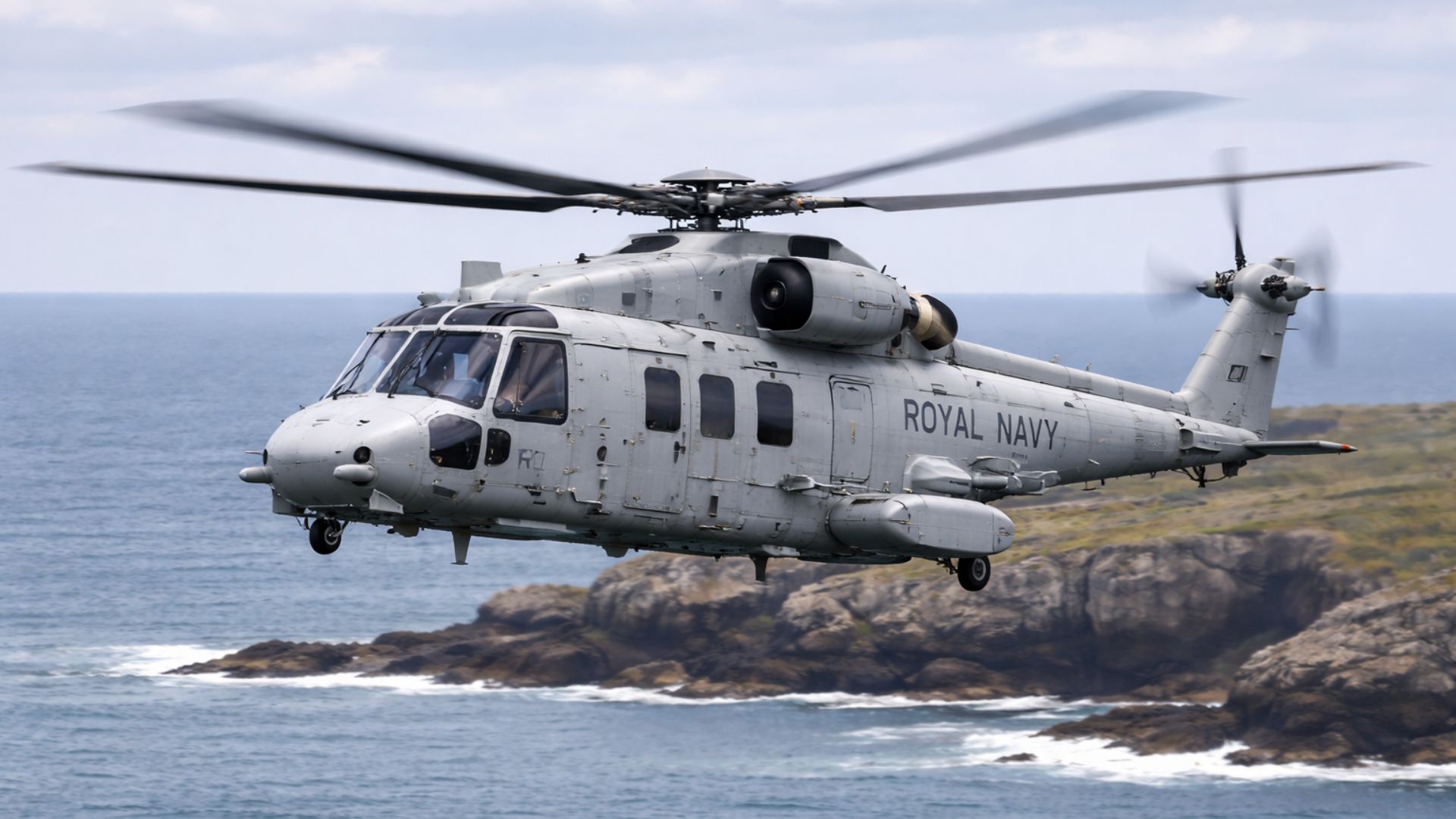
British Prototype Proteus Makes Inaugural Flight Without Crew in the Cockpit and Strengthens Bet on Autonomy for Naval Operations. Royal Navy Program with Leonardo Combines Sensors, Computers, and Ground Supervision to Increase Persistence at Sea and Reduce Human Risk in Complex Missions.
The Royal Navy conducted the first flight of a full-scale autonomous helicopter developed to operate without a crew onboard and expand the range of naval missions in higher-risk environments.
Named Proteus, the aircraft is presented by the British Navy as a technological demonstrator capable of flying with controls executed independently by onboard systems, replacing the presence of a pilot and crew in the cockpit with sensors, computers, and decision-making software.
The inaugural flight took place from Predannack Airfield on the Lizard Peninsula in Cornwall, an area used as a support field for helicopter units based nearby and also described by the Royal Navy as a hub dedicated to the development of unmanned systems.
-
He started running at 66 years old, broke records at 82, and is now a subject of study for having a metabolic age comparable to that of a 20-year-old, in a case that is intriguing scientists and inspiring the world.

-
Oldest tree on the planet reappears after 130 years of searches: Wattieza, 385 million years old, was 10 meters tall and had no leaves or seeds; Gilboa fossils in New York solved the mystery in 2007.

-
A 48-square-meter house assembled in hours with 4,000 bricks made of recycled plastic that does not absorb moisture, has natural thermal insulation, and costs less than 90,000 reais in a complete kit.

-
Luciano Hang revealed that Havan’s air fleet has already accumulated more than 20,000 landings, 10,000 flight hours, and 6 million kilometers traveled, and he says that without the planes, the company would never have grown so quickly.

The operation was monitored by technical teams and representatives from defense and industry, in a short test profile aimed at confirming the essential operation of the system under real conditions before the gradual expansion of the flight envelope.
First Flight of the Proteus and Autonomy Under Ground Supervision
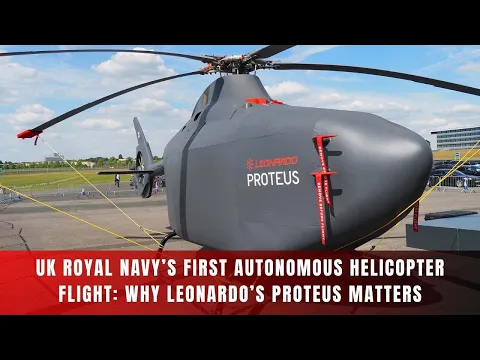

According to the Royal Navy, during this first mission, the Proteus executed a streamlined verification routine and managed to operate its own flight controls without direct human intervention, under constant supervision and monitoring by test pilots positioned on the ground to ensure safety.
The British Navy claims that the helicopter’s autonomy is linked to its ability to perceive the environment through sensors, process information with onboard computational systems, make decisions, and act according to defined mission parameters.
The Proteus was designed and built by Leonardo in the UK, from the Yeovil unit, a traditional hub for British helicopters.
The Royal Navy describes the program as an industrial and technological effort of £60 million, associated with around 100 specialized jobs in the country.
The stated goal is to “unlock the potential” of unmanned rotary-wing aircraft and prepare for joint operations with manned helicopters in a model of “hybrid air wing,” in which each platform is employed according to the type of task and level of risk.
Naval Drones and the Scale Jump of the Full-Size Helicopter
The British Navy already operates drones in specific roles, such as Malloy octocopters and the Peregrine, described as a smaller helicopter aimed at surveillance.
However, the Proteus is presented as a jump in scale and ambition, as it combines larger size, complexity, and, most importantly, autonomy.
The comparison is relevant because, in naval employment, the size of the aircraft and payload capacity directly influence operational range, the set of possible sensors, and persistence in prolonged missions over the sea.
The demonstrator was designed to carry more than one ton of payload, according to the Royal Navy, and operate in challenging conditions, such as high sea states and strong winds.
The logic, described in official communications, is to enable tasks considered “dirty, dangerous, and dull” to be performed by an unmanned system, preserving personnel and freeing manned aircraft for other critical sorties.
At the same time, the Proteus is intended to increase the number of hours on patrol without the human limitation of fatigue, a factor that often shortens shifts and requires rotations in prolonged missions.
Anti-Submarine Warfare, Sonobuoys, and Patrol in the Atlantic
The immediate priority associated with the program, according to the Royal Navy, is supporting anti-submarine warfare operations and maritime patrol.
This emphasis appears both in the general description of the project and in the details of how the aircraft would be employed in submarine search scenarios.
In a previous announcement about the contract, the British Navy stated that the tests would assess the helicopter’s ability to deploy sonobuoys, devices used to capture acoustic signals in the ocean and transmit information that aids in detecting and tracking submerged targets.
Official materials also indicate that, once relevant activity is identified, the system could report results to mission command and call for support from manned platforms.
Hybrid Operation and What Changes in the Role of the Human Operator
The operational design suggested in the Royal Navy’s communications is that of a “task-oriented” autonomous helicopter, where an operator defines the mission and monitors its fulfillment within established safety limits and rules.
Instead of “piloting” in the traditional sense, human supervision acts as a layer of control and assurance, while the main processing occurs onboard, with the helicopter evaluating sensor data, adjusting routes, and maintaining stability automatically.
Testing in Yeovil and the Transition from Ground to Flight
The development chain leading to the flight was also recorded in public stages.
Before takeoff, the Proteus underwent a “ground running” phase in Yeovil, with rotor rotation, engine checks, and testing of systems and sensors still on the ground, a procedure that usually precedes the first effective movements of an aircraft.
The Royal Navy stated that these verifications were extensive and involved engineers, technicians, and representatives from defense innovation, creating a trust foundation for the transition from the laboratory and test yard to the open operational environment.
Transformation of Naval Aviation and the Strategy in the North Atlantic
Aside from the technological aspect, the announcement was framed by the Royal Navy as part of a broader transformation of naval aviation, described in documents and statements as “maritime aviation transformation.”
In official discourse, autonomy is now seen as a central piece to increase capacity at sea without relying solely on the proportional increase of personnel and manned assets, an idea aligned with the adoption of unmanned systems across different navies.
In this context, the Proteus emerges as a platform to generate evidence, validate concepts, and guide future investment decisions, more so than as a product ready for production.
The project has also been publicly connected to initiatives and strategies announced by the UK Ministry of Defence, including the intention to form a “New Hybrid Navy” and employ autonomous helicopters in hybrid wings.
The Royal Navy also mentioned the “Atlantic Bastion strategy” as one of the scenarios where the aircraft could fit, alongside networks of ships, helicopters, submarines, and allied detection systems.
In news coverage, the launch of the Proteus was associated with strengthening capabilities in the North Atlantic and increased defense investments in Europe following the changing security environment on the continent.
Industry, Autonomy in Rotary-Wing, and Mission Without Crew
For the industry, the flight of the Proteus reinforces the bet on autonomy applied to rotary-wing aircraft at a level of size and mission more demanding than light surveillance drones.
Leonardo highlights that the demonstrator was designed for modularity and evolution of rotorcraft technologies, while the Royal Navy emphasizes the gain in persistence and the possibility of reducing human risks in prolonged maritime tasks.
The next step, as indicated by the very profile of “demonstrator,” is likely a gradual expansion of testing, with new flight profiles and assessments of payload integration and operational routines.
If the autonomy of full-scale helicopters advances from the demonstration stage to regular employment at sea, which missions today reserved for manned aircraft will be the first to migrate to a truly hybrid model?








-

-

-

-

-

9 pessoas reagiram a isso.