





 Portuguese
  English
  Spanish
  6 min of reading
  1 comment


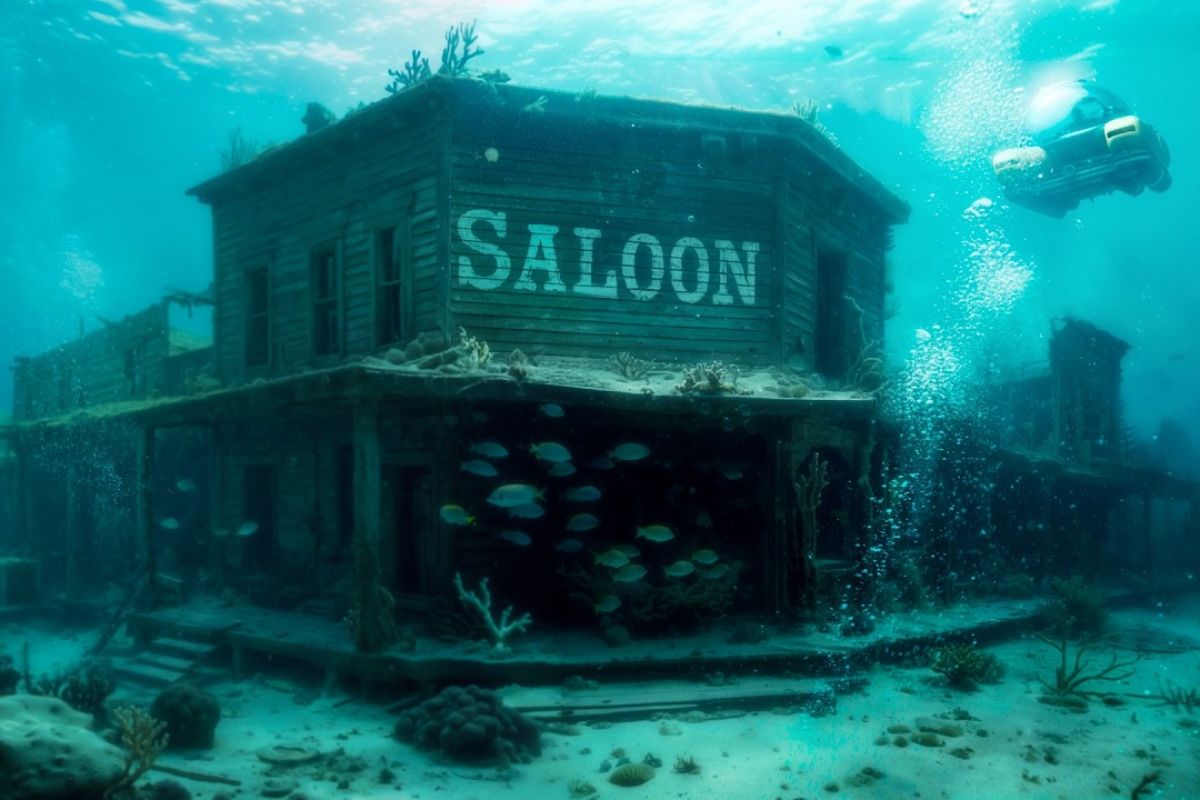


City Built During California Gold Rush Disappeared When A Dam Raised The Lake And Covered Hotels, Churches, And Cemetery. Decades Later, Ultrasonic Sensors And A Submarine Mapped A Bridge, An Airplane, And Burned Foundations, Suggesting That The Valley Was Already Ruined Before The Water In Total Silence.
The town that disappeared beneath a lake came back on the radar when underwater sensors began to draw, in the dark, outlines of structures that shouldn’t be there. What seemed like just another recreational reservoir gained new weight when a bridge and an airplane emerged as consistent shadows in the mapping. The name of the town is Mormon Island. It was a settlement from the California gold rush and today lies submerged under Folsom Lake, in the American River valley.
The town was born in the midst of the California Gold Rush, following the discovery of gold along the banks of the American River in March 1848. The news brought thousands of people to the valley, accelerated an improvised economic cycle, and left a physical legacy that, decades later, became trapped under sediments and low visibility.
Gold Rush And The City That Grew Too Fast

The story begins with the discovery of gold and the formation of a city that concentrated hotels, churches, carriages, and even a cemetery, in a typical frontier logic.
-
Friends have been building a small “town” for 30 years to grow old together, with compact houses, a common area, nature surrounding it, and a collective life project designed for friendship, coexistence, and simplicity.

-
This small town in Germany created its own currency 24 years ago, today it circulates millions per year, is accepted in over 300 stores, and the German government allowed all of this to happen under one condition.

-
Curitiba is shrinking and is expected to lose 97,000 residents by 2050, while inland cities in Paraná such as Sarandi, Araucária, and Toledo are experiencing accelerated growth that is changing the entire state’s map.

-
Tourists were poisoned on Everest in a million-dollar fraud scheme involving helicopters that diverted over $19 million and shocked international authorities.


In no time, bars, a post office, and dance spaces sprang up, while the promise of wealth attracted new groups to the valley.
One character summarizes the economic side of this movement: Samuel Brennan, cited as California’s first millionaire, not for extracting gold but for selling equipment to those trying to find gold.
This difference between mining and providing helps explain why the town grew faster than the infrastructure and records could keep up.
As the years went by, the gold lost its appeal, and floods began to impose a recurring cost on the valley and downstream areas.
The sequence of intense mining, unstable occupation, and extreme events creates a scenario where the town becomes vulnerable to simultaneous social and physical collapses.
Later, what remained of the town indicated a decisive detail: exposed foundations and the absence of complete buildings suggest that a large fire had destroyed the structures before the final flooding.
When the material base is already compromised, water does not preserve a town; it merely seals what remains.
Dam, Lake, And The Valley Erased From The Map

The dam was built in response to deadly floods that affected the valley and advanced toward Sacramento, and the new lake served as a large-scale hydraulic solution.
By raising the water level, the project transformed the territory into a reservoir that covered the old town and reconfigured land use.
The cited volume, 1.3 billion tons of water, illustrates the problem for any direct search attempts.
Even when a town is nearby, the combination of depth, turbidity, and sediments reduces visual inspection to a few centimeters, creating an environment where the lake effectively becomes a time capsule.
In addition to the sediment, there is an operational risk that alters planning: the lake behaves like a submerged forest, with trees and branches capable of entangling equipment.
In such environments, the strategy is not to descend and see, but to map first, validate targets, and only then approach safely.
The scanning area is also a critical factor: a water mirror of about 120 km² requires prioritization, calibration, and route repetition.
In this scenario, the town is not hidden; it is diluted in spatial uncertainty, and the lake punishes any untested assumption with data.
Sensors, Ultrasonics, And The Bridge That Became A Reference

The central method relies on sensors that operate on the echo principle, similar to the return of a sound in a canyon.
By emitting pulses and measuring the return time, the sensors build a map of the bottom, useful even when the water is dark and visibility is low.
Calibration usually starts with a recent and known target, such as a vessel that sank a few days earlier, as this allows comparing expectation and results.
After this adjustment, the sensors begin identifying larger shapes, such as the bridge, whose support structure and transition to an old road appear as coherent signatures in the mapping.
The bridge, in itself, changes the logic of the search: bridges connect banks, and banks connect human routes, increasing the likelihood of proximity to the old town.
When a bridge appears under the lake, it becomes a vector for geographical inference, not an isolated finding.
At the same time, the system has limitations: there is a blind spot directly below the sensor, which distorts proportions and requires recomposition through multiple passes.
The work shifts from treasure hunting to measurement engineering, involving repetition, checking, and interpretation.
Airplane At The Bottom Of The Lake And The Noise Between Tragedy And Coincidence
During the scanning process, the sensors detected a shape with artificial characteristics, distinct from rocks and natural contours.
The initial hypothesis pointed to an airplane, reinforced by elongated shadows compatible with a tail, engine, and wing parts, placing the search under another layer of responsibility.
There is a precedent that weighs in this reading: on January 1, 1965, two airplanes collided over the lake, resulting in four deaths, and one of the aircraft is said to have crashed and was never found.
The possibility of locating an airplane expands the case’s scope, as it goes beyond just the memory of the town and touches families, records, and investigation.
However, confirmation depends on technical identification, not visual impression. By aggregating scans and comparing characteristics, the mapped airplane was associated with an LA 4180, consistent with reports of a seaplane that sank in 1986, with safe evacuation before sinking.
This contrast between expectation and confirmation is the central point: sensors provide clues, but the final interpretation requires data cross-referencing, operational limits, and caution to avoid confusing different objects in a lake with low visibility and high sludge accumulation.
What Remains Of The Town And Why The Treasure May Be Something Else
With the bridge as a reference, the search concentrated efforts where historical records indicated a greater likelihood of finding the town.
The result frustrated the classic image of preserved streets and intact buildings: what emerged were foundations, baselines, and signs of occupation, consistent with a scenario already destroyed by fire before flooding.
The town then reveals itself less as a submerged museum and more as a set of evidence: foundations, a bridge, an airplane, boats, and layers of sediment that hide and, at the same time, preserve traces.
When the focus shifts from gold to material proof, the value becomes historical and technical.
This also explains why the lake efficiently keeps secrets: the mud accumulates quickly, covering surfaces and erasing details, making any recent or ancient object part of the same background.
The town did not vanish on its own; it was reduced to a signature on the lake’s bottom.
In the end, the most uncomfortable question is not where the gold is, but what can still be safely proven. A bridge indicates routes; an airplane indicates events; the town indicates economic cycles and public decisions like the dam.
Each piece reinforces that the valley has not been erased; it has merely become inaccessible without sensors.
The town returned to the debate not out of nostalgia, but because sensors, the bridge, and the airplane formed a set of signals hard to ignore in a lake with low visibility.
The scenario also reopens a less romantic reading of the Gold Rush: not always what remains is wealth; sometimes it is just foundations and silence.
If you had access to sensors to map a lake in your area, would you first look for a bridge, an airplane, or the limits of the old town? And what water-engulfed place, in your local memory, would you bet still has clues waiting to reappear?










Me peguei assistindo esta reportagem mesmo sem entender mt o inglês, mas entendendo a história achei interessante ,se todos tivessem essa tecnologia com toda certeza descobriam mais riquezas em nosso planeta!Parabéns pra tds dessa bela descoberta!