





 Portuguese
  English
  Spanish
  9 min of reading
  0 comments


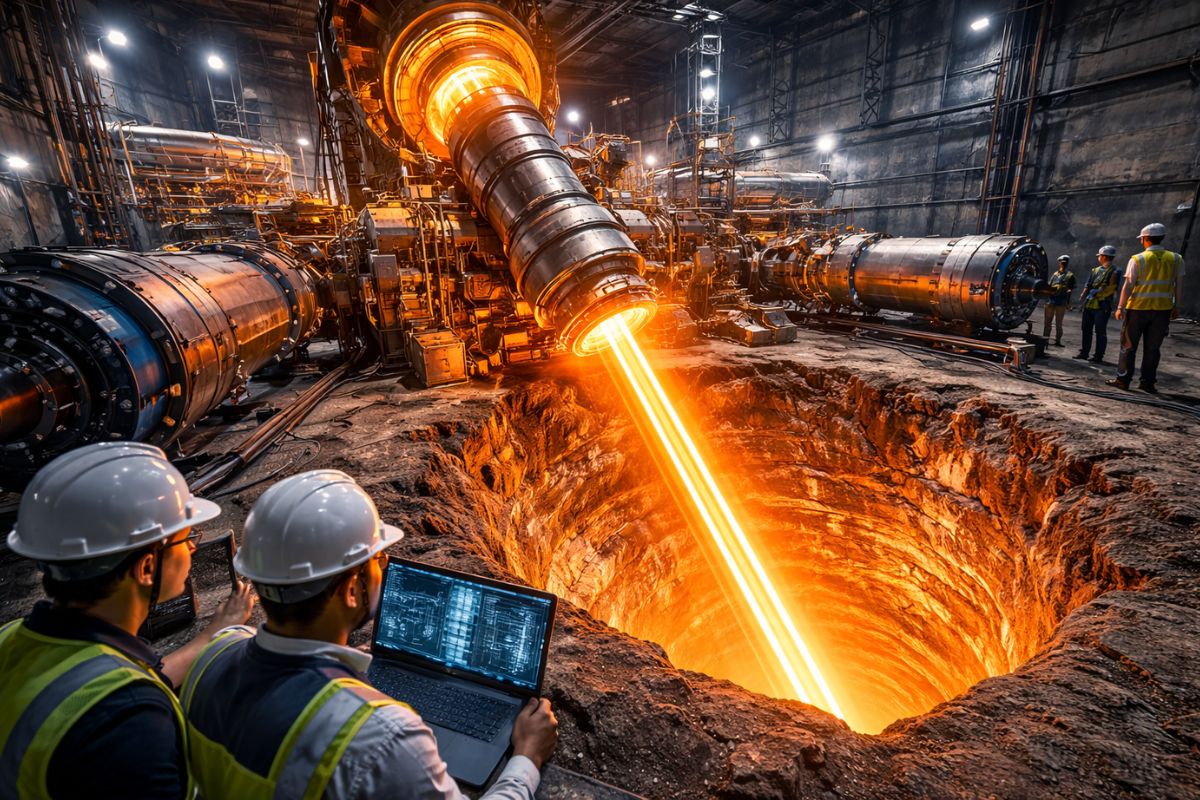
A Drilling That Held Humanity Back For Decades Could Change With Millimeter Waves: In Houston, A Repurposed Platform Uses A 1 Megawatt Gyratron, Waveguides With Internal Peaks, And 99.8% Reflectivity Mirrors To Melt And Vitrify Rock, Seeking 5 To 10 Km Toward Extreme Subsurface Heat
The drilling that held humanity back for decades did not stop due to a lack of will or steel; it stopped because physics itself begins to demand a toll when the depth becomes kilometers and heat becomes the rule. In Houston, a team is trying to turn the tables by swapping torque for concentrated energy, with vitrified rock taking on the role previously held by metallic casing and cement.
The drilling that held humanity back for decades appears here as an engineering problem that has repeated in different attempts: the deeper you go, the less useful energy reaches the end, the more time is wasted changing bits, and the more the rock ceases to “break” and begins to behave like a ductile material under pressure. The declared target is to drill between 5 and 10 km, where geothermal heat starts to become interesting without relying on exceptional geography.
Why Conventional Drilling Collapses When Depth Becomes A Furnace

The bottleneck that brought down historic projects has a simple name: energy that does not reach the bottom intact. The foundation describes that, at 10 km, the torque applied at the surface does not reach the bottom; it dissipates along the way.
-
Friends have been building a small “town” for 30 years to grow old together, with compact houses, a common area, nature surrounding it, and a collective life project designed for friendship, coexistence, and simplicity.

-
This small town in Germany created its own currency 24 years ago, today it circulates millions per year, is accepted in over 300 stores, and the German government allowed all of this to happen under one condition.

-
Curitiba is shrinking and is expected to lose 97,000 residents by 2050, while inland cities in Paraná such as Sarandi, Araucária, and Toledo are experiencing accelerated growth that is changing the entire state’s map.

-
Tourists were poisoned on Everest in a million-dollar fraud scheme involving helicopters that diverted over $19 million and shocked international authorities.

The shaft twists and flexes along thousands of meters of steel pipes, and the force is lost before the bit can actually work as it should.
It is a limit of mechanical transmission, not just of installed power.
The second brake is thermal and grows quickly. The temperature rises about 30°C for every kilometer down.
At 5 km, the steel begins to soften, components wear out rapidly, and changing the drilling head can take days because it involves bringing thousands of meters of tubing back to the surface and lowering everything again.
Even when the heat is partially “overcome,” the third obstacle emerges: at about 300°C and extreme pressure, the rock loses its brittle behavior and begins to flow like clay.
This transition between brittle and ductile is described as a graveyard of deep drilling attempts.
What Changes When Energy Enters As Millimeter Waves And Not As Torque

The proposal described revolves around a startup referred to as Quaise, also called Quaz in the material, located in Houston and operating on repurposed infrastructure from the oil sector.
The logic is pragmatic: use existing supply chains and experience from Texas drilling platforms, but swap the search for oil for a route to deep geothermal energy.
The “heart” stops being the bit cutting rock and becomes a beam of millimeter waves heating rock until it melts or vaporizes.
The material effect is visible in the described samples: rock that turns into black glass, vitrified, after being superheated.
The foundation states that silicate rock begins to melt at around 1,200°C, and vaporization begins at around 2,000°C.
This change matters because the system starts to demand much less torque and weight on the tool since the hard work is done by heating, and the removal becomes scraping vitrified material, which is more fragile than solid rock.
Instead of fighting hardness, the strategy is to change the physical state of the target.
The Three-Step Cycle That Tries To Make The Hole Perfect And Repeatable
The drilling described is called fusion drilling and, for now, operates as a three-step cycle.
First, the waveguide is positioned above the bottom of the hole by a defined distance, and the beam emerges, expanding and melting a section larger than the internal diameter of the guide. For this, the guide is lowered at a constant speed, the penetration rate.
Here, there is a detail that differentiates this approach from the traditional bit: energy travels through the waveguides, so the “big hole” needs to be formed by controlling the beam, not by teeth cutting along the edges.
In the second step, the beam is turned off, and the waveguide is rotated to scrape and smooth the sidewalls with a mechanical scraping tool.
The reason is technical and developmental: the system is not yet operating at maximum power, and the team wants to accurately measure whether the melting rate is leaving debris behind, as this defines how fast the guide can descend and how wide the hole can be.
In the third step, compressed air is blown to clear the hole, pushing vaporized and scraped debris out, launching that material into a water tank at the surface before the cycle restarts.
The goal is controlled repetition, not just an open hole by chance.
Vitrified Rock As Lining And The Direct Attack On Steel And Cement Costs
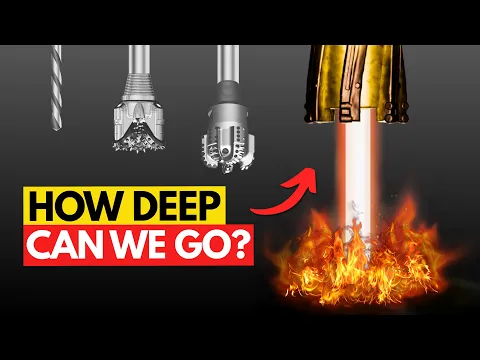

The described result of the process is a hole with a shiny vitrified surface, a “lining” made by the melted rock itself.
This targets an expensive point of conventional drilling: after each segment, engineers insert steel linings and pump cement to stabilize, prevent collapse, and stop fluid leaks between layers, keeping the drill column moving freely.
The deeper you go, the thicker the lining tends to need to be, and the hole becomes smaller and more expensive.
The vitrification approach attempts to circumvent this by using the rock itself as a lining, reducing dependence on steel and cement.
It’s an aggressive bet: transforming what would be rubble and instability into a containment structure.
The promised gain is not just in speed but in “flattening the cost curve”, so going deeper does not automatically mean more expensive per kilometer, a phrase that appears as an explicit goal of the project.
1 Megawatt Gyratron, Waveguides, And 99.8% Mirrors That Cannot Fail

The energy of the system comes from a gyratron, described as a vacuum electronic device originally developed for nuclear fusion experiments, used to superheat plasma.
The foundation makes a relevant technical correction: strictly speaking, a gyratron does not produce laser; it produces radiation in the microwave range, so it is a maser.
The current system would produce about 1 megawatt of continuous energy in millimeter waves, with limited efficiency, as only about 30% to 50% of the input electric energy turns into usable beam, depending on the configuration.
There is an upgrade planned to use the entire megawatt, which would bring the process closer to vaporization than melting, reducing the need for the scraping stage.
To carry the beam to the bottom, waveguides come into play, with internal peaks of about 1 millimeter in height that act as mirrors for the radiation, guiding the beam without letting it disperse.
As drilling progresses, new sections are added one by one, like in conventional drilling piping.
A problem of alignment and flexibility then arises, solved with a beam relay, compared to a periscope arm, which uses precision mirrors to reflect the beam around corners and reposition the bit. These mirrors have a reflectivity of over 99.8%.
The foundation makes it clear why this is obsessive: a loss of 0.2% in a 1 megawatt beam becomes 2 kW of heat absorbed at a point that should redirect, not absorb. And since the beam is capable of melting rock, it is also hot enough to melt steel.
These reflectors are not passive. They are actively cooled with circulating water, removing tens of liters per minute, to prevent catastrophic failures.
Additionally, to allow the beam to travel more efficiently, the system is kept under ultra-high vacuum conditions for as long as possible, until a transition point where most of the beam is directed downward and a small portion is diverted to measurement equipment.
It is a setup that mixes power, precision optics, and vacuum maintenance in the industrial environment of a drill.
5 To 10 Km As An Intermediate Target And What Is At Stake In Deep Geothermal Energy
The underlying argument is that deep geothermal energy is almost infinite but trapped beneath kilometers of rock that conventional drilling cannot penetrate economically.
If drilling can reliably reach 5 to 10 km, the system enters a zone where the heat can sustain an energy cycle: two holes side by side, one to inject water into the hot rock and the other to bring the fluid back.
The foundation notes that at 10 to 20 km, the rock can reach 400°C to 500°C, and at the surface, the hot fluid goes through a turbine to generate electricity, is cooled, and reinjected, closing a loop that recirculates water.
The numbers presented are ambitious and reflect the scale of interest: the U.S. Department of Energy would estimate that exploring deep geothermal systems could provide more than 90 gigawatts of electricity capacity in the United States by 2050.
Global studies cited attributed to the International Energy Agency suggest that accessible geothermal resources could exceed 550 terawatts, more than 150 times the current annual global electricity demand, according to the foundation itself.
The shock here is economic: drilling two wells for geothermal at up to 4 km would cost about 6 million euros, but doubling the depth to around 7 km would cost more than seven times that amount.
And most deep geothermal energy would be between 10 and 12 km, a range described as unviable without radical change.
Speed, TRL, And What Could Hold Everything Back Again
In the field, the team reportedly averaged a progress rate of 1 inch every 5 minutes, considered slow compared to conventional drilling but innovative in reducing long stops for bit changes.
The future goal with maximum power would be to achieve something like 3 to 5 meters per hour. The project appears to be in a P&D phase, noted as TRL 6 or 7 on a scale associated with NASA, with lab demonstrations and prototype in a real location in Houston.
It is development in real-world conditions, not just bench testing.
The foundation also exposes criticisms that already surround the concept. The purging system with gas and compressed air would work well at shallow depths, but talking about many kilometers, moving fine particles and vaporized rock over that distance would require huge amounts of compressed air and industrial pumps, increasing costs, power consumption, and complexity.
There are still questions about cooling the material during ascent, with the risk of sticking in the bit or the walls and sealing the hole.
In conventional drilling, this is mitigated with a water flow that carries material to the surface, but here water would not be viable because millimeter waves are favorably absorbed by water, drastically reducing the efficiency of the process.
On top of that is the discussion about supercritical water, which can behave like both liquid and gas and could potentially force its way back into the hole, absorbing energy and stopping the system.
It is a list of risks that is not detail; it is the heart of the challenge.
Implementation Strategy, Infrastructure Utilization, And A Timeline That Tries To Be Realistic
The described commercial strategy is to avoid facing depth and extreme heat at the same time, at least in the beginning.
First, aiming for shallower, high-temperature sites, where conventional drilling fails, generating revenue and experience while ultra-deep well challenges are resolved.
The cited progression is almost pedagogical: start with single-digit meters, then dozens, hundreds, thousands.
The material points out that they have already done single digits and dozens, would be doing hundreds, aiming to reach thousands in 2026 and thousands in very high temperatures in 2027.
There are also declared milestones: 2025 would be a landmark year with the debut of a hybrid at real scale combining traditional rotary method with millimeter wave drilling, represented by the Houston site.
For 2026, the cited forecast is the first thermal energy extraction from an enhanced superheated geothermal system. For 2028, the ambition is to realize the first superheated geothermal plant.
The timeline is aggressive but at least describes steps and not a single miraculous leap.
The drilling that held humanity back for decades is presented as a sum of physical limitations, lost torque, softening steel, bits that require days to change, rock that stops breaking and starts flowing, and costs that explode with depth.
In Houston, the proposed turn swaps mechanical effort for a millimeter wave system with a 1 megawatt gyratron, waveguides with internal peaks, mirrors with over 99.8% reflectivity, and a concept that uses vitrified rock as lining, targeting 5 to 10 km toward extreme heat.
If successful, it changes cost, time, and depth limits, but the path still requires overcoming debris removal at kilometers, hole stability, and energy efficiency without relying on water in the well.
I want a comment that gets to the point and reveals your technical instinct: do you think the biggest risk of this drilling that held humanity back lies in the removal of vaporized material over kilometers, in the thermal control of the mirrors, or in the rock sealing the hole on the way back? And if you could choose, would you first aim to drill 5 to 10 km to prove cost, or would you aim directly for 10 to 12 km to try to “unlock” deep geothermal energy for good?










Seja o primeiro a reagir!