





 Portuguese
  English
  Spanish
  5 min of reading
  2 comments


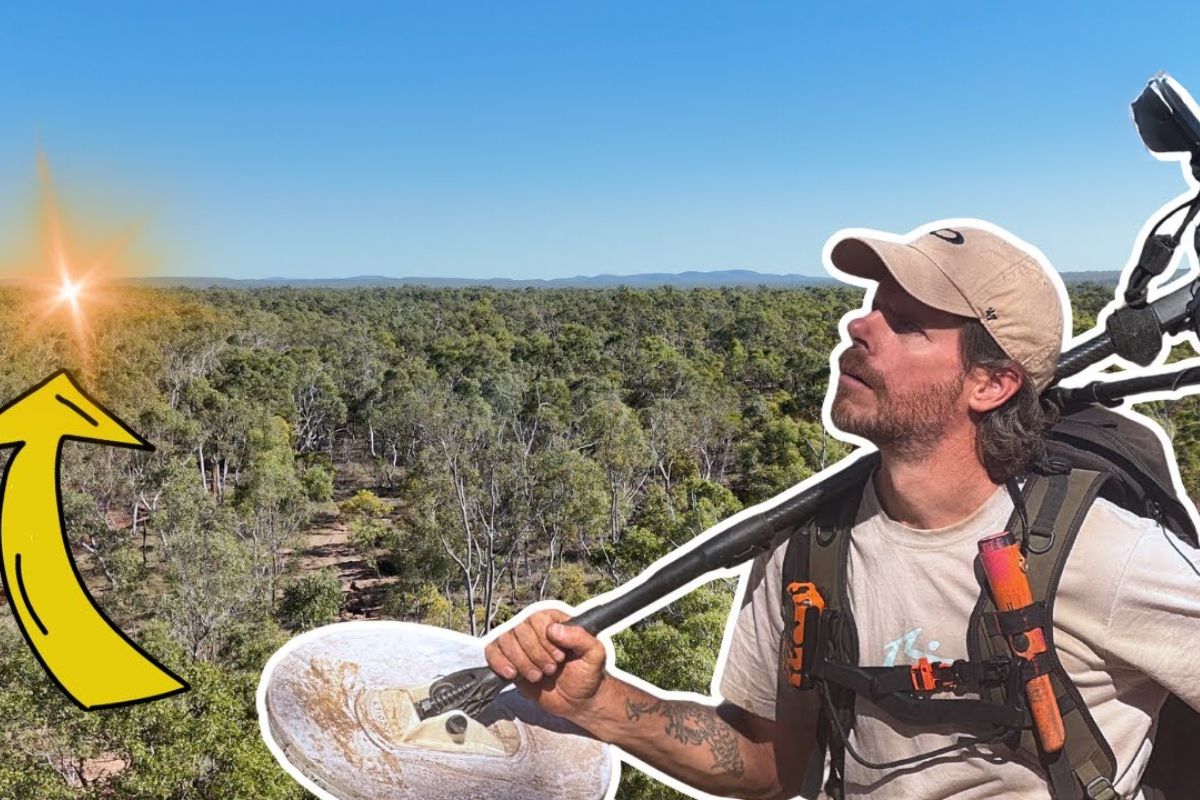


After Contact on Social Media, Two Prospectors Travel More Than 24 Hours to Queensland, Australia, Abandon Their Car in the Sand, and Continue on an Electric Bicycle Toward Remote Streams. With Metal Detectors and Partial Clues, They Try to Locate Chinese Excavations and the Lost Gold That History Says Is Hidden.
The farmer’s promise was simple and absolute: “If you manage to get in, you can keep everything.” In practice, this turned the lost gold into a logistical test and terrain reading in northern Queensland, where any misstep costs energy, time, and water.
The plan was three days long with little room for improvisation. No maps, no markers, and no formal record of the old areas, the mission relied on incomplete clues, geological observation, and the constant use of metal detectors to separate real signals from noise in an environment that does not forgive haste.
The Farmer’s Phrase and What It Really Means in the Field

When a landowner authorizes the collection of whatever is found, the risk does not disappear; it changes nature.
-
Friends have been building a small “town” for 30 years to grow old together, with compact houses, a common area, nature surrounding it, and a collective life project designed for friendship, coexistence, and simplicity.

-
This small town in Germany created its own currency 24 years ago, today it circulates millions per year, is accepted in over 300 stores, and the German government allowed all of this to happen under one condition.

-
Curitiba is shrinking and is expected to lose 97,000 residents by 2050, while inland cities in Paraná such as Sarandi, Araucária, and Toledo are experiencing accelerated growth that is changing the entire state’s map.

-
Tourists were poisoned on Everest in a million-dollar fraud scheme involving helicopters that diverted over $19 million and shocked international authorities.


The lost gold becomes a concrete goal, but the responsibility for entering, exiting, and operating safely falls entirely on the prospector, especially in Queensland, where transportation is already part of the challenge.
This authorization also alters the decision-making dynamic.
The hunt shifts from “where it’s possible to go” to “how far the body can endure”, because the track ends and the forest begins.
From this point, the chance of locating Chinese excavations depends more on method than luck.
Three Days, More Than 24 Hours of Travel, and the Bet on an Electric Bicycle

The mission began with a prolonged displacement, followed by a physical limit imposed by the loose sand and compromised traction.
The car was left behind when progress stopped, and the solution was a unique electric bicycle to carry people and equipment to remote areas of Queensland.
This created an operational bottleneck: every round trip became costlier in effort, and every decision began to have a domino effect on the three-day schedule.
The electric bicycle was not a picturesque detail; it was what kept the operation viable, because without it, the lost gold would remain an idea, not a real pursuit.
Why Streams, Tributaries, and “High Banks” Concentrate the Search for Lost Gold


The strategy favored water and relief.
The search for lost gold concentrated on narrow streams, inner curves, and deposition points where heavy material tends to be retained, as well as areas referred to as high banks, associated with ancient river beds.
In Queensland, this reading is reinforced when the terrain exposes quartz and ancient gravel.
The logic is simple and technical: gold is dense, travels with the flow, and seeks “centers of gravity” in the channel, such as gulfs and cavities.
When the bed shows ancient layers and consolidated material, the chance of retention increases, and metal detectors begin to be used with slow, repetitive, and controlled scans.
The Role of Conglomerate in Extraction Difficulty and Signal Interpretation
The conglomerate appeared as a recurring obstacle, described as “river rock in concrete.”
This type of base hardens excavation, traps particles, and also creates doubts: a signal can be lost gold trapped in the matrix or just interference from the material itself, requiring caution before asserting any find.
In practice, conglomerate requires patience and verification.
The team alternated attempts on the current bed and the exposed ancient bed because the river’s history changes over time and repositions what gets trapped.
With no modern trash and few common metallic objects, every signal becomes a decision, and this is where metal detectors weigh in favor, as long as used with discipline.
How to Recognize Chinese Excavations Without Maps and Why This Changes Everything
The account points to three systematically sought clues: rounded holes, hand-stacked stones, and citrus trees.
The combination of these marks was treated as the best indicator of ancient human presence in Queensland, precisely because “the Chinese left practically no trace” and there is no available record to guide the route.
When the Chinese excavations finally appear, the impact is immediate on planning.
They signal where there has been historic manual effort, where the overload has been removed, and where the channel has been “worked” to reach the bottom.
Chinese excavations are not a guarantee of wealth, but evidence of priority, and in a search for lost gold, this reorganizes time, energy, and the scanning area.
Metal Detectors in “Boiling Holes” and the Reason Gold Gets Trapped
The operation describes a specific type of target: small cavities in the bed, treated as boiling holes, where the flow deposits dense material.
The mechanism aligns with the physics of flow: heavy particles roll at high speeds and, when falling into a cavity, tend to remain, especially when the bottom is rigid.
It is at this point that excitement appears without turning into exaggeration.
The finding of small pieces reinforces the idea of continuity, as if the lost gold were there in fragments and clues, not in a single “big piece.”
The technical detail is what sustains the narrative: without common metallic trash, metal detectors repeatedly “point” to targets that, when opened, yield gold on a small scale, but significant enough to validate the location.
Environmental Risk, Fatigue, and the Line That Separates Courage from Recklessness
The scenario includes river crossings, sand, heat, dehydration, and the possible presence of crocodiles in isolated pools, the so-called billabongs.
In Queensland, this makes the search for lost gold also a continuous risk management exercise, where hydration, rhythm, and awareness of the surroundings are as important as detection.
Fatigue appears as an operational variable, not as drama.
The second day begins with signs of wear and irritation, which is relevant because poor decisions tend to arise when the body is in deficit.
Courage, in this context, is maintaining method when the terrain pushes, and not speeding up out of anxiety, especially when following clues of Chinese excavations in dense vegetation.
The mission in northern Queensland shows how a simple phrase from a farmer can turn into a real experiment of applied geology, resilience, and decision-making under pressure. The lost gold emerges less as legend and more as a consequence of method: follow water, identify ancient human marks, insist on the right signals, and accept that most finds are small but informative.
If you received the same offer of “keeping everything,” what would be your personal limit before retreating: heat, distance, crossings, animal risk, or lack of guidance? And when the lost gold appears in fragments, would you insist on one more day in Queensland or save the spot to return more prepared?










Quando ouço falar de prospecção de ouro, como nunca fiz algo desta forma, só achei algumas pedras coloridas em um determinada nascente de um moro misturado em pedreiras. Como já vejo busca do ouro chinês em alguns programas de TV e na minha suposição de onde procurar que acho mais viável é em túneis em montanhas ou em algumas cavernas que gostam de esconder suas caixas de ouro roubado e com algumas marcas em alguns pontos ou locais maus de difícil acesso.
Boa noite com toda a situação questão da fadiga sim coletaria sinais de ouro faria minha rota e voltaria mais preparado.