





 Portuguese
  English
  Spanish
  4 min of reading
  1 comment


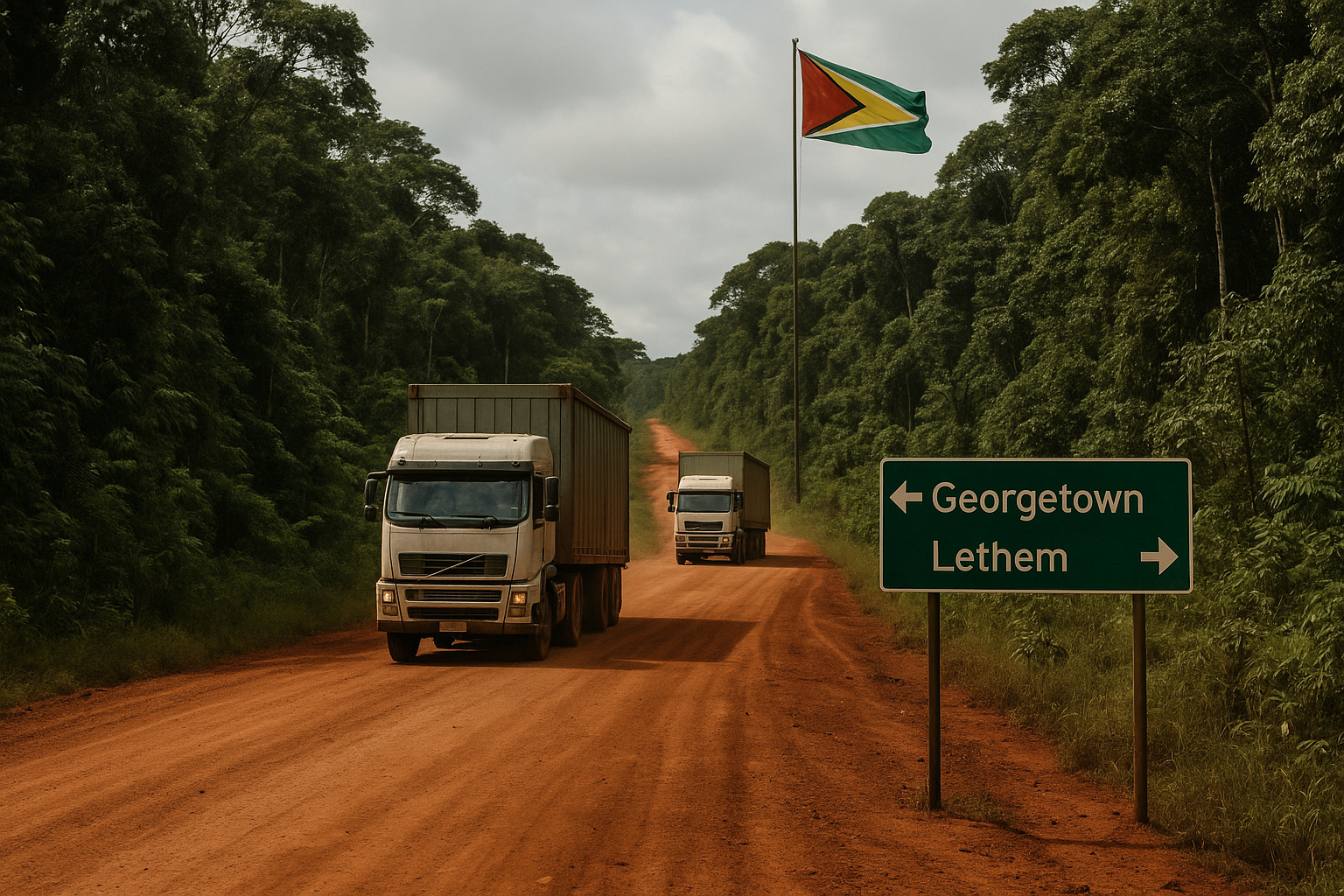


Guyana Invests Almost R$ 5.5 Billion in a 500 km Project Connecting the Capital Georgetown to the Border with Roraima, Transforming Trade, Logistics, and Access to the Essequibo Territory
Guyana, currently the fastest-growing country in the world, announced the construction of a highway approximately 500 kilometers long that will connect its capital, Georgetown, to the town of Lethem, at the border with Brazil, in Roraima. The project, estimated to cost nearly 1 billion dollars — around 5.4 billion reais —, promises to drastically reduce the time it takes to transport goods from 21 days by the Amazon River to just 48 hours by land.
Economic Growth Drives Project
The investment comes amid unprecedented economic growth. Guyana has multiplied the size of its economy six-fold in ten years, rising from 4.2 billion dollars in 2015 to 24 billion in 2024, according to the World Bank. Since 2020, the country has recorded annual growth rates above double digits, reaching 63% in 2022, 34% in 2023, and 43% in 2024. This expansion is directly linked to the immense oil reserves discovered in the country, now the largest per capita in the world.
The new highway, called the Linden-Lethem Road, also known as “El Sendero,” crosses the tropical forest and plains of Guyanese territory. Currently, the journey takes about 15 hours on dirt roads, with difficulties exacerbated by rain and dust in the dry season. Truck drivers report that vehicles often get stuck, making logistics expensive and time-consuming.
-
The government requests the Federal Revenue Service for a new system to automate the income tax declaration, reducing errors, time, and bureaucracy for millions of Brazilians.

-
Pix in installments, international Pix, and contactless payment without internet: the Central Bank revealed the new features coming to the tool that is already used by almost every adult in Brazil.

-
Mercado Livre has just started selling medications with delivery in up to three hours to your door, and this move could completely change the way Brazilians buy medicines on a daily basis.

-
In Dubai, rising tensions from the war in the Middle East are causing super-rich individuals to leave the Gulf and direct their fortunes to a new financial refuge in Asia.




Integration with Brazil and Strategic Outflow
According to Guyana’s Minister of Public Works, Juan Edghill, the highway will represent a “turning point for the future of Guyana.” The road will connect to the existing Takatu Bridge, linking the town of Lethem at the border to the municipality of Bonfim in Roraima. This will allow direct access to the Brazilian market, estimated to have more than 20 million consumers in the northern part of the country.
Moreover, the highway will be connected to the deep-water port of Palmyra, still under construction, near the border with Suriname. With this infrastructure, Brazilian exporters will have a logistical alternative to access the Atlantic in just two days, without relying on the river route through the Amazon, which currently takes three weeks.
Strategic Impacts in Essequibo
According to the portal Exame, a source connected to the project, cited by the French news agency (AFP), stated that the road will also have a strategic function, facilitating the transport of troops and military equipment to the Essequibo region — a territory administered by Guyana, but claimed by Venezuela for decades. Minister Edghill emphasized that “Essequibo is part of Guyana,” highlighting that there are indigenous communities, mining areas, and a large part of the forestry activity.
The territorial dispute between Guyana and Venezuela has intensified since the discoveries of oil in the region, turning Essequibo into one of the most sensitive points in South American geopolitics.
Local Social and Economic Impacts
While the government celebrates the benefits of regional integration, residents along the route face expectations and uncertainties. Michelle Fredericks, owner of a fast-food stand in Kurupukari, will be directly affected, as the new bridge will pass through her business location. Nevertheless, she remains optimistic: “You cannot fight against progress. That is how life is,” she told AFP, highlighting that she hopes to attract more visitors with the reduced travel time.
Truck drivers who use the current dirt road also see the project as crucial. Many report that during the rainy season, transportation costs increase due to delays and vehicles getting stuck. With the new paved highway and about 50 planned bridges, the expectation is that traffic will be constant and safer.
Expected Conclusion and Challenges of the Project
The project has been divided into four sections and will feature dozens of complex engineering works, including 50 bridges along the route. The most optimistic timeline suggests that the highway could be completed by 2030, provided there are no financial or climatic delays.
According to information from AFP, Guyana hopes that the highway will be decisive in consolidating its position as an emerging power in South America, expanding its presence in regional trade and reinforcing its sovereignty over Essequibo.
In light of this billion-dollar project and the promise of transforming logistics between Guyana and Brazil, do you believe the new highway will be merely an economic vector or will it also become a strategic factor in the territorial dispute over Essequibo?








Já passei nessa estrada é horrível