





 Portuguese
  English
  Spanish
  5 min of reading
  0 comments


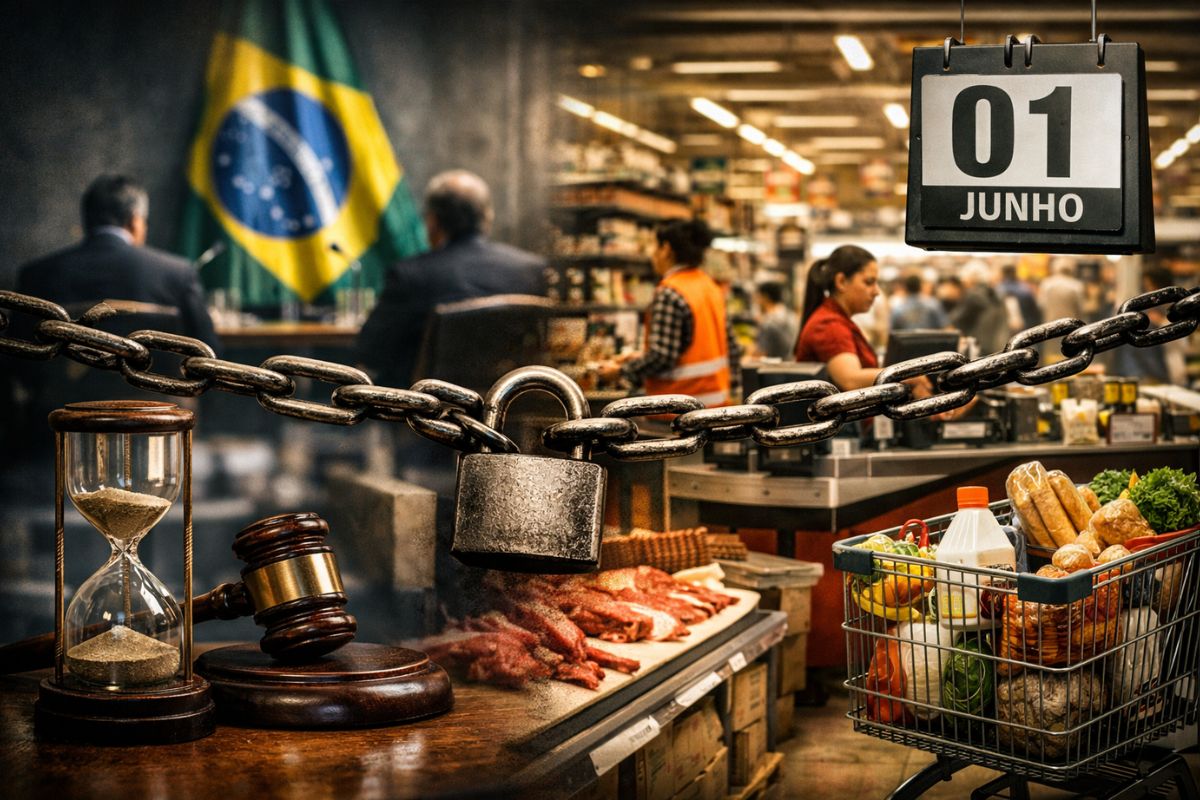
After Delaying Five Times, The Ministry Of Labor And Employment Extended By 90 Days The Rule That Conditions Work On Sundays And Holidays In Commerce To The Collective Agreement. Scheduled For March 1st, The Validity Was Pushed To June, And A 20-Member Committee Will Try To Unlock Consensus.
The federal government delayed for the fifth time the enforcement of the rule that changes work on sundays and holidays in commerce, pushing the expected start from March 1st to June. The decision, made by the Ministry of Labor and Employment, is expected to be finalized with publication in the Official Gazette this Thursday (26).
Today, the direct agreement between employers and employees still applies, but the change puts unions back at the center of the process: to open and operate on these dates, the way forward is through the collective agreement. The extension is presented as extra time for negotiation, while companies and unions still do not converge on costs, rules, and limits.
What Was Delayed And Who Made The Decision
The postponement is for 90 days and maintains, for another cycle, the current rule in practice: commerce continues to operate according to the understanding between employers and workers, without the immediate requirement of authorization through a specific collective instrument for these dates. The measure was set to start on March 1st, but the new deadline has now moved to June.
-
The government requests the Federal Revenue Service for a new system to automate the income tax declaration, reducing errors, time, and bureaucracy for millions of Brazilians.

-
Pix in installments, international Pix, and contactless payment without internet: the Central Bank revealed the new features coming to the tool that is already used by almost every adult in Brazil.

-
Mercado Livre has just started selling medications with delivery in up to three hours to your door, and this move could completely change the way Brazilians buy medicines on a daily basis.

-
In Dubai, rising tensions from the war in the Middle East are causing super-rich individuals to leave the Gulf and direct their fortunes to a new financial refuge in Asia.


The decision comes from the Ministry of Labor and Employment, which supports the extension as an attempt to create real space for agreement between the parties.
At the center of this discussion is Ordinance 3.665/2023, published in November 2023, and which has since been successively delayed, precisely due to the lack of consensus on how to apply the requirement in the day-to-day of retail.
Why Sundays And Holidays Have Turned Into An Impasse That Is Not Being Resolved
The government’s argument is that the ordinance seeks to reestablish the legality of work on holidays as determined by law, indicating that there was a “distortion” created when, in 2021, an ordinance began to authorize work on holidays more broadly, contrary to the understanding that this operation should be tied to collective negotiation.
On the other side, the negative reaction among companies arises because the change implies negotiating with unions and potentially dealing with additional costs and operational obligations that vary by category and region.
In practice, it is not just about “being able to open or not”: factors like scale, compensations, working conditions, predictability, and even how to monitor and prove what was agreed upon come into play.
What Changes In Practice: Collective Agreement As A Condition To Operate
With the rule in force, the operation of commerce on sundays and holidays ceases to depend only on internal decisions and now requires authorization through a collective agreement, that is, a deal established between workers’ unions and employers.
The central idea is to turn the exception into something negotiated, with clear rules, instead of a permanent permission for certain sectors.
This shifts the focus of debate to the negotiation table: each activity may have different conditions, and what applies in one city may not apply in a neighboring one. For the worker, the agreement can mean more protection and objective criteria. For the company, it means predictability only after an agreement is reached, and the risk of being stuck if the negotiation does not progress in time.
Which Sectors Enter The Direct Target Of The Change
The ordinance revoked the permanent authorization for work on holidays that had been granted by an ordinance in 2021 for a list of activities.
This is where the most immediate impacts arise, as many of these establishments tend to operate with high traffic precisely on sundays and holidays, when consumer demand increases.
Among the activities cited are:
• markets, supermarkets, and hypermarkets
• fish retailers
• fresh meat and game retailers
• fruit and vegetable retailers
• poultry and egg retailers
• pharmaceutical product retailers (pharmacies, including prescription compounding)
• commerce of regional items in spa towns
• commerce in ports, airports, roads, bus, and train stations
• commerce in hotels
• general commerce
• wholesalers and distributors of industrialized products
• resellers of tractors, trucks, cars, and similar vehicles
• general retail
The sensitive point is that the list mixes essential services for consumer routines with segments that depend on specific dates to maintain revenue and turnover. When opening becomes a matter of collective agreement, the “can open” comes with conditions: can open “if” and “how” it was negotiated.
Bipartite Commission And The Path To June: What Can Unlock And What Can Hold Back
To try to build a middle ground, the ministry reported that a bipartite commission will be created with 10 representatives from workers and 10 from employers.
The mission is to discuss the rules related to work on holidays in commerce and seek a consensus between the parties, since negotiation has not advanced due to a lack of agreement among unions, employers, and the government.
Until June, the scenario has two possible readings coexisting at the same time: the first is that the extra time can produce a more stable model, with less litigation and less “each one interprets it differently”.
The second is that the recurring postponement only pushes uncertainty, as companies and workers are left not knowing when the rule will really “start to be enforced” and what the final conditions will be for operating on sundays and holidays.
In your city, do markets and commerce usually open on sundays and holidays as a rule or as an exception, and does this help or hinder your family’s routine?
If you work in commerce, what is the most weighty factor: schedule, compensatory leave, extra pay, or last-minute unpredictability? And looking ahead to June, what do you consider a fair agreement to balance consumer, worker, and company without stalling operations?









-

-

-

6 pessoas reagiram a isso.