





 Portuguese
  English
  Spanish
  5 min of reading
  7 comments


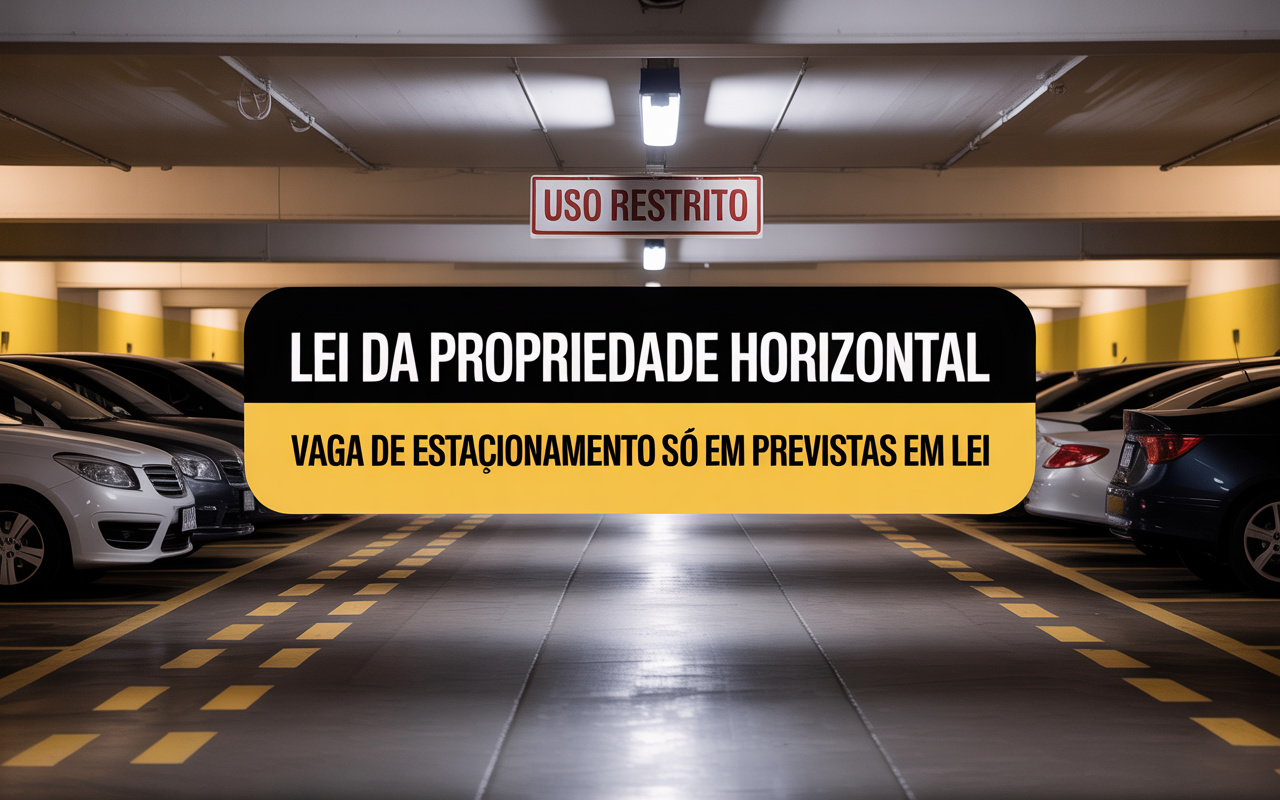


Horizontal Property Law and Civil Code Set Rules for the Use of Parking Spaces in Condominiums; Understand in Which Situations They Can Be Used.
Those who have lived in a condominium know: few things generate as much conflict as parking spaces. Discussions about who can park, the possibility of renting to others, or using the space as storage for household items are common in meetings and often end up in court. What many condominium owners are unaware of is that there is a clear legal basis for these situations. The so-called Horizontal Property Law, a term that in Brazil mainly corresponds to the Law No. 4,591/1964 (Condominiums and Incorporations) and the Civil Code of 2002, determines how and in which situations a parking space can be used.
And the courts have confirmed: the resident’s right depends on the type of parking space registered and the condominium agreement.
What the Law Says About Parking Spaces
The Law 4,591/1964 was pioneering in organizing the condominium regime in Brazil. Later, the Civil Code (arts. 1,331 to 1,358) consolidated these rules and brought detailed definitions.
-
The noise law will no longer be in effect at 10 PM starting in June with a new rule valid during the 2026 World Cup.

-
The Chamber opens a debate on driver’s licenses at 16 years old as part of a reform that includes around 270 proposals to change the Brazilian Traffic Code and may redesign rules for licensing, enforcement, and circulation in the country.

-
The new Civil Code could revolutionize marriages in Brazil with “express divorce” and changes that could exclude spouses from inheritance.

-
Banco do Brasil sues famous influencer for million-dollar debt and intensifies debate on delinquency, risks of seizure, and direct impact on Gkay’s credibility.


According to the legislation, parking spaces can be classified into three categories:
Common Area for Collective Use: when the parking spaces do not have their own registration in the property registry. In this case, use is regulated by the condominium agreement, which may include drawing lots, rotation, or fixed rules.
Parking Space Linked to the Autonomous Unit: when the parking space is legally an integral part of the apartment or house. In this case, it accompanies the property and cannot be negotiated separately.


Autonomous Parking Space (Own Registration): when registered independently in the registry office, with its own registration. In this situation, the resident can sell or rent the space, but only to another condominium owner, unless the agreement allows transfer to outsiders.
Situations Where Use Is Permitted
Based on the law and decisions from the Superior Court of Justice (STJ), the use of the parking space is only valid in some specific situations:
- Parking the Vehicle of the Condominium Owner or Their Family Members, provided the use of the area is respected.
- Sale or Rental of the Parking Space to Another Condominium Owner, when it has its own registration.
- Sale or Rental to Third Parties, only if expressly provided for in the condominium agreement.
- Use as a Common Area, if the agreement determines distribution by drawing lots or rotation among the residents.
Any use outside these hypotheses can be contested in court.
What Cannot Be Done with the Parking Space
Besides defining legitimate uses, the law and jurisprudence have also established prohibitions. Among them:
- Turning the Parking Space into Storage: the garage must be intended for vehicles, not furniture, appliances, or debris.
- Changing the Purpose of the Space: the STJ has ruled that turning a garage into a business or workshop is illegal without amending the agreement.
- Using the Parking Space to Host Vehicles of Others: unless there is explicit authorization, the garage cannot become a parking lot open to third parties.
These restrictions exist to preserve the safety, harmony, and purpose of the condominium.
STJ Jurisprudence: Emblematic Cases
The Superior Court of Justice has already analyzed several cases involving the use of parking spaces:
- REsp 1599515/SP (2017): confirmed that the space cannot be used for commercial purposes, as it undermines the building’s intended purpose.
- REsp 1,345,331/RS (2013): defined that autonomous spaces can only be sold to third parties if the condominium agreement permits.
- REsp 1,505,008/DF (2015): reinforced that improper use of a garage can be contested by the condominium, even if there is no express prohibition, when it undermines its original function.
These decisions show that the Judiciary has strictly applied the rules of the Horizontal Property Law and the Civil Code.
The Practical Impact on Condominium Owners
Knowing in which situations the parking space can or cannot be used has a direct impact on the resident’s life. Imagine:
- A condominium owner who rents the space to a stranger without provision in the agreement may be legally required to cancel the contract.
- Someone who uses the garage as storage for furniture may be fined and even face legal action for violating internal rules.
- Anyone trying to sell an autonomous parking space to someone outside the building, without authorization in the agreement, may have the transaction invalidated.
These situations not only generate conflicts but also legal costs and strain on coexistence.
Why the Law Is So Rigid
The logic behind these restrictions is simple: the garage is an essential part of the condominium structure, tied to safety, organization, and collective use. Allowing uses outside the standard would create risks for other residents.
At the same time, the law seeks to respect the right to individual property, which is why it distinguishes between common, linked, and autonomous spaces.
It is a delicate balance: preserving the community without violating the resident’s rights.
In the imagination of many condominium owners, the parking space seems to be just a piece of ground to park a car. But Brazilian legislation shows that it is a complex legal element, regulated by specific laws and solid jurisprudence.
The Horizontal Property Law and the Civil Code make it clear: the use of the space can only occur in situations determined by law and the condominium agreement.
In other words, the garage is much more than a physical space. It reflects how modern law organizes collective life in condominiums, balancing individual and collective interests.
And for those who still think that “in the garage I am in charge,” the answer is simple: no, the law is in charge.










Tem um condômino que quer colocar um armário na vaga de garagem para guardar alguns pertences.
Isso é permitido?
Moro em Maceió/ Alagoas.
Quando morei em Brasília, era permitido colocar os armários nas vagas.
Entendo que nao é correto, altera a destinação da vaga de garagem.
Em meu condomínio não existe vagas demarcadas e os condôminos estão deixando suas scooter pra segurar vaga , o que fazer nesse caso? As vezes chego e não tenho onde estacionar pois as mesmas estão ali p segurar a vaga
Como reagir a isso se o síndico não resolve?
É uma situaçao chata e desgastante! primeiro tem que olhar se a convenção ou regimento interno permite tal pratica (acho dificil permite). É de responsabilidade do sindico o cumprimento de normas: Cumprir e fazer cumprir a convenção, o regimento interno e as decisões das assembleias. O síndico pode ser responsabilizado civilmente por atos ilícitos, como negligência, imprudência ou imperícia, que causem danos aos condôminos. Os danos podem ser patrimoniais ou extrapatrimoniais.
Esse é um excelente assunto e tenho a acrescentar que as boas regras de convivio poderiam ser consideradas como por exemplo no meu condominio a depender da vaga cabe facilmente dois carros dentro da linha demarcada. Ocorre que a convenção de 1900 e bolinha estipula que a vaga é para veiculo automotor. Pois bem segundo a ausencia de bonsenso um visinho que nao tem carro mas tem 3 motos por essa interpretação literal tem que deixar as outras duas em garagem externas.
Acho que depende da convenção do condomínio. Conheço um em que foi definida que até duas motos podem ocupar uma vaga, não ultrapassando a área demarcada. Mas carro e moto, não!
Exato! depende da convençao, regimento interno e a estrutura do proprio condomínio.