





 Portuguese
  English
  Spanish
  5 min of reading
  0 comments


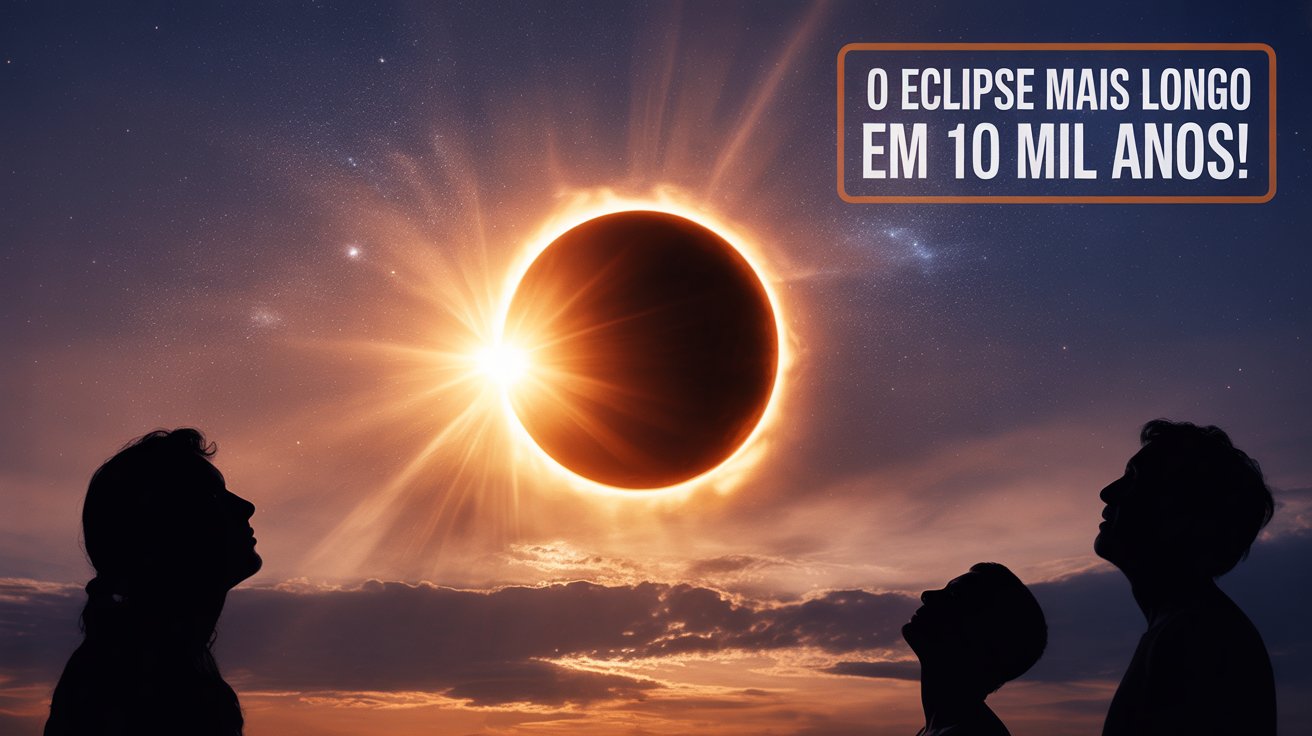
Longest Solar Eclipse in History Will Have Record Duration and Will Be Seen in Specific Regions of the Earth.
A total solar eclipse of unprecedented duration is set to occur, according to calculations from NASA (National Aeronautics and Space Administration).
With just over 7 minutes and 29 seconds of complete darkness, the phenomenon will be the longest recorded in the last 10,000 years, surpassing the current record of 6 minutes and 39 seconds, observed in 2009.
Astronomical Factors That Influence the Duration of the Solar Eclipse
According to NASA, the phenomenon is expected to occur on July 16, 2186. The duration of a total solar eclipse depends on a rare combination of astronomical factors that include the distance between the Earth and the Moon, the position of celestial bodies, and the orbital speed of the Moon around our planet.
-
Motorola launched the Signature with a gold seal from DxOMark, tying with the iPhone 17 Pro in camera performance, Snapdragon 8 Gen 5 that surpassed 3 million in benchmarks, and a zoom that impresses even at night.

-
Satellites reveal beneath the Sahara a giant river buried for thousands of kilometers: study shows that the largest hot desert on the planet was once traversed by a river system comparable to the largest on Earth.

-
Scientists have captured something never seen in space: newly born stars are creating gigantic rings of light a thousand times larger than the distance between the Earth and the Sun, and this changes everything we knew about stellar birth.

-
Geologists find traces of a continent that disappeared 155 million years ago after separating from Australia and reveal that it did not sink, but broke into fragments scattered across Southeast Asia.

For the 2186 event, all these elements will be aligned in a virtually perfect manner, resulting in an exceptionally prolonged total phase.
During the eclipse, the Moon will completely cover the Sun, blocking its light and plunging specific regions into darkness for several minutes, even though it will be daytime.
The phenomenon is called “total” precisely because of this complete occlusion of the solar disk, something that creates a unique and rare visual spectacle.
Prime Viewing Regions for the Longest Solar Eclipse
The path of the eclipse will primarily occur over the Atlantic Ocean, but the shadow of the Moon will also reach parts of South America and West Africa.
Among the countries that will have the best conditions to observe the eclipse are Brazil, particularly the northern region, as well as countries like French Guiana, Suriname, and parts of West Africa, including Liberia and Ivory Coast.
In these areas, observers will be able to experience more than seven minutes of total darkness during the day, something unusual and extraordinary.
Scientific Preparations for the 2186 Eclipse
The 2186 eclipse will be such a significant event that it is already being studied and planned by the global scientific community.
Observatories in the Americas, Europe, and Africa have been developing strategies to capture images and data with high precision, anticipating the use of technologies that will still be developed over the next 160 years.
The expected technological advancement should allow for detailed recordings of the solar corona — the Sun’s outer atmosphere, visible only during total eclipses — as well as the measurement of atmospheric variations, animal behavior, and phenomena associated with light and shadow.

Historical and Scientific Importance of Solar Eclipses
It is important to note that total solar eclipses are not frequent in the same location on Earth.
For the same geographic point to experience a total eclipse, it can take decades or even centuries.
Therefore, the eclipse of 2186, with its long duration, represents a unique and rare opportunity, even though people alive today may not be present to witness it.
Historically, solar eclipses have always evoked fascination and mystery.
Ancient cultures viewed these events as omens or divine manifestations.
Today, they are understood as results of the natural movement of celestial bodies and are studied to better understand the dynamics of the solar system, solar physics, and the environmental impacts that accompany the rapid change from light to darkness.
Phenomena Observed During Total Eclipses
In addition to the scientific aspect, total eclipses offer a unique opportunity to observe optical phenomena, such as the appearance of stars in the sky during the day, changes in ambient temperature, and unusual behaviors of animals and plants, which often confuse them with the onset of night.
The duration of the 2186 eclipse is surprising because total eclipses typically last from seconds to a few minutes.
The common average is about 2 to 3 minutes.
This extended event will allow scientists to study the solar corona and other features more deeply, potentially leading to important advances in astronomy and solar physics.
Technical Terms: Umbra and Penumbra Explained
The shadow of the Moon during a total eclipse is known as “umbra”, which is the area of complete darkness on the Earth’s surface.
Outside of it, there is the “penumbra”, where the Sun is only partially blocked, causing a partial eclipse.
For the duration of the eclipse to exceed seven minutes, as it will in 2186, the trajectory of the umbra must move slowly over the Earth’s surface, which depends on factors such as the Moon’s orbital speed and the angle of incidence of the Sun.
Comparison with Previous Eclipses
The longest recorded previous solar eclipse, which occurred on July 22, 2009, had a total duration of 6 minutes and 39 seconds, primarily visible in the Pacific and some parts of Southeast Asia.
The eclipse expected for 2186 will surpass this mark by almost a full minute, which is an extraordinary phenomenon for astronomers.
The Connection Between the Eclipse and Future Science
In addition to the scientific interest, this eclipse will be a landmark event for humanity, as it is a powerful reminder of the connection between our planet and the cosmos.
Science continues to evolve to better understand these events and their implications, and the solar eclipse of 2186 will serve as a natural laboratory for advanced studies that could help unravel the mysteries of the Sun and the Earth’s atmosphere.
With the countdown already started, researchers and space enthusiasts eagerly await this celestial spectacle that, although distant, already mobilizes global efforts for its observation and recording.
As technology is likely to be much more advanced by then, the event should be captured with details never seen before, expanding our knowledge of the universe.
Have you ever imagined what it would be like to witness the longest solar eclipse in history? What can science discover from this rare observation opportunity?







-

-

2 pessoas reagiram a isso.