





 Portuguese
  English
  Spanish
  4 min of reading
  0 comments


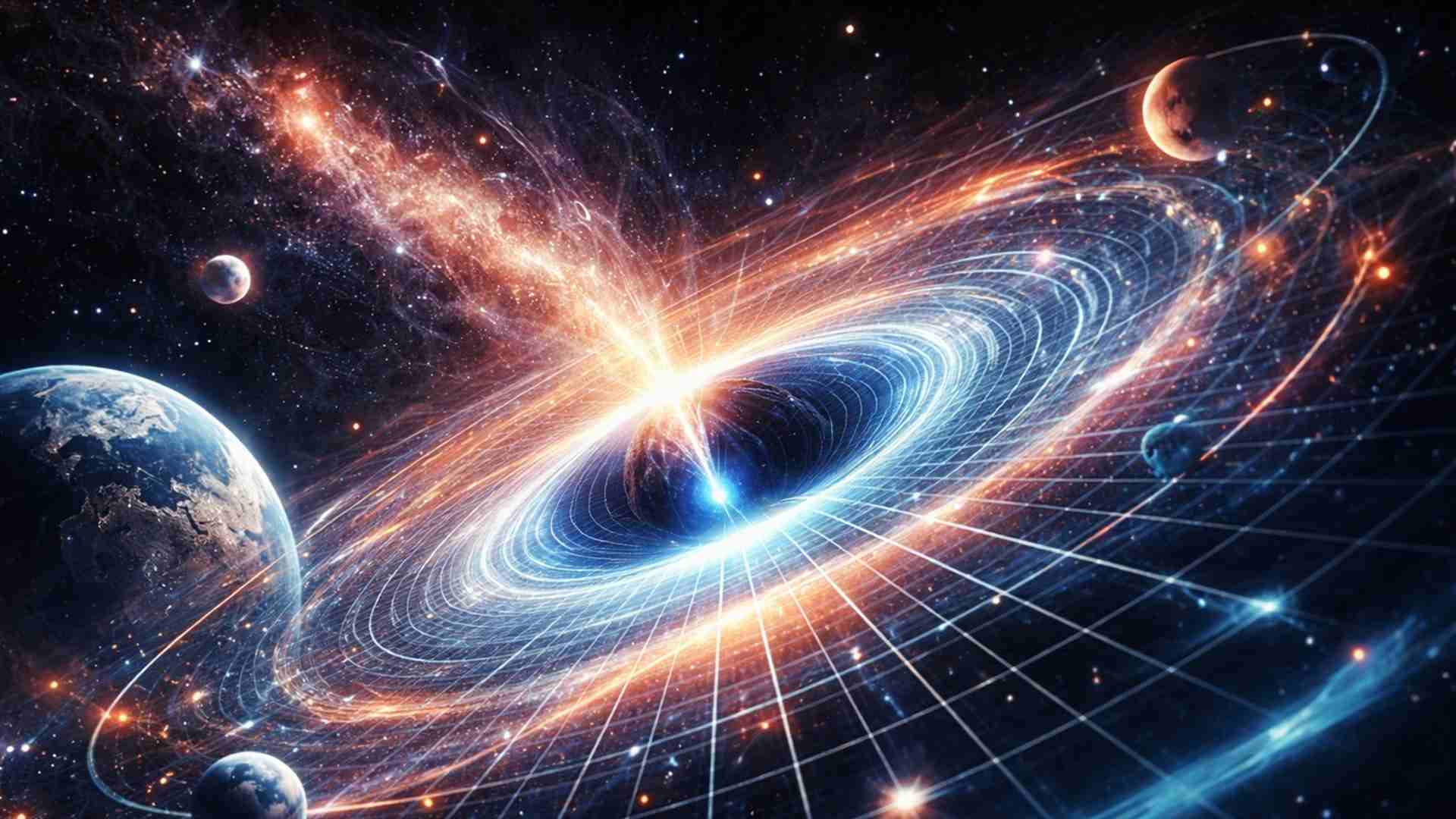
New Study Led by Ginestra Bianconi from Queen Mary University of London Suggests That Gravity Is Not a Fundamental Force but an Emergent Effect of Quantum Entropy, with Direct Implications for the Unification of General Relativity, Quantum Mechanics, and for the Understanding of Dark Matter and the Expansion of the Universe
Gravity, a central force in the formation of galaxies and the stability of planetary systems, may not be fundamental. A recent study by physicist and mathematician Ginestra Bianconi from Queen Mary University of London proposes that it emerges from quantum entropy, offering a path to reconcile general relativity and quantum mechanics.
An Entropic Approach to Gravity
The theory presented by Bianconi suggests that gravity is not a primary force but the result of an entropic action associated with quantum information.
Instead of masses curving space-time, as formulated by Einstein, gravitational interaction would arise from the collective behavior of quantum states.
-
With a cost per shot close to zero, the DragonFire laser could change naval warfare in 2027 and provide British ships with nearly unlimited defense against drones.

-
A British startup creates tires that generate electricity in electric vehicles when passing over potholes, speed bumps, and cracks.

-
Scientists have created robots made with living cells that have their own nervous system, swim on their own, explore the environment, and self-organize without any genetic engineering, and now they want to do the same with human cells.

-
Students create a solar-powered ambulance that operates without a plug, without fuel, and still keeps medical equipment running in remote areas.


At the heart of the proposal is the concept of quantum relative entropy, used to differentiate quantum states. In this framework, space-time ceases to be merely a passive backdrop and acts as a quantum operator that influences and reshapes these states.
According to the author, incorporating quantum entropy into the geometry of space-time preserves a softly curved and low-energy universe, consistent with current observations, but redefines the origin of gravity in a structurally distinct way.

Space-Time as a Dynamic Quantum Operator
The conceptual shift regarding Albert Einstein‘s view is profound. In general relativity, gravity arises from the curvature of space-time caused by mass and energy. In the new model, space-time itself actively participates in quantum dynamics.
Bianconi’s article, published in Physical Review D, describes this mechanism as an entropic action that couples matter fields to the geometry of space-time. This formulation introduces a new theoretical element: the so-called G field.
The G field is described as a vector field, endowed with direction and intensity, responsible for mediating the connection between matter and space-time. It plays a central role in how quantum information influences gravitational behavior.
Why Gravity Resists Direct Quantization
For decades, physics has faced difficulties in unifying general relativity, effective at cosmological scales, with quantum mechanics, which governs the microscopic world. The conceptual foundations of these theories are distinct, making direct fusion between them extremely complex.
Bianconi’s proposal circumvents this impasse by not attempting to quantize gravity traditionally. Instead, it treats gravity as an emergent phenomenon from the collective behavior of quantum states, allowing wave functions to interact with the gravitational field.
According to information released by Queen Mary University of London, this framework reduces the historical tension between the two theories by making space-time dynamic and sensitive to changes in quantum information. This conceptual repositioning alters the role of gravity within the framework of fundamental physics.
Implications for Dark Matter and the Expansion of the Universe
One of the most significant consequences of the theory is its possible relation to dark matter. Bianconi suggests that if gravity can be described in terms of particles associated with the G field, this same field could explain the gravitational effects attributed to dark matter.
The magazine Popular Mechanics highlighted that this approach offers a new perspective on the elusiveness of dark matter, which may not be composed of exotic particles yet to be detected, but rather by gravitational fields shaped by quantum information.
Moreover, the model predicts an emerging cosmological constant, which could help explain the discrepancy between theoretical predictions and experimental observations regarding the expansion of the universe. Although still unconfirmed, the theory proposes a bold reinterpretation of some of the greatest enigmas of modern astrophysics.
The idea is far from consensus, but it repositions gravity as a consequence of quantum entropy, opening new lines of investigation to understand the architecture of the universe as a whole, even though some points remain open and under discussion.
This article was prepared based on information from the study developed by Ginestra Bianconi from Queen Mary University of London, published in the journal Physical Review D, in addition to institutional material from the university itself and explanatory reporting from the magazine Popular Mechanics.







-

-

2 pessoas reagiram a isso.