





 Portuguese
  English
  Spanish
  6 min of reading
  2 comments


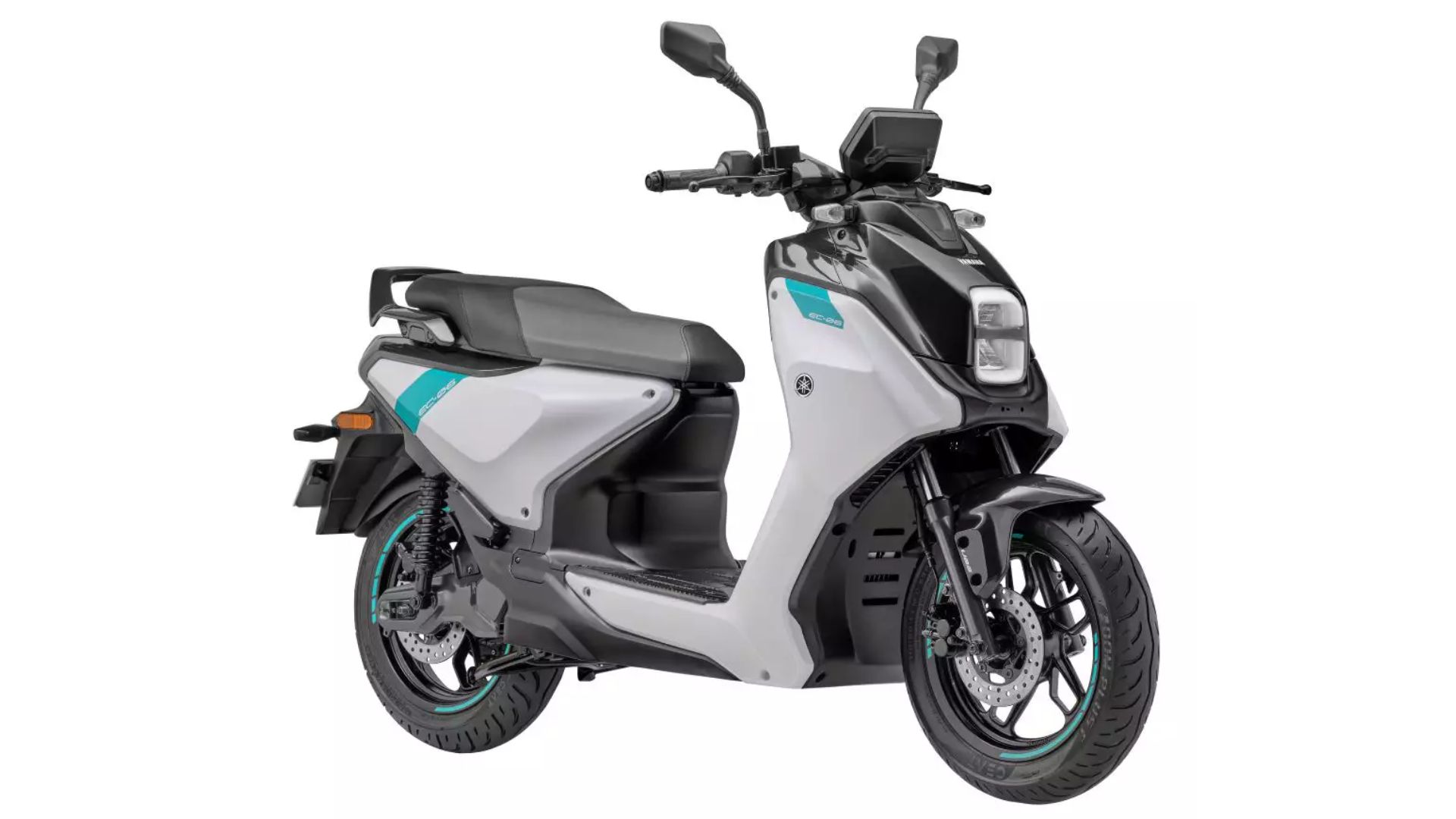


The New Aerox E Debuts in India Alongside the EC-06 and Strengthens Yamaha’s Electric Expansion, Combining Sporty Design, Urban Focus, and Partnership with Local Startup to Expand Presence in Strategic Markets.
Yamaha reinforced its electrification strategy by introducing two new electric scooters aimed primarily at the Indian market: the Aerox E, a sporty model, and the EC-06, focused on urban use and developed in partnership with the local startup River Mobility.
The two scooters mark the official entry of the Japanese brand into the two-wheeled EV segment in India, offering distinct but complementary proposals within the same zero-emissions electric mobility plan.
Aerox E Enters the Market with a Focus on Electric Performance
In the case of the Aerox E, Yamaha chose to start from a known base.
-
The car stored for 38 years: when opening the barn door, what appears is breathtaking and looks like a scene from a movie!

-
Fiat works miracles in the Brazilian market, lowers the price of its 0 km hatch to R$ 69,990, reestablishes the model as the cheapest car in the country, and reignites the battle against Kwid and C3.
-
Chevette with cooking gas: How the gas cylinder ends up being used in cars clandestinely and why this makeshift solution can result in leaks, explosions, damaged engines, and seized vehicles.
-
Fiat launches the new 2027 Toro hybrid with 48V, 176 hp, an electric motor of 15.5 hp, a 0.85 kWh battery, up to 7% fuel savings, 8% fewer emissions, and possible exemption from IPVA.

The electric model directly derives from the combustion scooter Aerox 155, already established among fans of sporty scooters in India.
The body maintains an aggressive look, with bulky fairings, angular lines, and a sporty “maxi-scooter” stance, preserving the DNA of the Aerox family.
Although the original title mentions 4 kW of power, the specifications released in India indicate that the electric system of the Aerox E delivers up to 9.4 kW to 9.5 kW of peak power and 48 Nm of torque, powered by a pair of removable batteries of approximately 3 kWh each, with a total capacity of around 6 kWh.
According to official data, Yamaha claims a certified range of 106 km per charge, a figure that, in practice, tends to approach the “up to 100 km” mentioned more simply in the promotional material.

The batteries are removable and can be charged at home, which reduces dependence on public charging infrastructure and is part of the brand’s decision to standardize removable battery solutions in its electric line for India.
Yamaha also cites the possibility of multiple charging options, including automotive-standard connectors, although complete details on charging times and potential fast-charging solutions have not been fully disclosed yet.
In terms of equipment, the Aerox E features resources aligned with a premium positioning.
The panel is a color TFT display with turn-by-turn navigation and connectivity via the Y-Connect app, which allows users to check usage data, maintenance reminders, and vehicle location.
The scooter also includes driving modes (Eco, Standard, and Power), a Boost function for stronger acceleration from a stop, reverse mode for maneuvering in tight spaces, as well as disc brakes on both wheels with single-channel ABS and traction control.
The production of the Aerox E will be the responsibility of India Yamaha Motor Pvt. Ltd., reinforcing the strategy to develop and manufacture products locally for emerging markets.
The brand positions the model as a high-value sporty electric scooter, aimed at consumers seeking performance, striking design, and status within the electric mobility segment.
EC-06 Expands Portfolio with Urban Focus and Technology Partnership
While the Aerox E targets the audience seeking sportiness and exclusivity, the EC-06 was designed as a more rational electric scooter, aimed at daily use in cities.
It is the first product resulting from the collaboration between Yamaha and the Indian startup River Mobility, a partnership that began after the Japanese investment in the company in 2024.
The model uses the already known River Indie as a technical base, but with its own visual and adjustments adapted to Yamaha’s positioning.

The EC-06 uses a fixed 4 kWh battery, responsible for powering an electric motor with about 4.5 kW of nominal power and 6.7 kW of peak power, with a maximum declared speed of around 90 km/h.
The certified range reported by the manufacturer is 160 km on a single charge, aimed at urban and peri-urban usage profiles.
The charging, done at a standard household outlet, takes approximately nine hours to go from 0% to 100%.
In terms of design, the EC-06 adopts robust proportions, with a high front and vertically arranged LED headlight, bulky wheel casings, and angular surfaces on the sides.
The look is less radical than that of the Aerox E but maintains a modern style, designed for those who need practicality in heavy traffic without sacrificing some degree of personality.
The storage compartment under the seat offers about 24.5 liters of capacity, sufficient for daily use items, although smaller than that of the River Indie, which prioritizes practicality even further.
The technology package includes a digital LCD panel with telemetry and connectivity, multiple driving modes, reverse function to ease maneuvers, and full LED lighting.
Yamaha emphasizes that the EC-06 was developed to provide a smooth ride, with immediate torque delivery and a focus on energy efficiency, catering to both short trips and slightly longer routes within typical urban use.
The manufacturing of the EC-06 will be handled by River Mobility itself, at its plant in Karnataka, while Yamaha takes care of development, calibration, and market positioning of the product.
In addition to expanding the brand’s electric portfolio, the model inaugurates a way of operating where a global manufacturer relies on a local startup to accelerate response times in a highly competitive market.
Yamaha’s Electrification and Strategic Expansion in India

The two launches are part of a broader plan by Yamaha, which aims for carbon neutrality by 2050 considering emissions associated with the use of its products.
To achieve this goal, the company has adopted a multi-path strategy, combining more efficient engines, alternative fuels, and increasingly, fully electric vehicles.
India appears in this context as a key market.
It is one of the largest countries in the world in terms of scooter and motorcycle volume, with a strong adoption of low-displacement mobility solutions and public policies that encourage electrification.
The Aerox E helps build a high-performance image in the premium EV segment, while the EC-06 serves as an entry point for those seeking a more accessible urban electric scooter, even though it is positioned above the most basic options on the market.
Situation in Brazil and Prospects for New Electric Models
For now, Yamaha indicates that Aerox E and EC-06 are confirmed only for the Indian market, with no announcement of arrival in Europe, Latin America, or Brazil.
In Brazilian territory, the brand’s electric efforts remain concentrated on the Neo’s Connected, a scooter produced in Manaus with an electric motor of about 2.4 kW, two removable batteries of 1.17 kWh each, and a declared range of up to 71 km in WMTC cycle.
In practice, the new Indian scooters and the Brazilian Neo’s reveal different approaches within the same electrification movement.
While the Aerox E explores the idea of a sporty electric “maxi-scooter” and the EC-06 bets on a partnership with a startup to deliver a modern urban product, the Neo’s caters to those who need a simple, lightweight, and low-speed vehicle designed for dense urban centers.
Nonetheless, the existence of an electric model already in national production shows that Yamaha is preparing the ground to, if deemed appropriate, expand its line of EVs here.
Do you believe that a sporty model like the Aerox E or an urban one like the EC-06 would have space — and price — to capture the public on the streets of Brazil?





O que publicar? sem não vem para o Brazil, perda de tempo uma informação desta,vamos focar nas chinesa e indianas,e mais garantido de vir para o brasil.
Rapaz não cheguei a ler a reportagem toda mas arrumem o título tá vergonhoso isso! Yahama????