





 Portuguese
  English
  Spanish
  5 min of reading
  0 comments


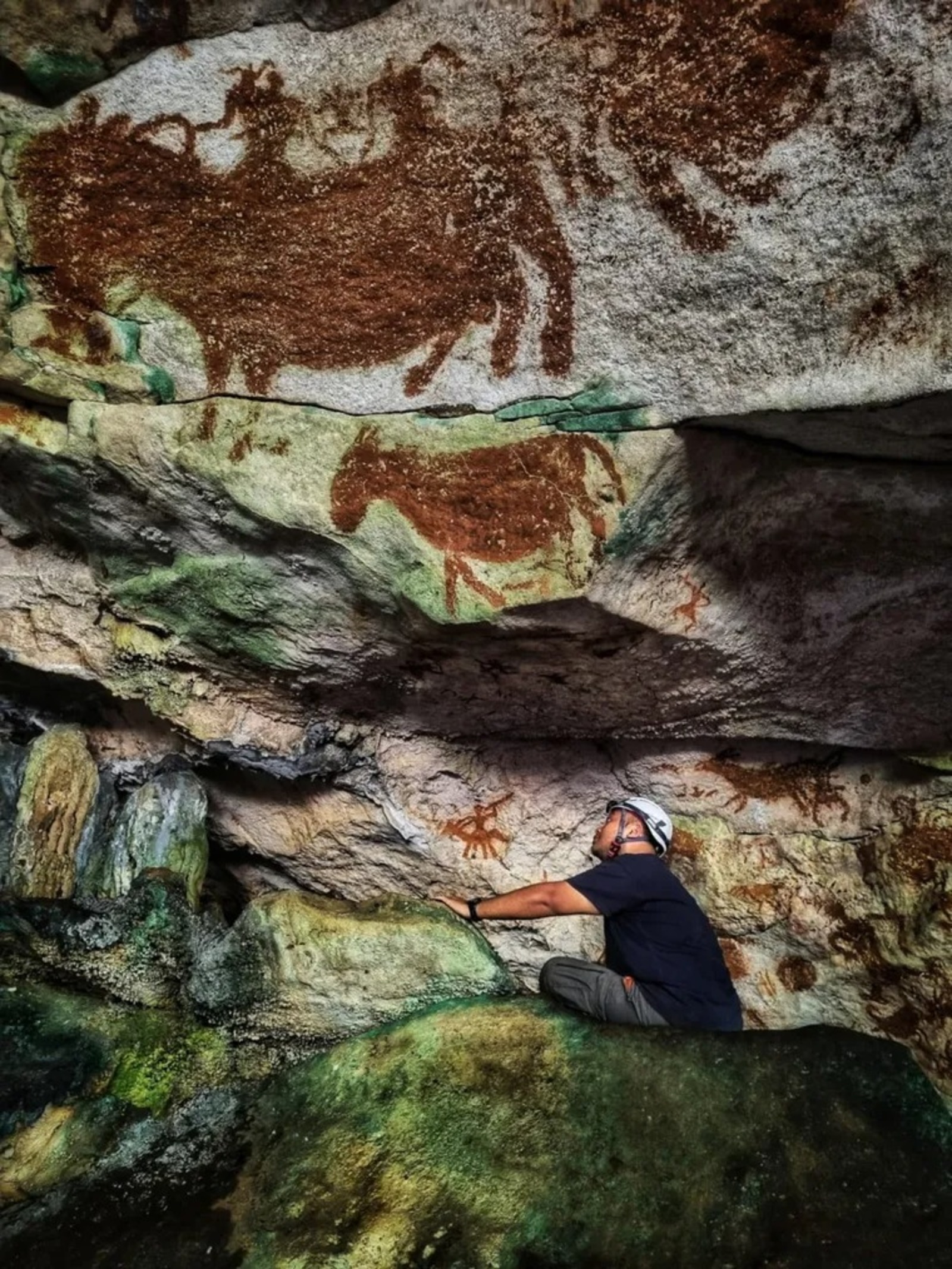
Hand Stencils 67,800 Years Old Show Complex Thinking, Oceanic Migrations, and Advanced Imagination Among First Inhabitants of Southeast Asia in Documented Human Prehistory in Tropical Caves of Indonesia
On a tropical island in Southeast Indonesia, a silent discovery is rewriting fundamental chapters of human history. On the island of Muna, a cave known to locals as Liang Metanduno houses prehistoric paintings that, for decades, have sparked curiosity and admiration. Today, this site solidifies itself as one of the oldest testimonies of modern human creativity.
A Sanctuary of Ancestral Images
Liang Metanduno is considered by locals to be a true gallery of archaic art. On the walls and ceiling, figures of humans appear to fly, boats filled with passengers and mounted warriors, all outlined in red, brown, and occasionally black pigments.
For a long time, it was believed that these representations were only a few thousand years old.
-
A nutritionist reveals that the real villain of your breakfast is not butter or eggs, but rather the excess of white bread, cookies, and refined sugar that you consume every day without realizing the damage it causes.

-
The Android as we know it has its days numbered after a new rule from Google that could end free APKs and completely transform the system by 2027.

-
Archaeologists use satellite technology and find a mysterious structure of 500 m² buried up to 6 meters beneath an ancient city in Egypt.

-
Supercomputer calculates when humanity may disappear from Earth, predicts a scorching supercontinent, temperatures of up to 70 degrees, and a planet moving towards becoming uninhabitable.


In 2015, however, archaeologist Adhi Agus Oktaviana from Indonesia’s National Agency for Research and Innovation (BRIN) arrived at the site in search of something older than the known animal paintings. His interest was focused on more primitive signs of human artistic expression.
The Encounter with the Hands of the Past
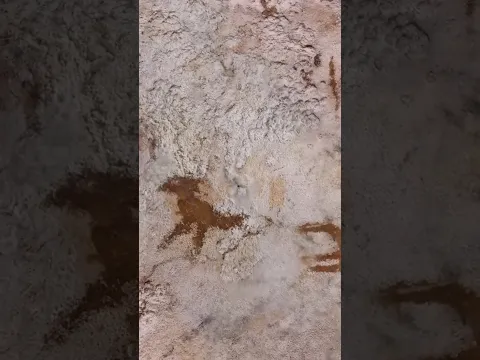
On the ceiling of the cave, near a brown scribble resembling a chicken, Oktaviana found two hand stencils.
One of them stood out for its elongated, pointed finger, resembling an animal claw. The unusual shape immediately caught the team’s attention.
To determine the age of these images, Oktaviana worked in partnership with Maxime Aubert, an explorer from National Geographic, archaeologist, and geochemist at Griffith University in Australia, as well as other colleagues.

The Oldest Rock Art Ever Attributed to Modern Humans
Using a new dating technique, researchers found that the claw-shaped stencil is at least 67,800 years old.
It is currently the oldest rock art attributed to modern humans. The findings were reported on Wednesday in the scientific journal “Nature.”
According to Oktaviana, “the age of the hand stencil in Muna shows that the first modern humans inhabiting Nusantara during the late Pleistocene already had sophisticated cognition.”
A Milestone That Surpasses Previous Records
The art from Muna is about 16,600 years older than the documented rock art in the Maros-Pangkep caves in Sulawesi.
It is also approximately 1,100 years older than the hand stencils found in Spain, which are believed to have been made by Neanderthals.
For Adam Brumm, an archaeologist at Griffith University and co-author of the study, this evidence confirms that modern humans were in the Indonesian archipelago at that time and were already transforming simple marks into creative and symbolic images.
Traces of Art That Cross Millennia
In addition to Liang Metanduno, researchers dated hand stencils in two other caves on neighboring islands. The analyses indicate ages between 44,500 and 20,400 years.
This suggests that the production of rock art in Indonesia remained active for tens of thousands of years, until the peak of the last ice age.
During that period, sea levels were lower, and a vast landmass exposed, known as Sundaland, connected areas now separated by ocean.
The Technique That Revealed the Time
To determine the ages, scientists used laser ablation uranium-series dating, a technique developed by Aubert and other researchers.
The method analyzes microscopic deposits of calcium carbonate formed over the pigment.
At Southern Cross University in Australia, the claw-shaped stencil was dated between 75,400 and 67,800 years, while the other stencil is about 60,900 years old.
Imagination Beyond the Visible World
The findings from Muna add to previous discoveries made by Aubert and Oktaviana in 2019, when they reported scenes of therianthropes hunting Sulawesi’s endemic pygmy buffalo and wild boars, known as anoa.
These narrative scenes, dated at 51,200 years, indicate that humans in the region were capable of imagining non-existent beings.
The newly dated hand stencils reinforce this idea. The claw-shaped finger may have been created by brush retouching or by the positioning of the hand, demonstrating, according to Aubert, complex thinking. They are drawing something that doesn’t really exist.
Rituals, Beliefs, and Interpretations
R. Cecep Eka Permana, an ethnoarchaeologist from the University of Indonesia who did not participate in the research, suggests that the hand stencils may be linked to rituals to ward off bad luck, still present in some indigenous groups of Sulawesi.
These findings challenge Eurocentric views that associated the emergence of modern minds solely with the arrival of humans in Western Europe. For Aubert, the lack of advanced dating technologies in the past contributed to this perception.
Research indicates that some modern humans left Africa between 60,000-90,000 years ago, passing through the Middle East and South Asia until reaching Sundaland.
From there, they navigated between islands until reaching Sahul, an ancient land mass that united Papua and Australia.
As Pleistocene human remains in Sulawesi are rare, rock art becomes one of the main pieces of evidence of this presence. “It’s an intimate window to look into the past,” says Aubert.
Paths Still Open
Oktaviana believes that the Aboriginal rock art in Madjebebe, in northern Australia, may have been inherited from ancestors of Nusantara.
Helen Farr, a maritime archaeologist at the University of Southampton, considers the discovery in Muna relevant and in line with genetic research indicating the capability to cross open seas 65,000 years ago.
As for the route used, there are still uncertainties. It may have been from the north, via Sulawesi, Maluku, and Papua, or from the south.
During an interview with National Geographic, Oktaviana pointed out on Google Maps a small island between Sulawesi and Flores that may hide new paintings. He intends to seek funding to explore it.
These discoveries reinforce that long before great civilizations, there were already humans capable of creating, imagining, and crossing oceans, leaving marks that still echo today in the walls of tropical caves.
With information from National Geographic Brazil.








-

-

-

-

10 pessoas reagiram a isso.