





 Portuguese
  English
  Spanish
  4 min of reading
  0 comments


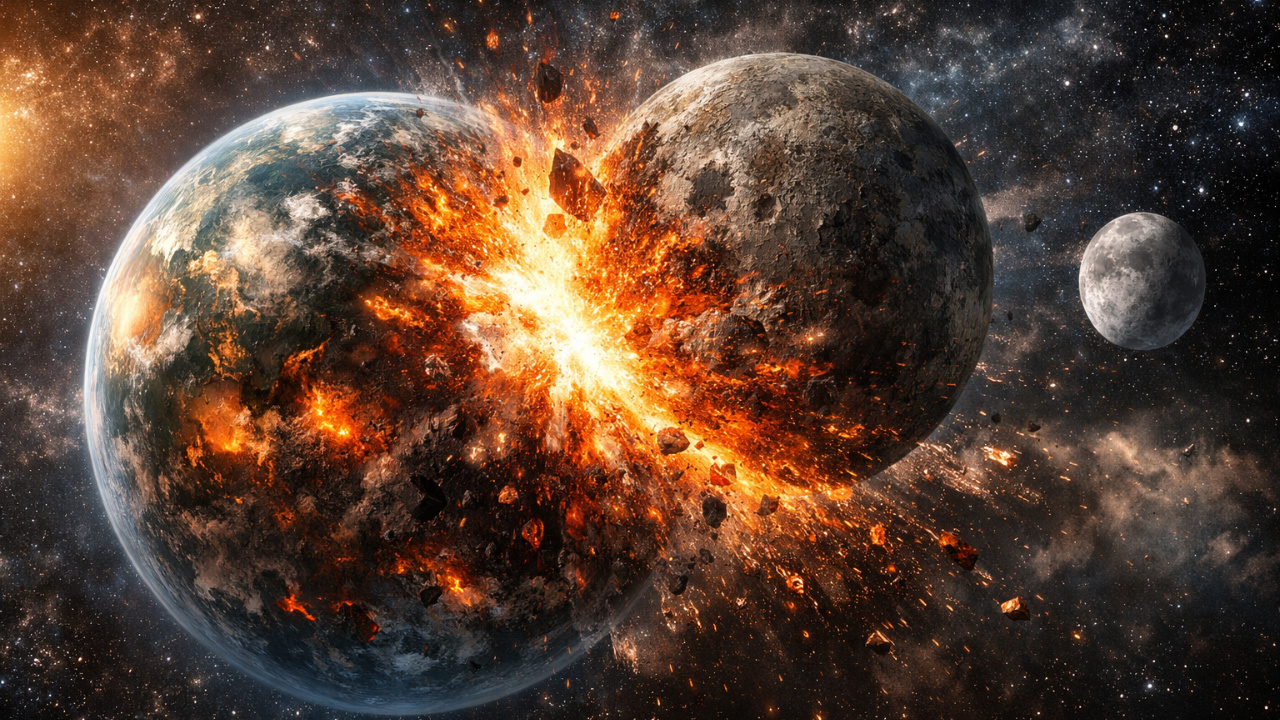
Understand How Theia Collided With Primitive Earth in a Giant Impact That Gave Rise to the Moon and Changed the History of the Planet.
About 4.5 billion years ago, a catastrophic event may have completely redefined the fate of our planet.
Scientists are investigating what: the collision between primitive Earth and a planet called Theia;
who: international researchers in the field of planetary science;
-
Motorola launched the Signature with a gold seal from DxOMark, tying with the iPhone 17 Pro in camera performance, Snapdragon 8 Gen 5 that surpassed 3 million in benchmarks, and a zoom that impresses even at night.

-
Satellites reveal beneath the Sahara a giant river buried for thousands of kilometers: study shows that the largest hot desert on the planet was once traversed by a river system comparable to the largest on Earth.

-
Scientists have captured something never seen in space: newly born stars are creating gigantic rings of light a thousand times larger than the distance between the Earth and the Sun, and this changes everything we knew about stellar birth.

-
Geologists find traces of a continent that disappeared 155 million years ago after separating from Australia and reveal that it did not sink, but broke into fragments scattered across Southeast Asia.

when: during the early days of the Solar System;
where: in the forming Earth orbit;
how: through a giant impact that launched debris into space;
why: to explain the origin of the Moon and its decisive influence on terrestrial life.
The hypothesis holds that, without this colossal impact, our natural satellite might not even exist — and consequently, the conditions that allowed for the development of life would be very different.
Giant Impact: The Theory That Dominates Planetary Science
The so-called giant impact hypothesis is currently the most accepted model to explain the formation of the Moon.
According to this proposal, Theia — a body roughly the size of Mars — collided with young Earth, ejecting a massive amount of material into space.
Over time, these fragments coalesced due to gravity, forming the satellite.
Furthermore, the event would have profoundly altered the planet’s dynamics.
The Moon began to exert a crucial gravitational role.
This cosmic “tug-of-war” helped stabilize Earth’s rotational axis, contributing to the maintenance of a relatively stable climate over billions of years.
“Without climatic stability, we would have much more extreme weather and climate conditions, which would not be good for the development of life”, explains Thorsten Kleine, a planetary scientist at the Max Planck Institute for Solar System Research in Germany.
Chemical Evidence Reinforces Common Origin
Recent research has expanded understanding of the relationship between Theia and primitive Earth.
In a study published in the journal Science, scientists analyzed lunar and terrestrial samples to investigate their composition.
The results indicate that both bodies were extremely similar from a chemical standpoint, suggesting that they formed in the same region of the Solar System.
This proximity would explain why it is so difficult to distinguish direct traces of Theia today.
Before Theia: Other Theories About the Formation of the Moon
The giant impact was not always the main explanation for the origin of the Moon.
Before space missions, three hypotheses dominated the scientific debate:
The Fission Theory: the Moon would have split off from rapidly rotating Earth.
Capture Theory: the satellite would have been captured by Earth’s gravity.
Co-formation Theory: Earth and Moon would have formed together.
However, evidence collected from Apollo missions changed this scenario.
Lunar Rocks Revealed Decisive Clues
The samples brought back by astronauts were crucial to validating the giant impact model.
“The Apollo astronauts brought back lunar rock samples, and when scientists analyzed them, they found that the Moon rocks showed remarkable chemical similarities with Earth”, says Raman Prinja, an astronomer at University College London and author of the children’s science book The Moon’s Wonders.
The rocks indicated formation under extreme heat and loss of volatile elements — typical signs of a massive collision.
Sarah Valencia, a lunar geologist at NASA, highlights that modern computational modeling has further strengthened this conclusion.
“The giant impact theory continues to be the best model to explain the chemistry and the relationship between Earth and the Moon”, says Valencia.
So, What Happened to Theia?
The fate of Theia remains one of the greatest enigmas in planetary science.
Unlike the asteroid that wiped out the dinosaurs, there is no clear crater associated with the event.
According to Kleine, this happens because Theia had around 10% of Earth’s mass — which would have led to its fragmentation and near-complete absorption by the planet.
“This would be the natural result of such a collision.
But we would expect to find a compositional signature of Theia on the Moon, which we have not yet found”, says the scientist.
He adds that the chemical similarity between the two bodies may mask this evidence.
Hidden Traces Inside the Earth?
Recent research raises new possibilities.
A 2023 study suggested that two gigantic structures deep within Earth’s mantle may be remnants of Theia.
If confirmed, this would mean that part of the planet still exists — literally — within the transformed primitive Earth.
“But just as the origin of Theia is not conclusively known, its fate is also unknown”, warns Valencia.
Artemis Missions May Bring Answers
The human return to the Moon has rekindled scientific enthusiasm.
The Artemis missions are set to collect new samples, especially in the lunar South Pole — an unexplored region.
Thus, the rocks brought back by Apollo came from a limited area of the lunar equator, which restricts broader conclusions.
“If we only went to six places on Earth, could we say that we explored the whole Earth and understood its evolution? Of course not! The Moon has infinite scientific potential”, says Valencia.
The Cosmic Legacy of Theia
Although shrouded in mystery, the story of Theia helps explain not only the formation of the Moon, but also the habitability of our planet itself.
Therefore, without the giant impact, Earth’s rotation, climate, and even natural cycles could be drastically different.
So, when observing the full Moon in the sky, it is worth remembering: it may be, in part, the last remnant of a planet that primitive Earth literally swallowed — and whose sacrifice shaped life as we know it.
See more at: Theia: The Planet That Earth May Have ‘Swallowed’, Helping to Form the Moon – BBC News Brasil








Seja o primeiro a reagir!