





 Portuguese
  English
  Spanish
  5 min of reading
  1 comment


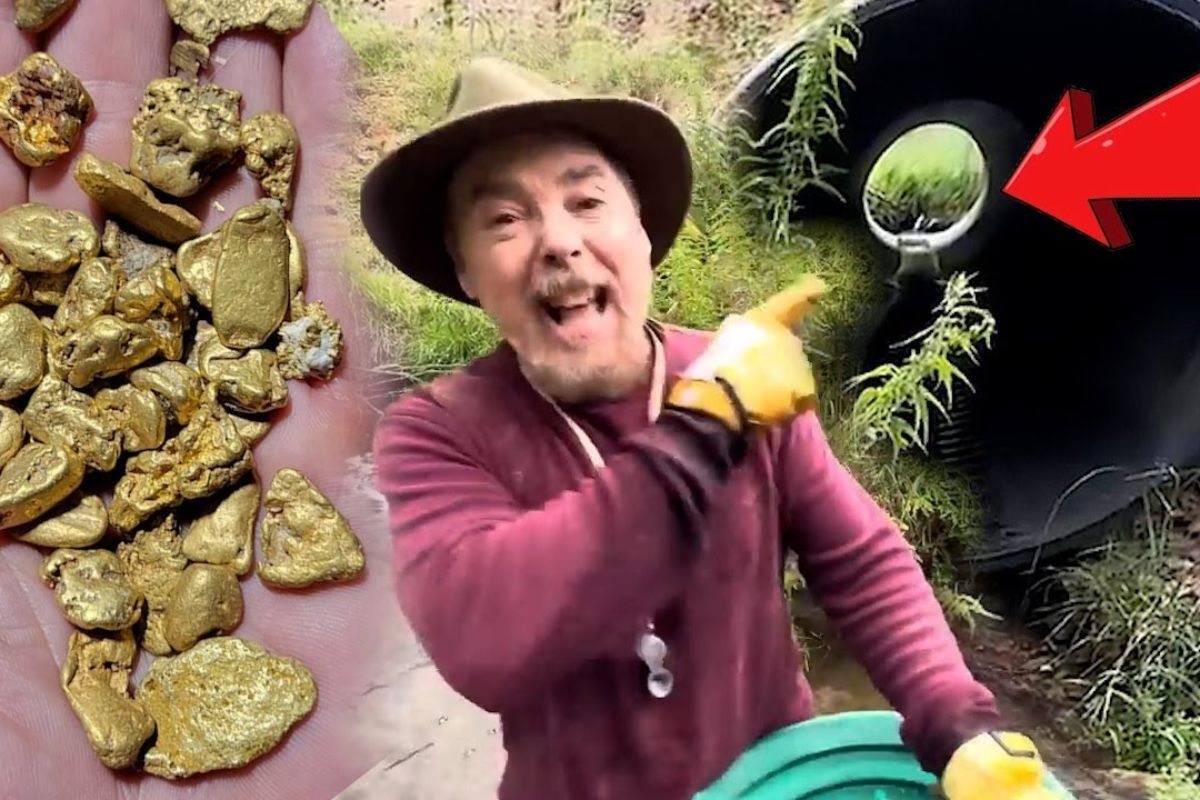


In Streams That Seem Ordinary, Gold Reappears in the Same Places Because Water Obeys Physics: Inner Curves, Heavy Gravel, Exposed Bedrock, and Pockets of Black Sand Create Natural Traps, While Ancient Signs of Excavation Indicate the Likely Direction of Denser Material in Each Season.
Gold in streams is often treated as a reward for equipment, but the account of miner and geologist Jeff Williams points to another logic: the real difference comes from silently reading the environment. He describes a routine based on prior research, sampling, and interpreting deposit patterns, rather than blind faith in the detector.
In the field, the central point is technical: heavy materials follow rules of hydrodynamics and gravity. In streams and creeks, curves, natural obstacles, and stretches of exposed bedrock reorganize gravel and push gold into low-energy zones, where it consistently reappears, even decades later.
Research Before Panning and What “3 Million in Gold” Changes in the Reading
Jeff Williams argues that the first step is not to enter the water, but to understand the district. He cites an area that is said to have produced “3 million in gold” and states that, without this context, prospecting becomes a random attempt.
-
He started running at 66 years old, broke records at 82, and is now a subject of study for having a metabolic age comparable to that of a 20-year-old, in a case that is intriguing scientists and inspiring the world.

-
Oldest tree on the planet reappears after 130 years of searches: Wattieza, 385 million years old, was 10 meters tall and had no leaves or seeds; Gilboa fossils in New York solved the mystery in 2007.

-
A 48-square-meter house assembled in hours with 4,000 bricks made of recycled plastic that does not absorb moisture, has natural thermal insulation, and costs less than 90,000 reais in a complete kit.

-
Luciano Hang revealed that Havan’s air fleet has already accumulated more than 20,000 landings, 10,000 flight hours, and 6 million kilometers traveled, and he says that without the planes, the company would never have grown so quickly.


The investigation includes checking tributaries, observing the surrounding geology, and estimating what kind of gold the area is likely to yield: fine, in gesso, raw, or in nuggets.
This approach shifts the question that really matters: where is the gold coming from and why does it stop where it does? In streams, transport is constant, but deposition is selective.
Repeated sampling at distinct points creates a picture of the stretch, revealing how the gravel is “working” at that moment, without relying on a single find.
Curves, Natural Obstacles, and Why Gravel Organizes Weight
The logic presented is that of natural sorting. Inner curves decrease water velocity and favor the deposition of dense material, while outer curves tend to erode and carry away light sediment.
When the stream encounters a large rock, a waterfall, or a narrowing, the energy of the flow rearranges and creates pockets where heavy gravel concentrates.
It is in this scenario that the “traps” described emerge: gold accumulates in front of and behind large obstructions, especially when there is bedrock in the bed.
The practical rule mentioned in the account is straightforward: large rocks require a large volume of water to move, and this same pulse of energy can transport and then drop gold at points where the current loses strength.
Field observation includes human structures that act as involuntary obstacles. Williams mentions corrugated tube culverts under roads and describes the entrance to these points as areas that capture material in the first three feet, with behavior similar to that of a retention box.
The geometry of flow defines where gold tends to stop, not the equipment’s shine.
Bedrock, Clay, and Moss: The Traps That Almost Nobody Sees

When bedrock appears, it changes the game because it offers fissures and irregularities where heavy materials settle. The account insists on cleaning and observing this solid bottom, as gold tends to sit in cracks.
Without bedrock, gravity still acts, but deposition can become more diffuse and easier to be overturned by floods.
Another recurring point is clay. When moving large rocks, Williams says he finds clay at the back of the stones and associates this with a practical advantage: gold “likes to stick” to clay.
The same reasoning applies to moss, described as material that captures very fine gold, acting as a natural filter in shallow streams.
The reading, therefore, is not just about where to insist, but where the environment retains.
Bedrock, clay, and moss act as capture surfaces, reducing the movement of dense particles and stabilizing gold in micro-deposits, which makes the outcome less dependent on luck and more dependent on observation.
Black Sand, Iron, and the Invisible Map of Mineralization
The most repeated signal in the account is the presence of black sand. It appears associated with magnetite, hematite, and other dense minerals, cited as indications that the system is concentrating heavy materials.
In a pan, black sand is not gold, but it serves as a process marker: if the stream is retaining dense minerals, it has the physical capacity to retain gold in that same gravel pack.
This map also climbs the slope. Williams describes outcrops of quartz and altered rock with iron staining, citing limonite and alteration material as indicators of mineralization in the host rock.
The thesis is that the mountain drains fragments and fines downwards, and the stream concentrates, so black sand becomes a reading of the trail, not an end.
The most intense part of the record appears when, after finding a large volume of black sand, he observes small pieces of gold mixed with lead and debris, suggesting an area that has been historically used.
The technical point remains: a significant amount of black sand, exposed bedrock, and well-selected gravel form a coherent set to explain why gold reappears.
Ancient Signals, Confluences, and Why Gold Returns to the Same Destination
The final argument ties together time and repetition. Williams describes seeing trenches, pits, and ancient excavations on slopes and near the bed, suggesting that veterans had already identified the same concentration logic.
He describes clusters of holes and mentions “gesso trenches,” reinforcing that the pattern is not new, just being rediscovered.
Another important reference is the meeting of two watercourses. Where two streams converge, the flow’s energy changes, the gravel mixes, and gravity selects the densest once more.
The account states that even after 100 years, due to erosion and reworking of the bed, gold can still be collected at these concentration points.
On balance, the secret described is not in technology but in reading. Curves, obstacles, bedrock, and black sand act as the language of the stream.
The “detective” who compares signals understands why, where, and how much the system is delivering, before insisting on any tool.
Attention: any activity in streams involves physical risk and environmental impact. Even when the discussion is technical, responsible use assumes prudence, respect for the location, and compliance with applicable rules.
In the end, the discovery of gold tends to be less a matter of luck and more the consequence of recognizing patterns that the stream itself repeats.
Those who observe curves, read gravel, identify bedrock, and understand black sand as a signal usually see the scenario before any tool.
Have you ever seen black sand in streams in your area and remember what type of curves it appeared most strongly, near bedrock or in gravel banks? And when it comes to gold, do you rely more on the detector or the silent reading of ancient signals that the stream insists on showing?








Super bacana, essa instrução.