





 Portuguese
  English
  Spanish
  4 min of reading
  0 comments


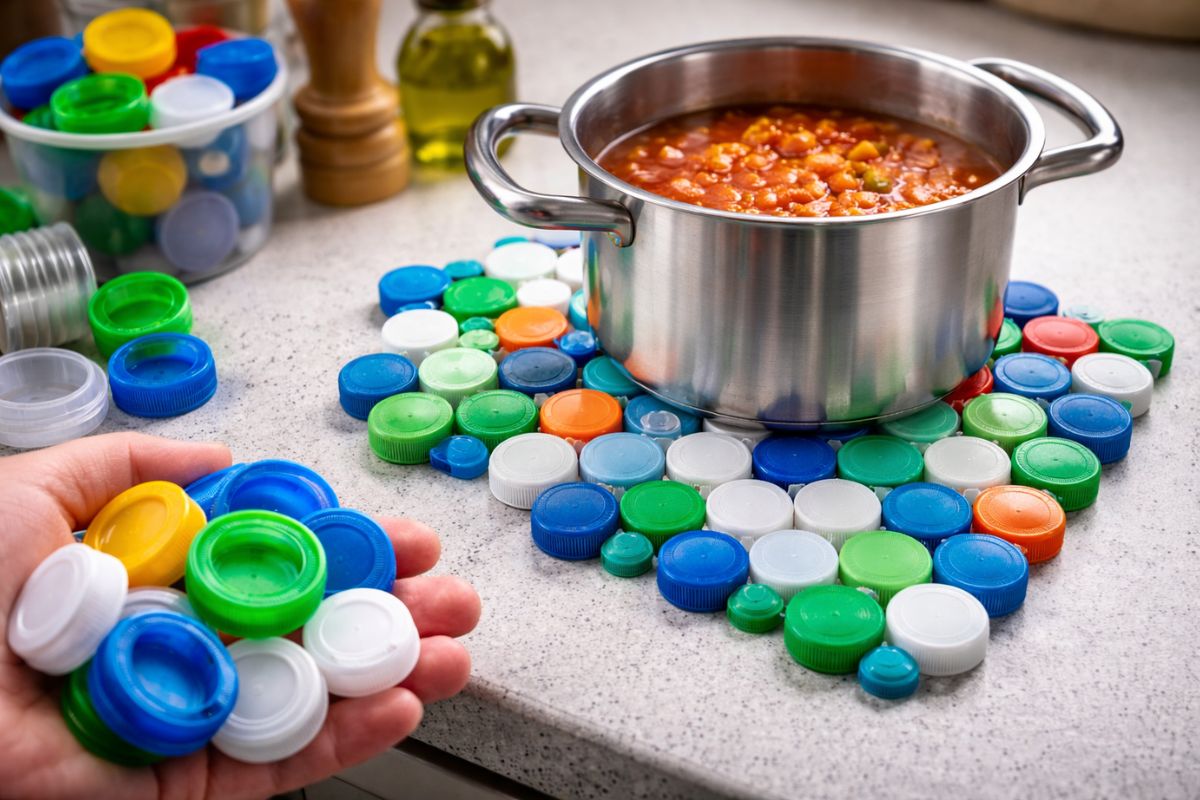
Instead Of Going To Waste, Milk Bottle Caps Are On The Radar Of Those Who Want A Sturdy Thermal Support, Because They Withstand Heat And Weight. With Careful Cleaning And Gluing With Hot Glue Or Specific Plastic Adhesive, The Standardized Mosaic Reduces Slips In The Home Kitchen.
Milk bottle caps often go unnoticed in everyday life, but there is one detail that changes the perspective: the piece is thicker and stiffer than most other beverage caps, which helps when the intention is to make a thermal support to hold a pot or baking dish for a few moments.
In Brazilian kitchens, the idea is not to glamorize “waste,” but rather to observe material behavior and fitting. When the cleaning is done properly and the gluing respects the type of plastic, the result can be a firm thermal support that distributes weight and decreases the risk of the pot slipping when the countertop is full.
Why Milk Bottle Caps Count In This Resistance
There is a practical reason why milk bottle caps frequently appear in DIY projects: they tend to be more robust to the touch, with stiffness that better supports local pressure.
-
Friends have been building a small “town” for 30 years to grow old together, with compact houses, a common area, nature surrounding it, and a collective life project designed for friendship, coexistence, and simplicity.

-
This small town in Germany created its own currency 24 years ago, today it circulates millions per year, is accepted in over 300 stores, and the German government allowed all of this to happen under one condition.

-
Curitiba is shrinking and is expected to lose 97,000 residents by 2050, while inland cities in Paraná such as Sarandi, Araucária, and Toledo are experiencing accelerated growth that is changing the entire state’s map.

-
Tourists were poisoned on Everest in a million-dollar fraud scheme involving helicopters that diverted over $19 million and shocked international authorities.


This type of cap withstands contact with hot surfaces for short periods, which allows them to serve as thermal support in daily life.
Another point is hygiene.
Milk bottle caps usually do not easily absorb odors, but this only holds true when the cleaning is not rushed.
Cleaning here means removing residues, rinsing well, and letting dry completely before any gluing stage to avoid trapped odors and loss of adhesion.
The Standardized Fitting That Becomes Design And Supports Weight
What seems like just a pile of caps gains logic when you recognize the standardization.
Since several milk bottle caps have similar shapes, they fit together in repetitive designs and allow assembling small or larger plates.
The design is not just aesthetic: it defines how the weight is spread when a pot rests on it.
When the mosaic is well-sealed, the weight no longer falls onto a single point but spreads across multiple caps, increasing stability.
A thermal support that acts as a wide base is less likely to tip over, especially on smooth countertops, where any micro-unevenness can trigger slippage.
Cleaning And Gluing, Where The Thermal Support Gains Or Loses Strength
The step that separates an improvised solution from a usable thermal support is preparation.
First comes cleaning each cap, paying attention to the inside, where residues tend to accumulate.
Then, once everything is dry, it’s good to test the design on the floor or table, so you don’t discover at the end that a cap is missing or that the shape is unstable.
In gluing, two solutions often arise: hot glue and specific plastic adhesive. Hot glue helps bond quickly but requires constant pressure for a few seconds to prevent gaps.
The specific plastic adhesive is usually chosen when a more uniform connection is desired in plastic materials, provided that the specified curing time from the manufacturer is followed and it is not used with wet pieces.
Base, Finishing, And The Test That Prevents A Scare With The Pot
For the set not to turn into a crooked board, the base is as important as the caps.
A piece of thin wood or a repurposed silicone sheet can work as a support, as long as it is flat and firm.
Marking the outline and cutting carefully is what prevents raised edges that create unevenness, a classic point of instability.
On the bottom, protection is simple: felt, EVA, or heat-resistant fabric help avoid scratches on stone or wood, and also increase the thermal support adhesion on the countertop.
Before trusting it, it’s worth testing with a cold pot first, then a warm one, to see if any cap shifts. If it does, return it to the countertop and reinforce with hot glue or specific plastic adhesive, always ensuring the pieces are dry after cleaning.
What turns milk bottle caps into a “treasure” is not a miracle, but a combination of material, pattern, and execution.
A thermal support only stays firm when the cleaning is done correctly and the gluing holds, whether using hot glue or specific plastic adhesive.
From there, the mosaic does the work of distributing the weight and reducing falls.
In your kitchen, what weighs most in your decision to try this with milk bottle caps: savings, sustainability, or safety for supporting the pot? Do you trust hot glue or specific plastic adhesive more? And what’s the most unlikely thing you’ve repurposed after a good cleaning?










-

-

-

-

-

46 pessoas reagiram a isso.