





 Portuguese
  English
  Spanish
  4 min of reading
  1 comment


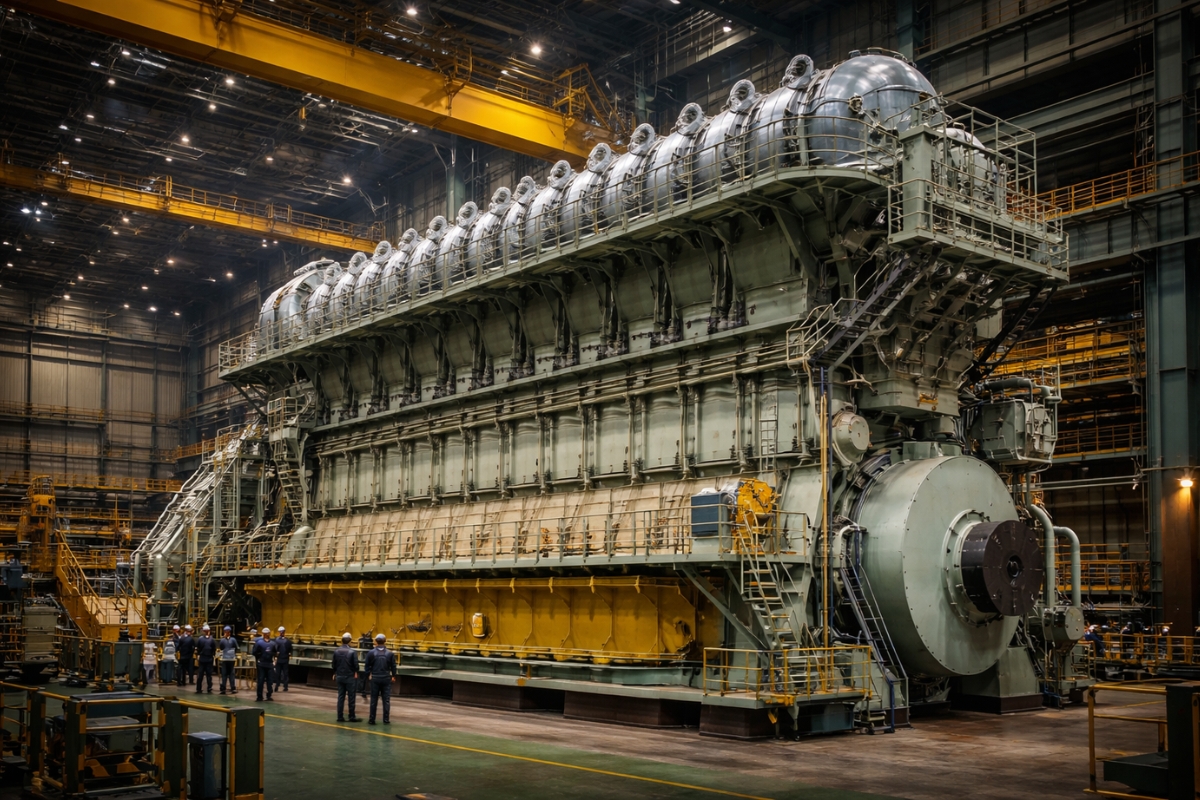


Consuming Up to 250 Tons of Fuel Per Day, the RT-flex96C Transforms Heavy Oil into Up to 108,000 kW of Continuous Power, Sustaining Intercontinental Voyages for Weeks
The Wärtsilä-Sulzer RT-flex96C is currently the largest and most powerful internal combustion engine in operation in the world, a maritime “monster” designed to move the largest container ships on the planet.
What Is the Wärtsilä RT-flex96C
The RT-flex96C is a two-stroke, low-speed, turbocharged marine diesel engine developed by Wärtsilä for the propulsion of large cargo ships. In the 14-cylinder inline configuration, it reaches up to 80,080 kW (about 108,000 hp) at 102 rpm, making it the largest and most efficient series-produced internal combustion engine ever manufactured.
Mainly used in long-distance mega container ships, the RT-flex96C is designed to operate on heavy fuel oil (HFO), reducing the cost per ton transported. In practice, it replaces the role of dozens of automotive engines: its power is comparable to the sum of approximately 1,000 standard passenger cars.
-
Friends have been building a small “town” for 30 years to grow old together, with compact houses, a common area, nature surrounding it, and a collective life project designed for friendship, coexistence, and simplicity.

-
This small town in Germany created its own currency 24 years ago, today it circulates millions per year, is accepted in over 300 stores, and the German government allowed all of this to happen under one condition.

-
Curitiba is shrinking and is expected to lose 97,000 residents by 2050, while inland cities in Paraná such as Sarandi, Araucária, and Toledo are experiencing accelerated growth that is changing the entire state’s map.

-
Tourists were poisoned on Everest in a million-dollar fraud scheme involving helicopters that diverted over $19 million and shocked international authorities.



Colossal Dimensions and Technical Data
In the 14-cylinder version, the engine is about 27 m long, 13.4–13.5 m high, and weighs around 2,300 tons, equivalent to a multi-story building standing inside the ship’s hold. Each piston measures approximately 6 m high, weighs about 5.5 tons, and works in a cylinder with a diameter of 96 cm and a stroke of 2,500 mm.
The total displacement ranges from approximately 10,920 to 25,480 liters, depending on the number of cylinders, with about 1,820 liters per cylinder. The nominal rotation speed is 102 rpm, with an average piston speed of 8.5 m/s, generating a maximum torque of nearly 7.6 million N·m. In terms of power, the engine delivers up to about 6,030 kW per cylinder, reaching between 36,180 and 84,420 kW in the most common commercial configurations.
Fuel Consumption and Efficiency
The RT-flex96C was designed to be extremely efficient within the realm of low-speed marine engines. The specific fuel consumption at full load is around 171 g/kWh for the engine alone, which can drop to about 163 g/kWh in the maximum efficiency range thanks to operational adjustments.
In absolute terms, this means that the engine can consume up to about 250 tons of fuel per day under normal working conditions on large ships. In each cycle, a single piston injects approximately 160 g of fuel, demonstrating the scale of the system. With the integration of waste heat recovery plants (Waste Heat Recovery, WHR) and strategies like “Delta Tuning,” it is possible to reduce the overall consumption of the power plant (engine + WHR) to around 156 g/kWh under reference conditions.
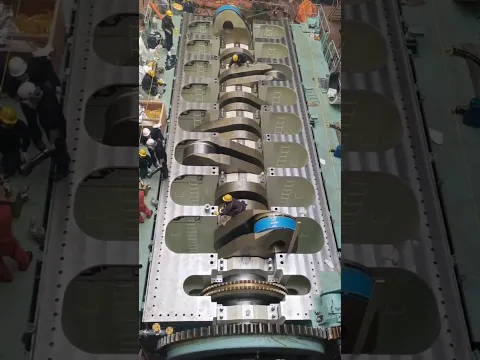

RT-flex Technology: Common-Rail and Electronic Control
The major difference of the RT-flex96C compared to the previous RTA96C generation lies in the fuel injection system and valve control. Instead of a traditional mechanical control, it uses fully electronic common-rail technology, allowing precise control of injection pressure, fuel advance, and valve opening timing at any load regime.
This flexibility results in better fuel economy at partial loads, virtually smoke-free operation across the entire speed range, and reduced component wear. Additionally, the engine has been developed to fully meet the NOx emission limits of the MARPOL Annex VI Convention (IMO Tier II) applicable to large marine engines, balancing high performance with international environmental requirements.
Lubrication, Maintenance, and Reliability
The cylinders of the RT-flex96C are continuously lubricated by direct injection of specific oils, formulated to protect friction surfaces and neutralize the strong acids generated by the combustion of sulfur-rich heavy oil. This strategy reduces wear and increases the lifespan of internal components, even under severe 24/7 operating conditions.
The RT-flex96C family was designed with a focus on reliability and low life-cycle cost: in typical applications, the intervals between major overhauls can reach about three years, with low maintenance costs per kWh generated. Among the benefits noted by manufacturers are high reliability, low initial cost per kW, low lubricating oil consumption rate, and reduced downtime costs for maintenance.
Applications: The Heart of the Mega Container Ships
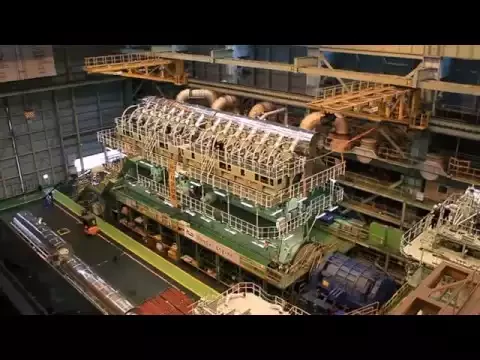
The RT-flex96C mainly equips large container ships, including post-Panamax and ultra-large vessels, often with capacities exceeding 10,000 TEU. On these ships, the engine is directly coupled to the propeller shaft, without a reduction gear, taking advantage of low speed to push large diameter propellers with maximum propulsion efficiency.
The combination of extreme power, relatively low consumption per kWh, and high reliability makes this engine a key component of global logistics, responsible for moving a significant portion of the world container trade. In a scenario where every gain in efficiency directly impacts international freight costs, the RT-flex96C has established itself as a benchmark solution for shipowners operating long-distance routes.
Why This Engine Matters for the Future of Shipping
While discussions about decarbonization and alternative fuels are gaining momentum, engines like the RT-flex96C remain central to global maritime transport, precisely due to their high efficiency and robustness. By combining colossal power, competitive specific consumption, and environmental compliance, it represents the pinnacle of engineering in low-speed marine combustion engines.
In the near future, technologies inspired by this platform—such as even more advanced waste heat recovery systems, electronic adjustments, and integration with lower-emission fuels—should continue to guide the evolution of large marine engines. For those following the industry, understanding the RT-flex96C is essential to comprehend how giant ships can cross entire oceans with maximum energy efficiency and minimal operational disruption.










Para maior eficiência desses motores, é só obrigar a utilização de bio diesel junto ao óleo combustível pesado. 14% são suficientes.