





 Portuguese
  English
  Spanish
  4 min of reading
  8 comments


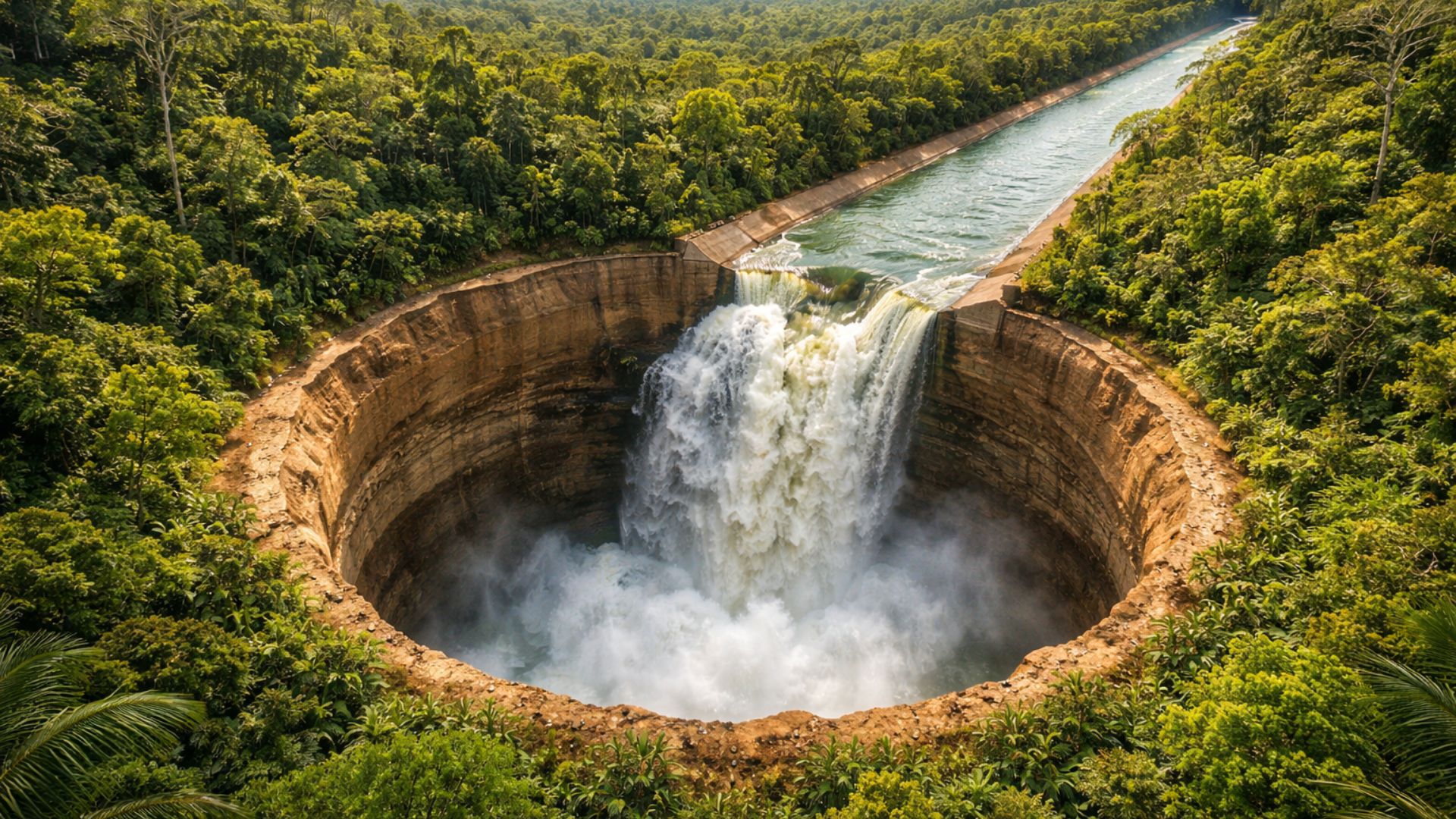


Subterranean Reservoir Beneath the Amazon Holds Estimated Volume of Over 162,000 km³ of Freshwater, Exceeding the Guarani Aquifer in Total Capacity. Studies Indicate Strategic Potential for Regional Supply, but Warn of Technical, Environmental Limits and Management Challenges.
The Amazon region houses, underground, a set of aquifers grouped by researchers as Grande Amazônia Aquifer System (SAGA), with estimates reaching 162,520 km³ of freshwater, a volume greater than that of the Guarani Aquifer, often cited as 37,000 km³.
Although the number is enormous, experts treat this type of comparison as theoretical potential because underground reserves do not automatically convert to available water for withdrawal without risk, nor can they be exploited indiscriminately without local impacts.
Grande Amazônia Aquifer System and the Alter do Chão
The SAGA is described in technical literature as a system that encompasses geological units capable of storing groundwater beneath the basins of Acre, Solimões, Amazonas, and Marajó, forming a hydrogeological mosaic associated with the Amazonian Hydrogeological Province.
-
Friends have been building a small “town” for 30 years to grow old together, with compact houses, a common area, nature surrounding it, and a collective life project designed for friendship, coexistence, and simplicity.

-
This small town in Germany created its own currency 24 years ago, today it circulates millions per year, is accepted in over 300 stores, and the German government allowed all of this to happen under one condition.

-
Curitiba is shrinking and is expected to lose 97,000 residents by 2050, while inland cities in Paraná such as Sarandi, Araucária, and Toledo are experiencing accelerated growth that is changing the entire state’s map.

-
Tourists were poisoned on Everest in a million-dollar fraud scheme involving helicopters that diverted over $19 million and shocked international authorities.


Within this set, the Alter do Chão Aquifer has gained prominence due to concentrated studies and high volume estimates appearing in promotional materials, often cited at approximately 86,4 thousand km³ with an area of about 437,5 thousand km².

However, the same discussion often comes with methodological alerts because volumes depend on parameters such as porosity, saturated thickness, and the extent considered, which causes different studies to produce results that are not always comparable.
Depth and the Use of the Expression “Subterranean Ocean”
The expression “subterranean ocean” serves as a metaphor to communicate scale but does not describe an empty void filled with water; it refers to water stored in the pores and fractures of rocks, in layers with some more productive sections and others less permeable.
When the topic is depth, the data also varies by region: there are didactic descriptions that place shallower free portions and confined sectors at hundreds of meters, which helps explain why capture is unequal and depends on local conditions.
The reference to 3,000 meters beneath the Amazon frequently appears in recent content, but it is not the most common way to characterize the Alter do Chão and often mixes with discussions about deep subterranean flows investigated from oil wells.
Comparison with the Guarani Aquifer


The Guarani Aquifer remains one of the largest transboundary reserves in the world and extends across Brazil, Argentina, Paraguay, and Uruguay, with widely publicized accumulated volume estimates from Brazilian public agencies around 37,000 km³.
In technical work, the debate on magnitudes usually includes not only total volume but also notions of recharge and exploitable share, as not all stored water can be withdrawn safely and replenished consistently over time.
In this type of reading, comparisons such as “four times greater” depend on which numbers enter the calculation, and can vary depending on whether the source uses estimates for the entire SAGA, for the Alter do Chão alone, or for different sections of the Guarani.
Can It Supply the World for Centuries?
The idea that Amazonian groundwater could supply the planet for centuries often arises from a simple division between estimated volume and global consumption, but this reasoning does not account for technical limits, costs, logistics, and, primarily, the environmental effects of intense extraction.
Moreover, the very concept of “reserve” can be interpreted in different ways, because part of what is stored may have slow renewal, and withdrawing more than what can be replenished tends to lower levels, reduce flows, and increase degradation risks.
On the other hand, regional use of groundwater is already significant in Amazonian cities, and technical studies indicate that, in Manaus, a substantial portion of public supply relies on withdrawals associated with the Alter do Chão.
Preservation and Governance Challenges
Even when water is considered of good quality in many places, reports and studies point to vulnerabilities associated with urbanization, lack of sewage collection and treatment, and the presence of potential contamination sources in urban and peri-urban areas.
Another recurring problem is the limitation of continuous monitoring, as observation networks require long data series to identify trends, and technical agencies describe efforts to implement and expand monitoring in strategic aquifers.
As the SAGA relates to an extensive area, partly transboundary, governance also appears as a practical challenge, as protection actions, well control, and usage rules require coordination among federative entities and, when applicable, international dialogue.
Instead of promises of water export or “infinite” availability, the discussion most aligned with what science and public management can sustain today revolves around sanitation, protection of recharge areas, licensing, oversight, and transparency of data.
With moderate extraction and planning, aquifers can serve as a strategic reserve to weather droughts, support urban expansion, and reduce pressure on surface water sources, but this depends on clear rules and an increasingly refined hydrogeological portrait.









por isso faz-se necessário que o Brasil tenha um sistema de defesa militar real, mas o que vemos é um governo fraco que deixou as forças armadas sem dinheiro até para papel higiênico.
Com um tesouro desses na mão, é questão de tempo para as potências estrangeiras tomarem, leia-se China e Estados Unidos.
Vocês do presídiário **** que gastava fortunas em motociatas para não trabalhar e JAMAIS investigou esquemas do INSS e era amiguinho do Voccaro do banco Master somente sabem espalhar mentiras.
Super bem canalizado, só acho que na beirada merecia umas grades de proteção 😏
Por que abastecer o mundo?