





 Portuguese
  English
  Spanish
  5 min of reading
  1 comment


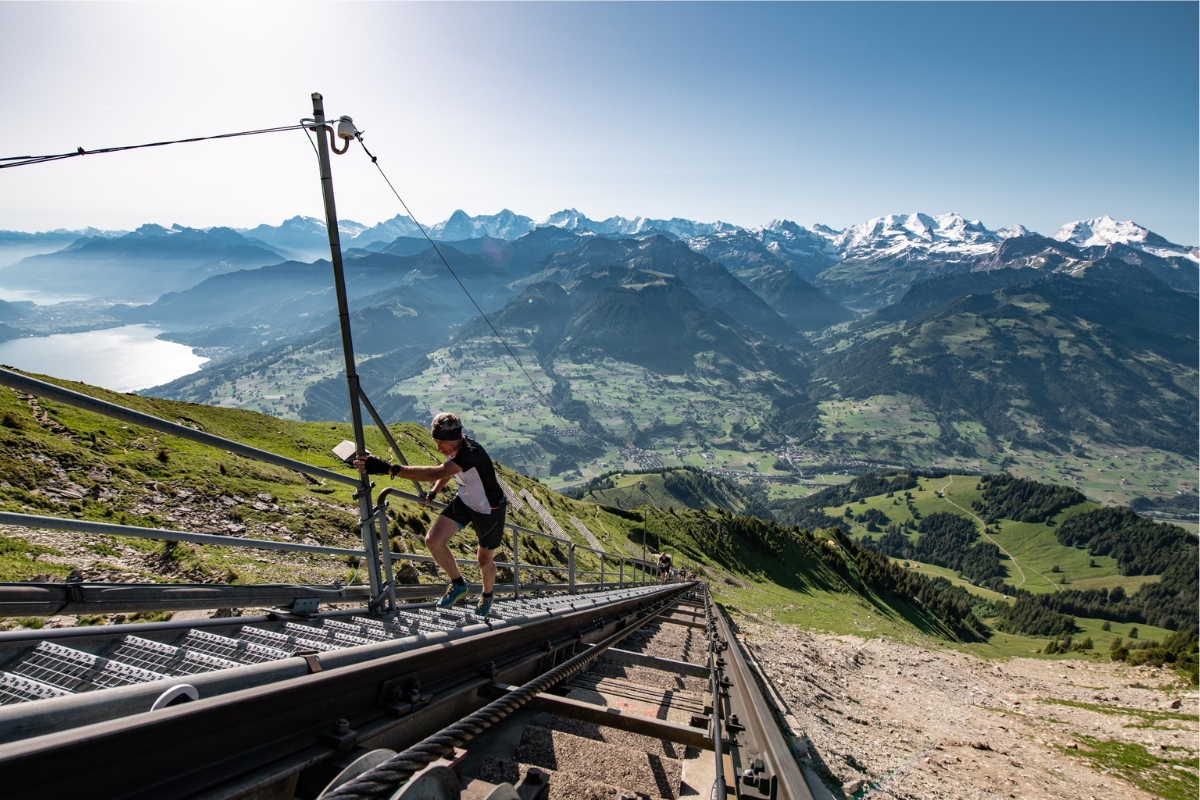


At Mount Niesen, the Niesenbahn Funicular Stairs Total 11,674 Steps and Overcome 1,669 Meters of Altitude in an Ascent That Requires Athletic Preparation
The world’s longest stairway is in Switzerland and attracts attention for its unusual size. There are 11,674 steps in sequence, following the line of the Niesenbahn funicular at Mount Niesen.
The structure overcomes 1,669 meters of altitude and extends for about 3.4 to 3.5 kilometers. In practice, it is a tough test for legs, breath, and endurance.
It was not created for tourism. Its main function is to serve maintenance and inspections in a mountain section with extreme inclines and rapidly changing weather conditions.
-
He started running at 66 years old, broke records at 82, and is now a subject of study for having a metabolic age comparable to that of a 20-year-old, in a case that is intriguing scientists and inspiring the world.

-
Oldest tree on the planet reappears after 130 years of searches: Wattieza, 385 million years old, was 10 meters tall and had no leaves or seeds; Gilboa fossils in New York solved the mystery in 2007.

-
A 48-square-meter house assembled in hours with 4,000 bricks made of recycled plastic that does not absorb moisture, has natural thermal insulation, and costs less than 90,000 reais in a complete kit.

-
Luciano Hang revealed that Havan’s air fleet has already accumulated more than 20,000 landings, 10,000 flight hours, and 6 million kilometers traveled, and he says that without the planes, the company would never have grown so quickly.


The Record-Setting Stairway That Almost No One Can Climb on a Daily Basis
The Niesenbahn stairway is recognized as the longest in the world. The highlight comes from the set of rare numbers in the same construction: 11,674 steps, 1,669 meters of altitude gained, and even 3.5 kilometers in length.
Even though it is a service structure, it has become a global reference for being an uninterrupted and extremely steep ascent. The view beside the track reinforces the impression of an endless route.
The point is that it is normally closed to the public. Only on one annual occasion does the stairway change function and become the setting for a sporting event.
Mount Niesen, Canton of Bern: Where Is the Stairway That Accompanies the Niesenbahn Funicular

The Mount Niesen is located in the canton of Bern, near the regions of Spiez and Mülenen. The mountain overlooks Lake Thun and well-known peaks of the Bernese Alps.
The Niesenbahn funicular was completed in 1910, creating quicker access to the top. Along with the track, a continuous stairway was built to support the technical operation of the line.
The structure was designed to facilitate inspections in a terrain with very steep sections. This includes points where cables, tracks, towers, and electrical systems are located.
Ascent of 3.4 to 3.5 km and Incline of Up to 68%: Why Is This Stairway So Extreme
The numbers help explain why it attracts so much attention. The first is the volume: 11,674 steps practically without long breaks to regain rhythm.
The second is the altitude gained: 1,669 meters, starting from about 693 meters in Mülenen and reaching over 2,360 meters near the top. That changes the effort required from the body.
The third is the incline. There are sections that reach about 66% at the lower part and even 68% at the upper part, which is well above the usual in building stairs and industrial structures.
Niesen Stairway Run: The Race That Transforms Maintenance Steps Into a Competition Track
Once a year, the stairway is opened for the Niesen Stairway Run, an event that puts athletes in front of the 11,674 steps on a direct route to the top.
The race includes individual and relay categories. The route is divided into two parts, with the first stage ascending about 2.1 km and nearly 1,000 meters of altitude.
The second stage completes the final 1.3 km to the top. The organization monitors participants and maintains safety rules since the combination of altitude, incline, and continuous effort requires full attention.
How Long Does It Take to Climb the 11,674 Steps of Mount Niesen

The Niesenbahn stairway also draws attention for the time required to reach the top. Even with preparation, the ascent demands a steady pace from start to finish, with practically no sections to relieve the legs.
In the Niesen Stairway Run, there is a registered male record of 55:55.70 and a female record of 1:07:07, numbers that impress with the level of effort demanded in a route with 11,674 steps.
For well-trained participants, but not professionals, the effort can exceed 2 hours. For an average physically fit person, the estimate is between 2 and 3 hours of constant climbing, with few points to catch their breath.
Why the Stairway Exists: Inspection of Cables, Towers, and Electrical Systems in High Mountain
Despite its fame, the stairway is a functional structure. It exists to provide access to areas used by technical teams during the maintenance of the funicular.
Technicians use the steps to check steel cables, supports, and system components, often under intense cold, snow, or rain. The inclined terrain makes the work even more demanding.
The stairway functions as a fixed inspection route, avoiding reliance solely on irregular trails on a slope with rapidly changing weather.
The Physical Effort That Reminds of Routines in Sectors Such as Oil and Gas, Mining, and Heavy Construction
The work environment at Niesen resembles challenges in fields such as oil and gas, mining, energy, and heavy construction. These are environments where access is difficult, and physical effort is part of the operation.
The difference is the scale. At Niesen, the inspection route is a huge stairway, with continuous ascent and without the same ease of long breaks.
This reinforces how large transportation and infrastructure systems still depend on direct human labor, even with advanced technology.


Tourism at the Top and the “Endless Stairway” That Dominates Photos and Videos on Social Media
Even with the stairway closed to the public most of the time, the Niesenbahn funicular takes tourists to the top of Mount Niesen.
The site has become a known viewpoint, offering panoramic views and a restaurant facility. From above, many people capture the stairway alongside the tracks.
This contrast between technical work and alpine landscape fuels viral videos and increases curiosity about the so-called endless stairway.
The Niesenbahn stairway stands out for gathering 11,674 steps, 1,669 meters of altitude, and a route of 3.4 to 3.5 kilometers in a continuous ascent.
Besides the record, the structure shows how maintenance and safety in high mountains require practical solutions. In the end, it is a work that mixes engineering, physical endurance, and a level of effort that impresses even those who face heavy routines every day.








Quantos degraus tem mesmo? Esqueci, acho que não repetiram o suficiente. Essas notícias atualmente parece que são feitas pra semianalfabetos ou pessoas com sérios problemas no entendimento de conteúdo textual.