





 Portuguese
  English
  Spanish
 5 min of reading
  0 comments


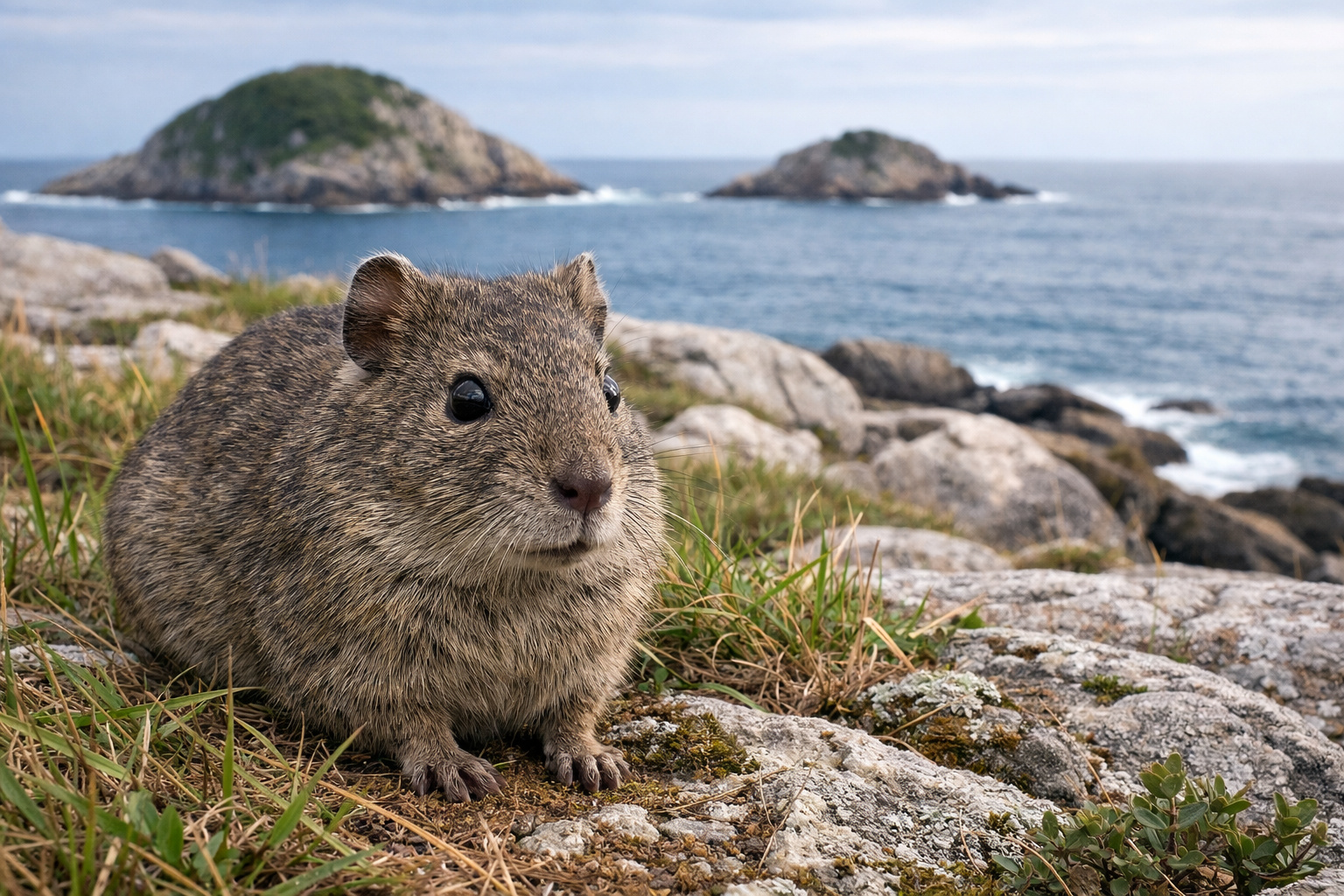
Isolated A Few Kilometers Off The Coast Of Santa Catarina, A Small Rodent With Unique Geographic Distribution On The Planet Reveals How Chance, Geology And Environmental Conservation Determine The Fate Of An Entire Species
Located about eight kilometers from the coast of Florianópolis, in Santa Catarina, a small rocky archipelago hosts one of the greatest symbols of Brazilian biodiversity and, at the same time, one of the most extreme cases of environmental fragility ever recorded in the country. On an island with just over 10 hectares of total area lives the Preá-de-Moleques-do-Sul (Cavia intermedia), currently considered the rarest mammal in the world, with the smallest known geographic distribution among all mammals.
This information was released by the Gazeta do Povo, based on interviews and data provided by researchers from the Santa Catarina Environmental Institute, who have been monitoring the species for decades. The animal exists exclusively on the largest island of the Moleques do Sul archipelago, an area that is part of the State Park of Serra do Tabuleiro, the largest conservation unit in the state of Santa Catarina.
This absolute isolation, while allowing the survival of the preá until today, also represents its greatest threat. After all, any environmental, climatic, or human change in this extremely reduced space can irreversibly compromise the entire species.
-
He started running at 66 years old, broke records at 82, and is now a subject of study for having a metabolic age comparable to that of a 20-year-old, in a case that is intriguing scientists and inspiring the world.

-
Oldest tree on the planet reappears after 130 years of searches: Wattieza, 385 million years old, was 10 meters tall and had no leaves or seeds; Gilboa fossils in New York solved the mystery in 2007.

-
A 48-square-meter house assembled in hours with 4,000 bricks made of recycled plastic that does not absorb moisture, has natural thermal insulation, and costs less than 90,000 reais in a complete kit.

-
Luciano Hang revealed that Havan’s air fleet has already accumulated more than 20,000 landings, 10,000 flight hours, and 6 million kilometers traveled, and he says that without the planes, the company would never have grown so quickly.

A Tiny Population Living On The Edge Of Survival
Currently, the population of the Preá-de-Moleques-do-Sul is estimated to be between 40 and 60 individuals, a number that varies according to food availability and environmental conditions throughout the year. In biological and ecological terms, this is an extremely low contingent, especially considering that rodents typically exhibit numerous populations and wide territorial distribution.
“When we think in terms of species, especially rodents and mammals, this is an extremely small number,” says biologist Marcos Eugênio Maes from the Santa Catarina Environmental Institute. According to him, the risk is constant. Any localized event — such as a prolonged drought, a disease, or even a fire — can directly affect all existing individuals.
Moreover, the preá occupies only about 4 hectares of the island, an area dominated by grasses and open vegetation, which serve as a food base. During the hottest periods of the day, the animals take refuge in areas of denser vegetation and return to feed early in the morning, at dusk, and at night, typical behavior of small rodents that seek to reduce thermal stress.
Although it has no known natural predators on the island, the species faces a severe limitation of resources. When the population grows beyond the capacity of the environment, food scarcity naturally occurs, leading to a reduction in the number of individuals. The lifespan of the Preá-de-Moleques-do-Sul is relatively short, ranging from two to four years, with rapid reproduction, a characteristic common among rodents.
Geological Isolation Created The Rarest Mammal On The Planet

The explanation for the exclusive existence of the Preá-de-Moleques-do-Sul goes back to a geological process that started about 8,000 years ago, after the rise in sea level along the Santa Catarina coast. According to the theory most accepted among specialists, the islands of the Moleques do Sul archipelago were originally hilltops connected to the mainland.
As the ocean advanced, these areas gradually became isolated, trapping small populations of preás that previously moved freely across the continental territory. Over thousands of years, this extreme isolation led to continuous reproduction in a small, closed group, triggering a process known as speciation, which gave rise to Cavia intermedia, a distinct species from its mainland relatives.
This evolutionary process, while fascinating from a scientific perspective, resulted in a highly vulnerable species. Currently, the Preá-de-Moleques-do-Sul is classified as critically endangered at the global, national, and state levels, ranking among the 20 most threatened small mammals in the world.
Interestingly, the protection of the animal began even before its official discovery. The State Park of Serra do Tabuleiro was created in the 1970s, while the scientific confirmation of the species only occurred in the 1980s, during expeditions initially focused on studying seabirds. It was the casual finding of a skeleton with unusual characteristics that led researchers to identify a new species of mammal.
Access Prohibited And Risk Of Irreversible Extinction
Despite the scientific interest and fascination that the story of the preá arouses, landing on the archipelago is strictly prohibited. The area is classified as a no-take zone, and only authorized researchers and employees of environmental agencies can access the location, following strict protocols.
According to Maes, any human presence poses a significant risk. Visitors can introduce seeds, pathogens, bacteria, viruses, or parasites that the animal’s immune system is not prepared to handle. Additionally, the archipelago is an important nesting area for seabirds, whose nests are directly on the ground, increasing the risk of indirect impacts.
There are concerning reports of illegal bonfires in the area. A fire, even a small one, would be catastrophic. “If this species goes extinct, there will be no possibility of recovery. It is a permanent loss,” warns the biologist.
Area enforcement is carried out by the Santa Catarina Environmental Institute, the Environmental Military Police, and the Brazilian Navy. Cases of illegal landings must be reported to environmental authorities. In the case of the Preá-de-Moleques-do-Sul, there is no margin for error: the survival of the species depends entirely on the absolute preservation of one of the smallest and most fragile habitats on the planet.
With an entire species confined to just 10 hectares and dependent on a fragile environmental balance, what will happen when there is no more space, time, or margin for error in wildlife conservation?








-

-

3 pessoas reagiram a isso.