





 Portuguese
  English
  Spanish
  5 min of reading
  0 comments


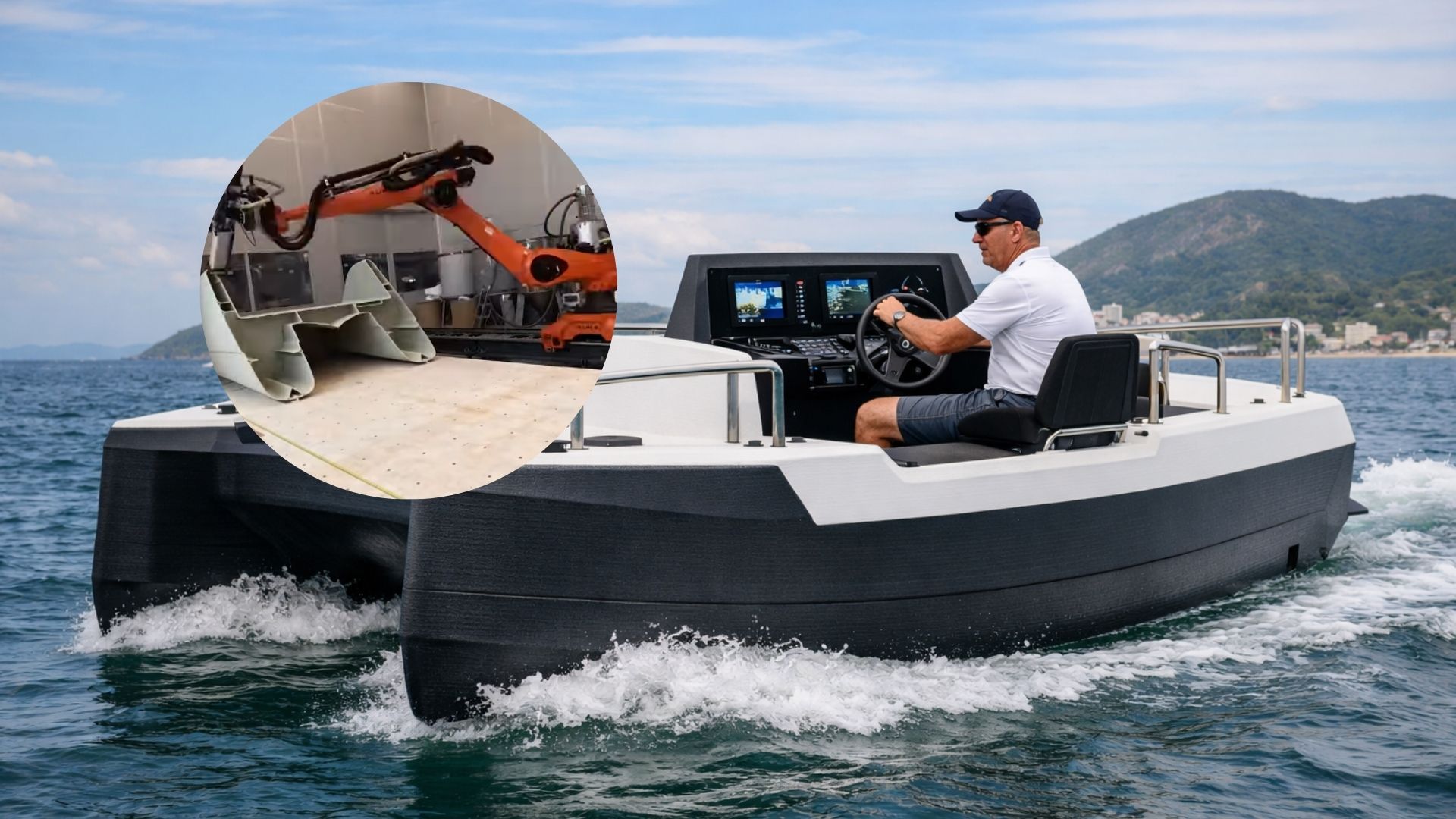
3D Printed Catamaran Six Meters Long Grabs Attention for Using Recycled Plastic Reinforced with Glass Fiber and for Seamless Structural Manufacturing. Project Presented by Italian Company Explores Large-Scale Additive Manufacturing and Indicates New Applications of Technology in the Nautical Sector.
A 6-meter-long catamaran, produced in approximately 160 hours of 3D printing, was presented by the Italian company Caracol as a project developed to operate in open water.
According to the company, the vessel was produced as a single structural piece, with no seams, and uses recycled polypropylene reinforced with 30% glass fiber, a combination that, according to the manufacturer, aims to meet the structural and operational requirements of the marine environment.
Caracol operates in the industrial scale additive manufacturing segment and maintains operations in Italy and the United States.
-
Motorola launched the Signature with a gold seal from DxOMark, tying with the iPhone 17 Pro in camera performance, Snapdragon 8 Gen 5 that surpassed 3 million in benchmarks, and a zoom that impresses even at night.

-
Satellites reveal beneath the Sahara a giant river buried for thousands of kilometers: study shows that the largest hot desert on the planet was once traversed by a river system comparable to the largest on Earth.

-
Scientists have captured something never seen in space: newly born stars are creating gigantic rings of light a thousand times larger than the distance between the Earth and the Sun, and this changes everything we knew about stellar birth.

-
Geologists find traces of a continent that disappeared 155 million years ago after separating from Australia and reveal that it did not sink, but broke into fragments scattered across Southeast Asia.

In this context, the company decided to apply 3D printing to a sector traditionally based on molds and lamination processes, such as shipbuilding.
The result was described by the manufacturer itself as a “functional monolithic catamaran”, a term used to indicate that the hull and structure were designed to function as an integrated whole.
Monolithic Hull and Seamless Manufacturing
By defining the vessel as monolithic, Caracol asserts that the boat was designed to be manufactured as a continuous structure.
Unlike conventional methods, where parts of the hull are produced separately and then joined together, the presented model seeks to eliminate structural joints throughout the production process.

This approach requires specific adjustments even in the digital design phase.
To enable the printing of the hull as a single piece, the project had to consider factors such as overall weight, geometry, stiffness, and equipment limitations.
According to the company, these variables directly influenced the time dedicated to the initial stages of development.
Caracol informs that the phases of design and slicing took more time than usual “due to the considerable size and complex geometry of the boat.”
Slicing, in this case, involves converting the three-dimensional model into instructions that guide the robot during material deposition, defining parameters such as path, speed, and thermal control.
160 Hours of Printing and Finishing Stage
Once the digital model preparation was completed, the printing of the catamaran took about 160 hours, equivalent to nearly seven days of continuous operation.
The company presents this period as the time needed to manufacture the main structure of the vessel through large format additive manufacturing.
After printing, the hull underwent a finishing process.
Surface marks created by layer deposition, common in this type of manufacturing, were treated with CNC machining, which stands for Computer Numerical Control.
This type of finishing uses computer-controlled machines to smooth surfaces and adjust dimensions.
According to Caracol, the use of CNC allows the final result to conform to standards required in the nautical sector.

However, the company does not detail in the released material what technical tests were conducted after finishing or what specific protocols supported the classification of the boat as suitable for navigation in open water.
Recycled Plastic with Glass Fiber Reinforcement
Another aspect highlighted by the manufacturer is the composition of the material used in printing.
The hull was produced with recycled polypropylene, identified as rPP, reinforced with 30% glass fiber.
According to the company, the addition of fiber serves to increase the stiffness and structural stability of the printed piece.
Caracol describes the composite as suitable for large format 3D printing and compatible with nautical applications.
Despite this, the company does not publicly disclose the origin of the recycled polypropylene used.
It also does not specify whether other components of the vessel, besides the hull, were manufactured with the same material.
In the statement, the manufacturer does not present comparative data on performance, durability, or behavior of the material in relation to traditional solutions used in building vessels of similar size.
Model Preparation and Industrial Replication
Although the printing time is one of the points emphasized in the announcement, Caracol draws attention to the complexity of the model preparation stage.
According to the company, the design and slicing effort tends to be greater in the first unit, especially for large structures and complex geometries.
The manufacturer states that once the technical parameters of the model have been defined, these settings can be reused in future productions.
This way, the time dedicated to the initial phases could be reduced in subsequent prints, maintaining the same construction standard.
In a statement, Caracol explains that these preparatory stages are performed only once per model and can be replicated, “significantly reducing preparation time for subsequent constructions.”
The company associates this potential with the logic of standardization of industrial additive manufacturing.
International Partnership and Application in the Nautical Sector
The development of the catamaran took place in collaboration with the V2 Group, a Spanish company specializing in the design, engineering, and production of leisure vessels.
The company also works in nautical and naval applications.

The project utilized a large format additive manufacturing platform, a technology known by the acronym LFAM.
According to the involved companies, the aim of the partnership is to advance beyond a prototype.
The stated intention is to industrialize the process and increase production, applying the technology to other projects in the maritime sector.
In a statement, Caracol asserts that the project demonstrates the viability of robotic additive manufacturing on a large scale for nautical applications.
The released material, however, does not provide detailed information on costs, energy consumption, technical certifications, or direct comparisons with traditional shipbuilding methods.
Moreover, no verifiable information in the announcement was released regarding the technical criteria adopted to define the boat’s capability to operate in open water, nor results from structural or hydrodynamic tests associated with the project.
With 3D printing advancing toward larger and more complex structures, what technical and regulatory criteria will determine whether this type of manufacturing can be consolidated in the nautical sector?







Seja o primeiro a reagir!