





 Portuguese
  English
  Spanish
  4 min of reading
  0 comments


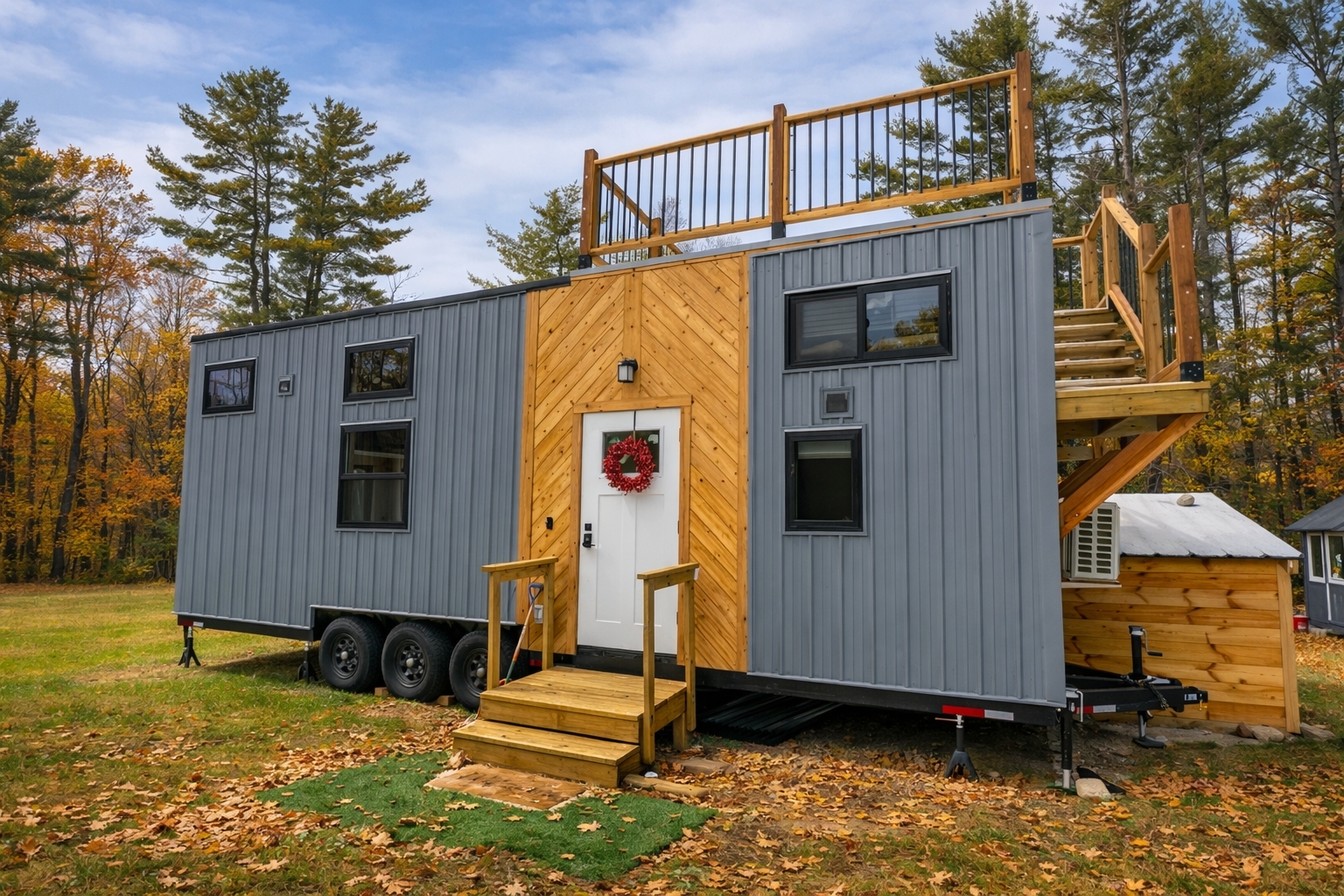
The Backcountry Tiny Homes Model Features Open Plan, L-Shaped Sofa Bed, Fully Equipped Kitchen, And Private Loft, As Well As A Rooftop With Removable Guardrail Designed For Outdoor Gatherings.
A tiny house is one where every inch needs to work double. And that’s why the model grabs attention right away: it doesn’t try to “enlarge” the interior with magic, but creates a second area outside the main volume, a rooftop terrace that becomes a social space when the house is parked.
The structure was designed to fit on a three-axle trailer and is 9 meters long. For North American standards, it’s compact but not exaggerated. It can be seen as a permanent residence while still keeping the option to hit the road. On the outside, the look also plays in favor of the “modern cabin” appeal: cedar with male and female joints and metal details, all looking premium, those that easily yield beautiful photos.
The differential, of course, is the rooftop. It’s not huge, but it’s the kind of area that changes the use of the house. A barbecue, an afternoon, a coffee in the sun, a chat with friends. And it has a clever detail: the guardrail is removable, which makes transportation easier.
-
Friends have been building a small “town” for 30 years to grow old together, with compact houses, a common area, nature surrounding it, and a collective life project designed for friendship, coexistence, and simplicity.

-
This small town in Germany created its own currency 24 years ago, today it circulates millions per year, is accepted in over 300 stores, and the German government allowed all of this to happen under one condition.

-
Curitiba is shrinking and is expected to lose 97,000 residents by 2050, while inland cities in Paraná such as Sarandi, Araucária, and Toledo are experiencing accelerated growth that is changing the entire state’s map.

-
Tourists were poisoned on Everest in a million-dollar fraud scheme involving helicopters that diverted over $19 million and shocked international authorities.


The Rooftop Terrace Is The Simplest And Most Effective Trick

The idea is straightforward. In a tiny house, expanding the interior space is expensive and complicates the structure. A rooftop terrace provides “extra space” without conflicting with the layout. The catch is that the access appears to be external. From the project photos, it’s most likely that the owner needs to place a ladder or steps when parked, as there doesn’t seem to be a fixed integrated ladder.
This makes sense so as not to take up space inside the house. And it also keeps the interior cleaner, with less vertical circulation occupying usable area.
For those who think about actual use, it’s easy to imagine the terrace as the area that appears when the house stops being a vehicle and becomes a home. During travel, it is “stored away.” When parked, it becomes the balcony that many tiny houses dream of having.
Inside, The Open Layout Makes The House Feel Bigger Than It Is
The interior mixes pine with a marked finish and pine with male and female joints, with vinyl flooring. The proposal is cozy without falling into rustic excess. And the layout is open, which helps a lot in compact spaces.
The living room comes with a large L-shaped sofa bed, which already resolves visits without drama. There’s also a wood stove and split air conditioning, a combination that indicates an intention for use in varying climates. The windows are generous, keeping the space bright and avoiding that boxy feeling.
In the middle of the house is the dining area, featuring a table for two that also works as a desk. This type of solution separates a beautiful tiny house from a livable one. When the table becomes a workstation, the house stops being just a “place to sleep” and starts serving real-life purposes.
The kitchen is quite complete for the size: two-burner gas stove, refrigerator with freezer, sink, microwave, and space for other appliances. It’s not that staged kitchen from rental properties. But it looks like it can handle daily life.
The bathroom is on the opposite side of the living room and features a relatively large shower with glass, a sink with cabinet, and storage space. The toilet is an incinerating model, but there is an option to replace it with a flushing model, which broadens the audience willing to live there.
This description and the details of measurements and versions appear in the published text by New Atlas, which was the reference used to organize the project information.

The Loft Bedroom Provides Privacy But Maintains The Tiny House Vibe
The trailer has a unique private loft bedroom, with a low ceiling, accessed by a staircase that also incorporates storage. Upstairs, there’s room for a double bed and some built-in cabinets. It’s exactly the type of loft typical in the segment: comfortable for sleeping, tight for standing, and efficient for freeing up space below.
In the end, the project seems aimed at a very specific audience: people who want a “real” tiny house, with a usable living room, functional kitchen, full bathroom, and an extra to enjoy the outdoors, without needing a deck on the ground.
Price And Versions Show That The Park Is Modular And Designed For Various Budgets
The model is sold with options and three main versions. A basic structure starts at US$ 72,200. A model without furniture costs US$ 122,575. The move-in-ready version reaches US$ 136,100.
These price differences indicate a clear strategy: sell from the skeleton for those who want to customize to the complete package for those who just want to park and live.








Seja o primeiro a reagir!