





 Portuguese
  English
  Spanish
  4 min of reading
  1 comment


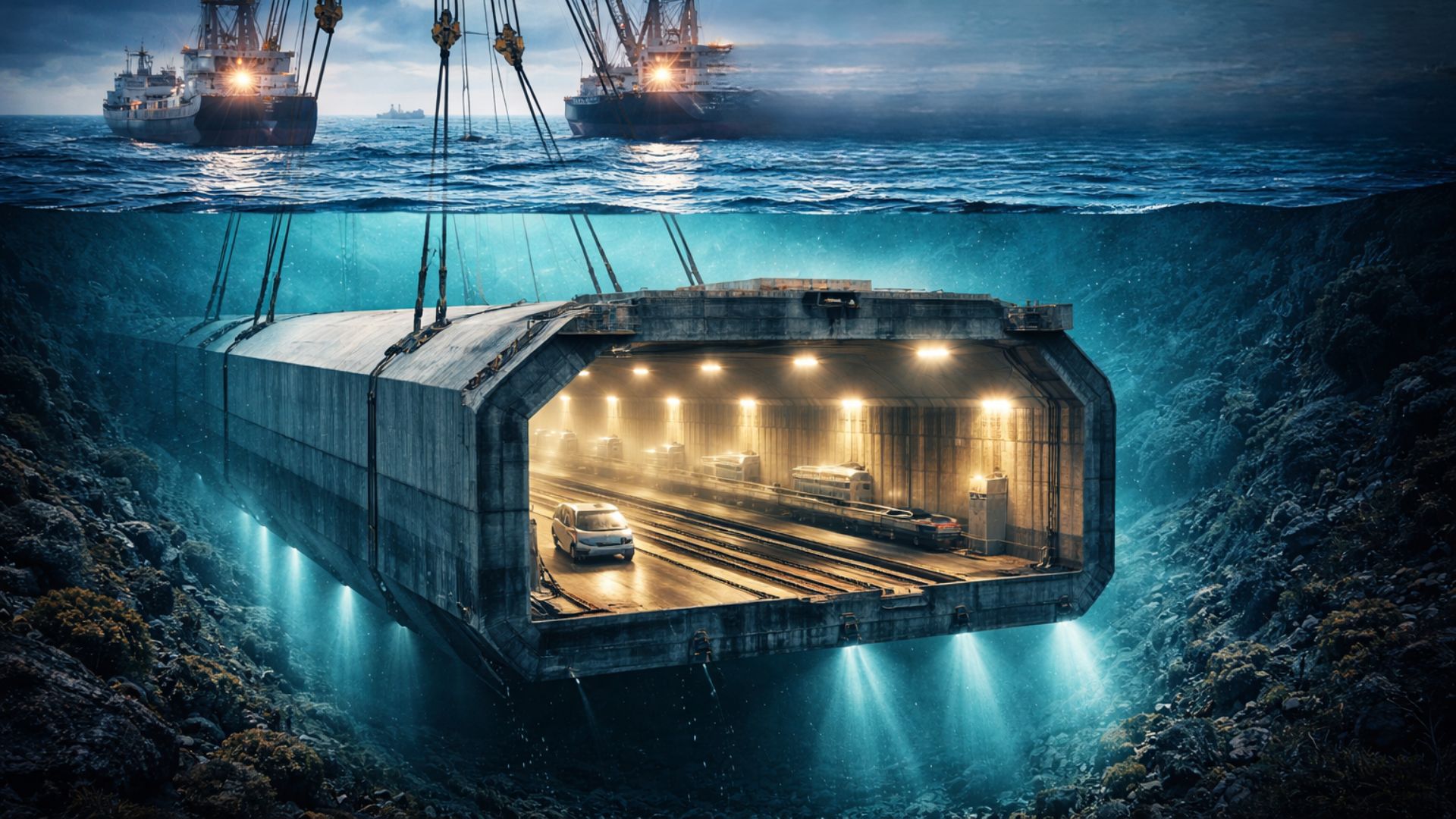


European Megaproject Advances Under The Baltic Sea With 18 Kilometers In Length, Millimetric Precision Engineering, And Billion-Dollar Investment To Shorten The Link Between Denmark And Germany, Drastically Reducing Crossing Time And Strengthening Strategic Transport Corridors On The Continent.
Denmark and Germany are advancing in the construction of the Fehmarnbelt Tunnel, an immersed tunnel of about 18 kilometers under the Baltic Sea that is set to replace the ferry crossing between Rødby and Puttgarden, reducing travel time to approximately 10 minutes by car and 7 minutes by train.
According to the layout, the new fixed link shortens overland routes and alters the logic of regional transport by directly connecting the Danish island of Lolland to northern Germany, focusing on a continuous flow of goods and passengers, without relying on boarding windows at the port.
The operation will be overseen by Femern A/S, the Danish state-owned company responsible for the project, which began construction on the Danish side in 2020 and on the German side in 2021, officially maintaining the goal of completing the tunnel by 2029.
-
Motorola launched the Signature with a gold seal from DxOMark, tying with the iPhone 17 Pro in camera performance, Snapdragon 8 Gen 5 that surpassed 3 million in benchmarks, and a zoom that impresses even at night.

-
Satellites reveal beneath the Sahara a giant river buried for thousands of kilometers: study shows that the largest hot desert on the planet was once traversed by a river system comparable to the largest on Earth.

-
Scientists have captured something never seen in space: newly born stars are creating gigantic rings of light a thousand times larger than the distance between the Earth and the Sun, and this changes everything we knew about stellar birth.

-
Geologists find traces of a continent that disappeared 155 million years ago after separating from Australia and reveal that it did not sink, but broke into fragments scattered across Southeast Asia.
Crossing Between Denmark And Germany Will Be Faster
Today, the trip depends on the ferry, which takes about an hour of navigation and still requires waiting time for boarding, especially during busy periods or under operational restrictions caused by wind and sea.
With the tunnel, the promise is predictability.
The driver will travel along a four-lane highway, while trains will run on two electrified lines, integrating the section into European transport corridors and the expansion of rail modal.
This configuration combines two objectives that often compete with each other, as it concentrates, on the same axis, road and rail traffic, directly impacting travel time and how companies plan deliveries and logistics chains.
Engineering of The Immersed Tunnel On The Seabed
Instead of drilling rock, the Fehmarnbelt adopts the method of immersed tunnel, in which concrete elements are produced on land, transported by vessels, and installed in a dredged trench on the seabed before being covered and protected.
Each standard module has a length of 217 meters and weighs about 73,500 tons, a size that requires specialized construction and transport logistics, in addition to a positioning operation with strict alignment control.
For the structure to function as a continuous and watertight corridor, the segments need to be fitted with millimeter-scale precision, as small variations can compromise joints, sealing, and internal systems, especially in an underwater environment.
The installation phase depends on specialized vessels and cranes, with constant monitoring by sensors, because it is not enough to submerge a block.
It is necessary to stabilize the element, adjust the fit, and complete sealing and protection steps before moving on to the next one.
Billion-Dollar Investment And Support From The European Union
The project’s budget appears in technical sources as around 7.4 billion euros, an amount associated with the largest infrastructure undertaking ever carried out by Denmark, while the European Union supports especially the rail component through transport integration programs.
In terms of funding, the German government reports support via the Connecting Europe Facility for the rail section, with an amount cited around 1.288 billion euros, and Femern has already announced approvals for contributions in specific calls from the bloc.
Even with the weight of the investment, the project is treated as a network piece, because it reduces operational distances and strengthens a corridor between Scandinavia and continental Europe, which tends to change routes, connection times, and capacity planning railway.
Construction Schedule And Delivery Forecast
The production of concrete elements occurs on a large scale, with parts already completed and prepared for subsequent stages, while the site is also advancing on accesses, portals, and associated infrastructure, which includes energy, signaling, and security systems.
Still, the schedule is closely monitored because the installation of elements at sea depends on operational and environmental procedures and approvals, and recent reports in Europe point to the risk of delays related to certifications and the operation of specialized vessels.
On the other hand, the official planning continues to indicate 2029 as the delivery horizon for the tunnel itself, although discussions about deadlines and stages in German territory, such as land railway connections, frequently appear in public analyses.
Environmental Impacts In The Baltic Sea
The construction requires dredging and sediment movement to open the trench where the elements will be laid, a stage that temporarily interferes with the seabed and can affect local habitats, which is why the project is accompanied by environmental requirements.
In response, Femern describes mitigation and compensation actions, including the creation and management of natural areas, as well as monitoring associated with construction phases, aiming to reduce damage and restore conditions after interventions.
Moreover, by focusing on a connection that favors electrified trains and reduces dependence on ferry crossings with waiting times, the project is presented as aligned with efficiency and transport transition goals, although its local impacts remain at the center of the technical debate.
If the Fehmarnbelt Tunnel delivers on its promises of travel time and reliability, how will this new route practically reshape the path of goods and tourists between Northern Europe and the rest of the continent?







Obras de tipo, vulto e necessidade como esta oferece opção mais vantajosa e com menos gasto de tempo na construção. Só que é necessário muita precaução quanto ao solo tendo em vista que movimentações vulcânicas tendem a fazer as placas tectônicas se deslocarem em qualquer lugar do globo terrestre, provocando desastres extremos em muitos outros lugares.
Não estamos “seguros” neste solo terráqueo.