





 Portuguese
  English
  Spanish
  5 min of reading
  1 comment


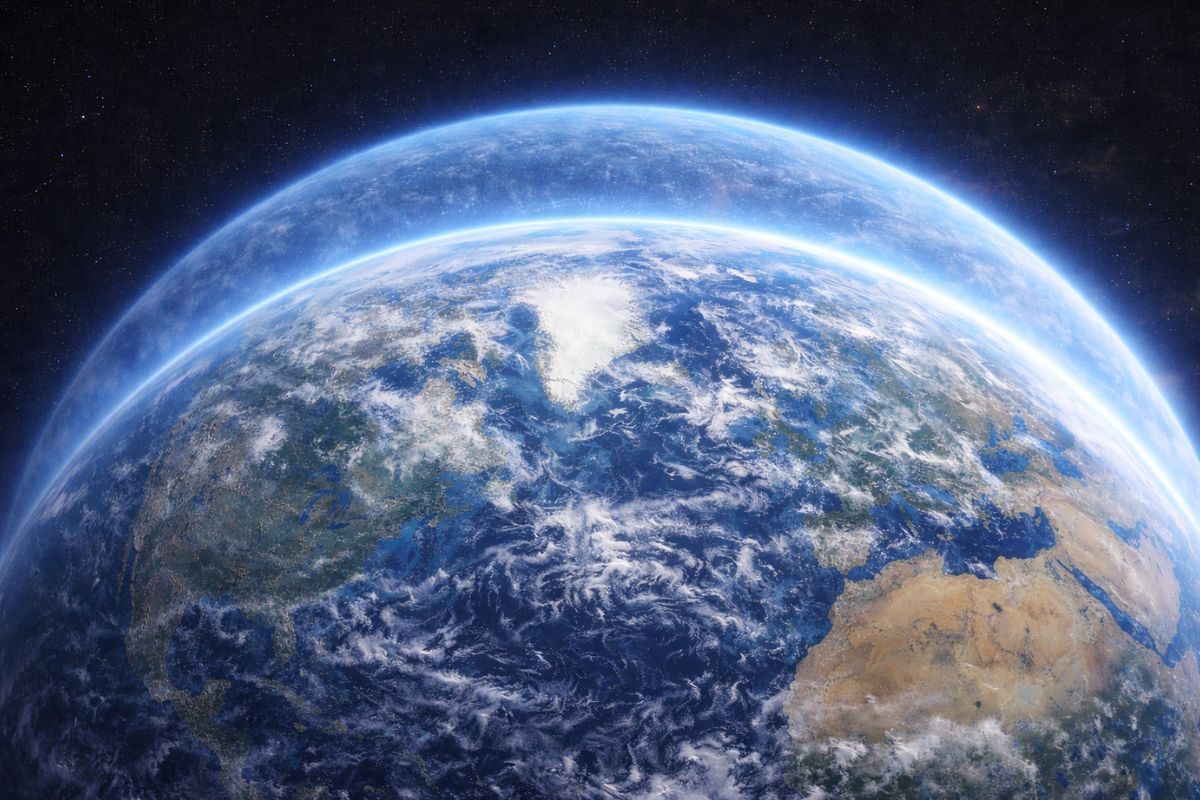


To Save the Ozone Layer, CFC Substitutes Have Started Generating an Eternal Chemical That Falls With Rain, Contaminates Water, Soil, Arctic Ice, and Is Already Found in Blood and Urine
Saving the ozone layer was one of the greatest environmental victories of the century, but the background below describes an unsettling side effect. By replacing the old CFCs, humanity accelerated the formation of a persistent pollutant that is now quietly settling on the Earth’s surface.
In this scenario, saving the ozone layer connects to a new concern: trifluoroacetic acid, known as an eternal chemical, which resists natural decomposition and accumulates for extremely long periods after being transported by air and deposited by rain.
When Saving the Ozone Layer Becomes an Unexpected Environmental Problem
The background explains that the substances introduced to protect the ozone layer have caused a consequence that was not at the center of public debate.
-
Motorola launched the Signature with a gold seal from DxOMark, tying with the iPhone 17 Pro in camera performance, Snapdragon 8 Gen 5 that surpassed 3 million in benchmarks, and a zoom that impresses even at night.

-
Satellites reveal beneath the Sahara a giant river buried for thousands of kilometers: study shows that the largest hot desert on the planet was once traversed by a river system comparable to the largest on Earth.

-
Scientists have captured something never seen in space: newly born stars are creating gigantic rings of light a thousand times larger than the distance between the Earth and the Sun, and this changes everything we knew about stellar birth.

-
Geologists find traces of a continent that disappeared 155 million years ago after separating from Australia and reveal that it did not sink, but broke into fragments scattered across Southeast Asia.

The original focus was to contain the impact of CFCs, but the substitutes have fed a chemical chain that ends in TFA, a persistent compound that spreads through water, soil, and remote regions.
The central point is not to deny the value of saving the ozone layer, but rather to recognize that environmental solutions can carry long-term costs when the substitution does not consider all secondary effects.
The Study Linking CFC Substitutes to TFA
According to the background, a study led by Lancaster University and published in the journal Geophysical Research Letters in February 2026 concludes that substitutes for the old CFCs have become the leading global source of trifluoroacetic acid.
This matters because it repositions the debate. It is not just a point source, but a dominant global source, which explains why deposition occurs even far from industrial areas.
What Is Trifluoroacetic Acid and Why Is It Called an Eternal Chemical?
TFA is described as an eternal chemical for a simple and dangerous reason: it resists natural decomposition. After falling with rain or being deposited from the air, it remains in the environment for extremely long periods.
In practice, this means that the planet does not “clean” TFA easily. The compound infiltrates water and soil, and over time, the problem stops being an event and becomes accumulated stock.
The Invisible Accumulation of Decades and the Mark of 335,500 Tons

The background provides a number that helps to gauge the scale of the phenomenon. Between 2000 and 2022, around 335,500 tons of TFA were deposited on the Earth’s surface.
This data turns the story into something concrete. It is not an abstract risk; it is a volume accumulated over more than two decades.
And, as the background itself states, pollution continues to increase, even with international efforts to reduce the use of certain gases.
How TFA Is Produced and Why Pollution Continues to Grow

According to the background, TFA results from the decomposition of gases used in refrigeration systems and also of certain inhalational anesthetics. The central problem lies in the timing: these components can remain in the atmosphere for decades before transforming into the acid that reaches the ground.
This delay creates a dangerous dynamic. Even if usage decreases at some pace, the effect can continue to show up for a long time because there is an “atmospheric stock” in processing.
Moreover, the scientists cited in the background still predict that the peak of annual production may occur at any moment between now and 2100, which adds uncertainty to the horizon.
The Arctic as Proof of the Global Reach of the Problem
The background highlights a detail that serves as both symbolic and scientific evidence: the discovery in ice cores in the Arctic. If TFA appears in glaciers, it is difficult to treat it as a local problem.
The text states that, even far from industrial areas, nearly all the acid detected in these glaciers originates from substitute gases from CFCs, transported by atmospheric currents for thousands of kilometers. When it reaches the Arctic, there is no “out of the way” for the pollutant.
Environmental Risks and Signals in Humans
The background describes a picture of alerts, albeit with nuances. In some regions, current levels would be considered below immediate harm limits by certain regulatory bodies, but the accumulation trajectory is described as irreversible and concerning.
Among the points noted in the background:
- The European Chemicals Agency considers the compound harmful to aquatic life;
- Studies detected the presence of the substance in the blood and urine of humans;
- German authorities proposed to classify the pollutant as potentially toxic to human reproduction.
The implicit message is clear: it is not enough to look at today’s level, because a persistent chemical changes the game over time.
HFOs: The Ecological Alternative That Also Becomes a Source of TFA
The background states that the latest class of refrigerants, HFOs, marketed as an ecological alternative, has also become a growing source of TFA.
The emphasis is on the use in automotive air conditioning systems, which expands the scale of dispersion by volume of use.
This passage reinforces a common tension in environmental politics: swapping one problematic compound for another can solve one indicator and create another.
The solution can become the seed of a new ecological disaster if the complete cycle is not considered.
Why International Monitoring Becomes Urgent
In light of this trajectory, researchers emphasize the need for more rigorous international monitoring.
The logic is straightforward: if pollution is growing, if the compound persists, and if new sources are coming into play, monitoring deposition and environmental presence ceases to be optional.
Saving the ozone layer remains crucial, but the case described by the background shows that environmental governance needs to look decades ahead, especially when the topic involves compounds that do not degrade easily.
The Lesson Behind the Story
The hardest lesson is that successful environmental policies can generate secondary effects that take time to appear. When the planet discovers too late, the cost is higher because the pollutant has already circulated and accumulated.
Therefore, according to information from the portal Xataka, it points to a principle of caution: when substituting a harmful substance for another, it is essential to evaluate long-term risks, including persistence, atmospheric transport, and final destination in the environment.
Saving the ozone layer should not mean accepting a new chemical liability without debate and oversight.
Do you think future environmental policies should require stricter long-term testing before releasing “green” substitutes on a global scale?






Não fou a humanidade, foram empresas desonestas que só visam lucro e deveriam ser punidas.