





 Portuguese
  English
  Spanish
  7 min of reading
  0 comments


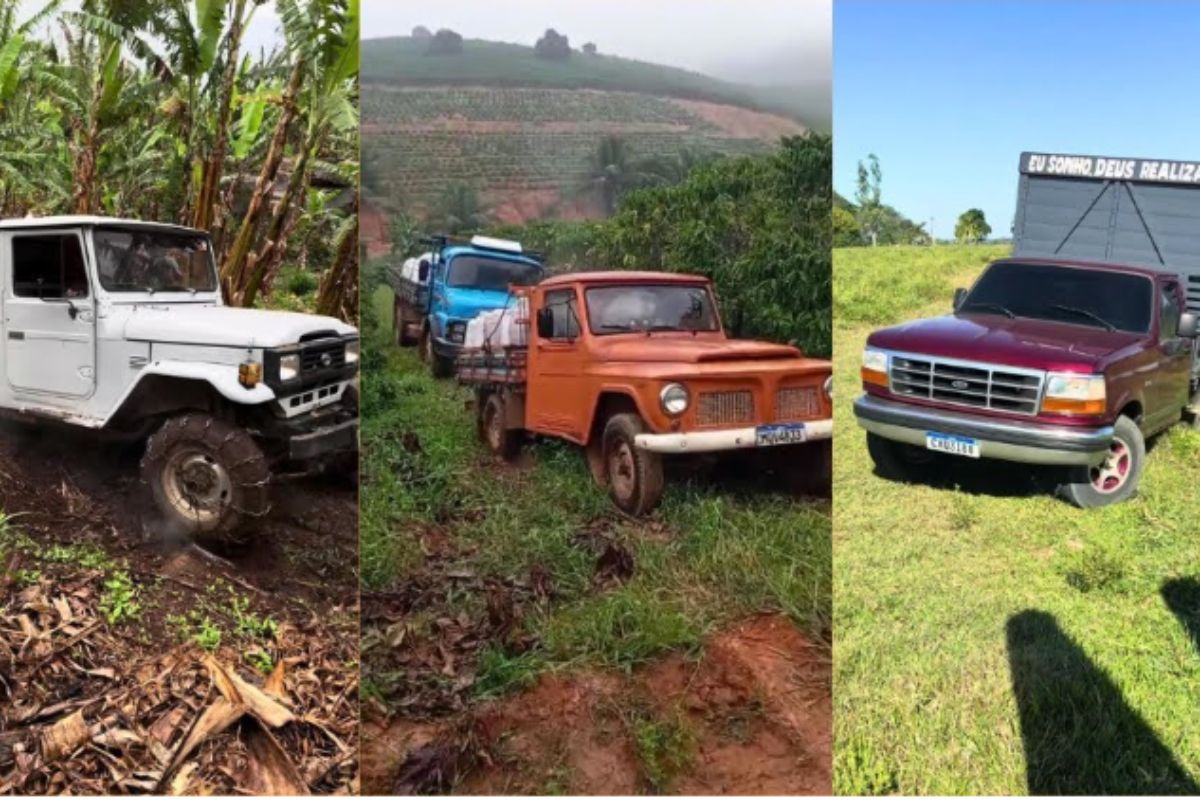
Toyota Bandeirante, F1000, Fiat Uno and Hilux Show How the Root Cars of the Countryside Still Rule the Farm, Even in the Era of Modern Pickup Trucks.
In the countryside, there has always been a special category of vehicle. It’s not the most beautiful, nor the newest, much less the most technological. It’s the one that has a sun-damaged body, torn seats, a noisy door, but you turn the key, it starts, engages, spits out smoke, and goes. These are the true root cars of the countryside, the tough ones that tackle mud, heavy tasks, and pull everything as if it were a leisure ride.
While many modern pickup trucks shining at the dealership turn into “old refrigerators” at the first bumpy road, the root cars of the countryside continue strong, carrying sacks, cattle, feed, fertilizer, people, dogs, and whatever comes their way. In this article, we take a journey back in time to remember the Toyota Bandeirante, F75, F1000, D20, C10, and even the Fiat Uno, these classics that have become legends in rural areas.
Toyota Bandeirante: The Sacred Entity of the Root Cars of the Countryside

If there’s one model that almost became a religion in the countryside, it’s the Toyota Bandeirante. Manufactured in Brazil from 1962 to 2001, it gained fame for being indestructible.
-
A French brand placed a car on four huge red balloons to prove that its suspension made the vehicle “float,” and the surreal scene became one of the most iconic and unusual images in automotive history.

-
Jeep Avenger begins production in Brazil, debuting as the brand’s new entry-level SUV and inaugurating an unprecedented phase by becoming the first national Jeep manufactured outside of Goiana, as part of a R$ 3 billion plan.
-
Costing R$ 12,490, the new Shineray Urban Lite 150 “cheap one” arrives in Brazil with a CVT transmission, digital dashboard, and LED lights, making it more affordable than the Biz and targeting those who want to abandon the bus.
-
Ducati brings to Brazil the Superleggera V4 Centenario: 228 hp that become 247 with a track kit, carbon fiber and carbon-ceramic brakes, estimated price between R$ 1.5 and 2 million, deliveries only in 2027.

The most famous engine was the Mercedes, with around 90 to 95 horsepower, but in practice it felt like it had about 300, given how much it could pull.
It was Bandeirante towing cows, trailers, broken tractors, neighbors stuck, whatever appeared. It did about 8 to 10 km per liter, depending on how hard you pressed the pedal, but those who have a Bandeirante don’t buy it for fuel economy; they buy it for its strength and the assurance that it won’t let you down.
In popular saying, the phrase is classic: “Bandeirante never breaks, it just takes a break”. And that’s exactly the spirit that defines the root cars of the countryside: a simple, tough, noisy machine, always ready to work another day.
F75 and Rural: Shovel DNA on Four Wheels

The Ford F75 is another icon among the root cars of the countryside. Many swear she left the factory with shovel DNA and the smell of a barn. Manufactured from 1970 to 1982, it came with Willys 2.6 or 3.0 engines, producing about 90 horsepower.
Fuel consumption? Keeping it light, it got around 6 to 7 km per liter. Stepping on it heavily, it dropped to about 4 km per liter, and that was pushing it, but it paid that off in service. It carried sacks, gas cylinders, milk, fertilizer, pigs, mothers-in-law, half a family’s move, all together.
The Rural version was practically the “SUV of the farm” long before that term became trendy. It could fit half the countryside crew inside: people, children, dogs, luggage, boxes of fruit.
People said the F75 was great for climbing hills, as long as you had the courage to stay inside until you got to the top.
F1000 and F250: Just Comfort Without Losing the Root Soul

When it comes to farmer trucks, it’s impossible not to remember the F1000. Born in the 80s and produced until 1998, it became a coveted dream in the countryside.
With a MWM 3.9 diesel engine, it had between 95 and 120 horsepower, depending on the model, and made between 9 to 12 km per liter, a spectacle for its time.
Compared to the Bandeirante and the F75, the F1000 seemed almost luxurious: more comfortable, softer for travel, but without losing the rough side of towing trailers, cattle, tractors, planters, and still arriving in town with style.
The F1000 marked so much that even today, when someone sees an old pickup truck on a dirt road, the first question is: “Is it an F1000?”
The F250 is from the 2000s onward. A robust engine, widely used on larger farms, providing more comfort, more electronics, but still with that truck spirit.
It’s the type of root car from the countryside that became a “middle ground” between the rough and the modern, still tackling heavy work without fuss.
C10 and D20: Tough Trucks That Even Carry Tree Stumps

In the 60s, the C10 started rolling through the countryside. Gasoline, 4.1 or 4.3-liter engines, producing between 140 to 150 horsepower. Loud, thirsty, achieving about 4 to 5 km per liter, but brave as few.
It wasn’t uncommon to see a C10 carrying cattle in the bed when the farmer had more courage than sense. It wasn’t just a pickup, it was a “tin cattle truck”, tackling jobs that many trailers won’t take on these days.
Then came the D20, manufactured from 1985 to 1996, with a Perkins Maxion engine ranging from 90 to 120 horsepower, achieving something between 8 to 12 km per liter, depending on the driver’s foot.
The D20 is the type of vehicle where the sun eats away the paint, the upholstery tears, but the door still closes with a touch and the engine keeps running smoothly.
Even today, there are many D20s on the farm, with burn marks on the body, but the engine full, torque abundant, and courage to pull tree stumps as if they were toys.
It’s not an exaggeration to say that a well-kept D20 can be worth more than many brand-new cars, given the high demand from those who know what it can withstand.
Fiat Uno: The Poor Man’s Pickup That Became Farm Heritage

It may seem like a joke, but it isn’t. In many properties, the Fiat Uno has become the famous “poor man’s pickup truck.”
Launched in 1984, with engines ranging from 48 to 70 horsepower, achieving between 12 to 16 km per liter, it gained the reputation of being a nearly unbreakable and very inexpensive to maintain car.
In practice, the Uno does things that many modern pickup trucks wouldn’t dare. It passes through narrow trails, enters bad roads, tackles light mud, avoids potholes, and if it gets stuck, two workers can push it and it comes out moving.
In the countryside, the Uno has served as: a feed truck, a milk truck, a staff pickup, a dog trailer, and a car to go to town to buy bread.
If it had a work ID, the Fiat Uno would be registered as “jack-of-all-trades for the property”. And that is precisely what places it on the list of root cars of the countryside, even without a truck bed.
Why Modern Pickup Trucks Struggle Where the Root Cars of the Countryside Excel


Hilux, Triton, Ranger, S10, everything today comes with digital air conditioning, nice dashboards, stability control, comfortable seats, and a ton of onboard electronics.
They’re great for traveling, driving around the city, and hitting the paved roads. But when it comes to dirt roads with bumps, potholes, stones, and mud slick like soap, the conversation changes.
Testimonies from those living in the countryside are clear: modern pickup trucks can handle it, but they struggle. They break expensive parts, high-pressure pumps, timing chains, sensitive suspensions.
If they need to venture into rough trails, face heavy rain, or tackle uphill muddy terrain, often the fear isn’t getting stuck, but rather incurring a debt of 40 to 60 thousand reais in repairs.
On the other hand, root cars of the countryside were designed with a different logic. Less electronics, more metal, more suspension travel, and more mechanical simplicity.
The bodywork may not be pretty, comfort may be limited, but the chances of breaking down in the middle of nowhere are much lower. And if they do break down, repairs are often possible in-house, with a trusted mechanic and more affordable parts.
In the end, the root car of the countryside is not just a vehicle, it’s a working tool, often as important as a tractor or implement.
It is part of the families’ history, appears in old photos, participated in moves, weddings, good harvests, bad harvests, births, and even city relocations.
Root Cars of the Countryside: Machine, Memory, and Identity
Toyota Bandeirante, F75, Rural, F1000, F250, C10, D20, Fiat Uno. Each of these models has a story told by the wood-burning stove, always with that “can you believe this car did such-and-such?” in the middle of the conversation.
They are the true root cars of the countryside, the ones that faced mud up to the bumper, rough hills, roads disappearing in the rain, towed loads over the limit, and yet continue to roll.
In an age where everything is increasingly electronic, fragile, and expensive, these old brutes have become symbols of resistance, simplicity, and hard work done well. And you, which of these root cars of the countryside has been part of your life or your family’s history?









-

-

-

5 pessoas reagiram a isso.