





 Portuguese
  English
  Spanish
  3 min of reading
  0 comments


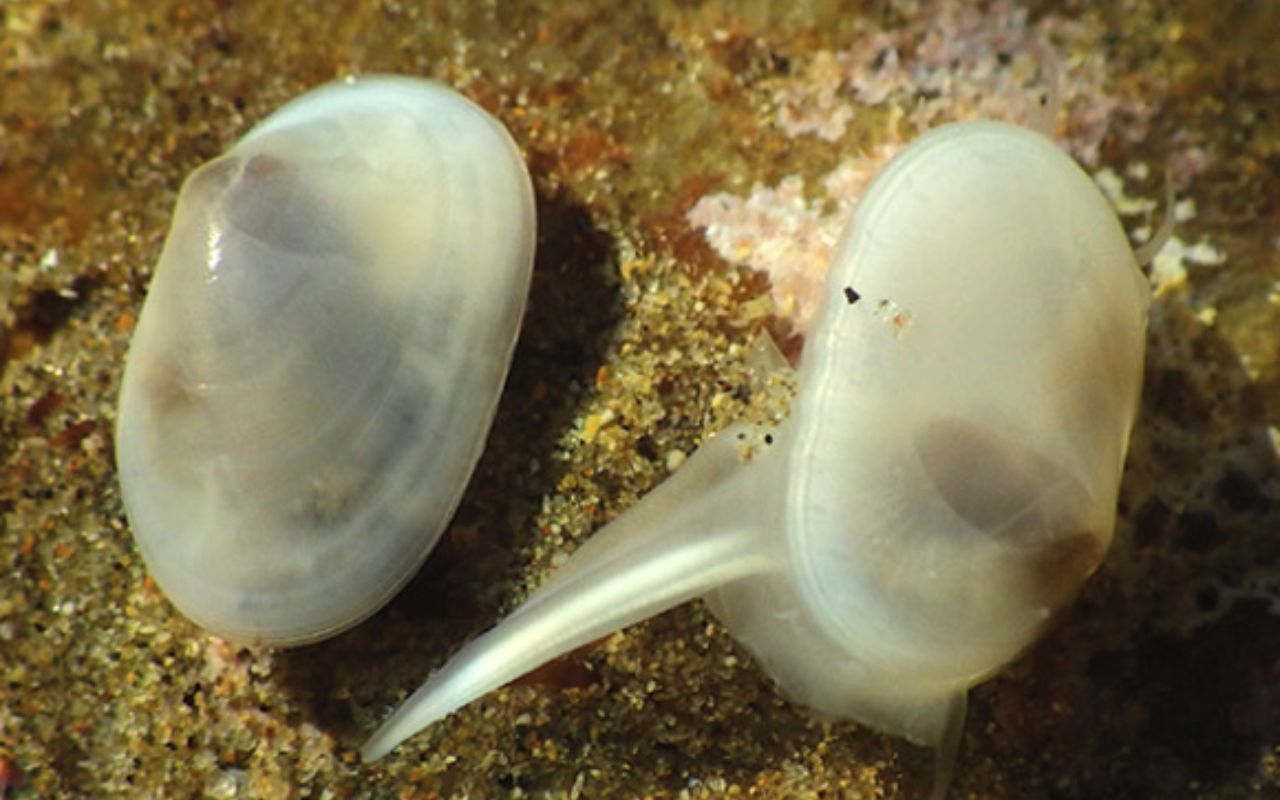
Transparent Mollusk (Cymatioa cooki) Considered Extinct About 30 Thousand Years Ago, Has Been Rediscovered in California, Defying Scientific Theories About Extinction.
A transparent mollusk, Cymatioa cooki, classified by science as extinct about 30 thousand years ago, has been recorded alive again on the coast of the United States.
The discovery, made by American researchers, occurred in California and was only confirmed after years of careful analysis.
The case draws attention because it contradicts ancient fossil records and broadens the debate about species that disappear from books but continue to exist in nature.
-
How to make a 3-tier wooden toolbox that opens all at once and organizes the workshop

-
Ceará enters the map of Brazil’s mountains with 6 formations recognized by IBGE

-
A former 27-year-old engineer gave up everything, went to live in a trailer in the middle of Texas, and created the largest telescope ranch in the world: clients from anywhere control about 550 devices bolted to concrete under a sky with no light pollution via computer.

-
With approximately 30 meters in length and engines exceeding 3,000 horsepower, a single tugboat is capable of exerting more than 100 tons of pulling force and precisely maneuvering a ship nearly 400 meters long and over 200,000 tons within a port.



The reappearance of the animal raises a central question: how many other species considered extinct may actually only be off the scientific radar?
Transparent Mollusk: A Finding That Went Unnoticed for Years
Although the scientific confirmation is recent, the first contact with the mollusk occurred in November 2018.
At that time, ecologist Jeff Goddard was conducting a routine coastal observation activity in Santa Barbara, California.
During his search for shellfish, he noticed nearly invisible organisms among rocks and sand. They were small, translucent, and fragile, characteristics that make them difficult to detect even in well-studied areas.
The rarity of the encounter only became clear after closer observation.
Unusual Behavior Raised Suspicions
What really differentiated the organisms was how they reacted to the environment. According to the researcher’s own account, the animals “extended and started to shake a shiny, white, striped foot, larger than its shell.”
This behavioral detail indicated that it was not a common mollusk. Even so, Goddard chose not to collect the specimens at that moment, avoiding interference with the natural environment.
Specialized Evaluation Revealed Something Out of the Ordinary
The recorded images were sent to Paul Valentich-Scott, former curator of malacology at the Santa Barbara Museum of Natural History, an expert in bivalve mollusks — those with two shells.
After analyzing the photographs, the researcher recognized the uniqueness of the finding. “That was something I had never seen before,” he stated, highlighting that he was deeply familiar with the species recorded along the coasts of the Americas.
Still, both agreed that a definitive confirmation would require direct analysis of a specimen.

Months of Searching Until Finding a Single Clue
From that point on, a series of frustrating attempts began. Between late 2018 and March 2019, Goddard returned to the site several times, totaling nine unsuccessful expeditions.
Only after this period was a small shell found under a rock, almost imperceptible.
The material, though minimal, was sufficient to allow for more detailed laboratory studies.
Old Records Revealed the True Identity of the Transparent Mollusk
During the analysis, Valentich-Scott decided to review old scientific literature.
The answer emerged in a book published in 1937, which described a species of transparent mollusk extinct tens of thousands of years ago.
The characteristics matched precisely. The animal corresponded to Cymatioa cooki, a species identified from fossils found in Baldwin Hills, California.
These fossils were dated between 28 thousand and 36 thousand years, leading experts to conclude, for decades, that the mollusk had completely disappeared.
One hypothesis to explain the reappearance involves recent changes in the ocean.
Goddard suggests that marine heatwaves may have modified currents and dispersion patterns.
According to him, these changes may have transported planktonic larvae to coastal areas between 2014 and 2016, allowing the species to establish itself again in regions accessible to human observation.
What Changes with the Rediscovery of the Transparent Mollusk?
The reappearance of a species considered extinct reinforces the idea that knowledge about the oceans is still limited.
Small, translucent mollusks that live partially buried can escape monitoring for thousands of years.
Furthermore, the case reignites discussions about marine conservation and the need for caution when officially declaring a species extinct.
The rediscovery of the extinct transparent mollusk not only revises a chapter of marine biology but also exposes how much ecosystems still hold surprises.
For scientists, the episode serves as a warning: the absence of records does not necessarily mean the definitive end of a species.
Source: MegaCurioso





-

1 person reacted to this.