





 Portuguese
  English
  Spanish
  4 min of reading
  0 comments


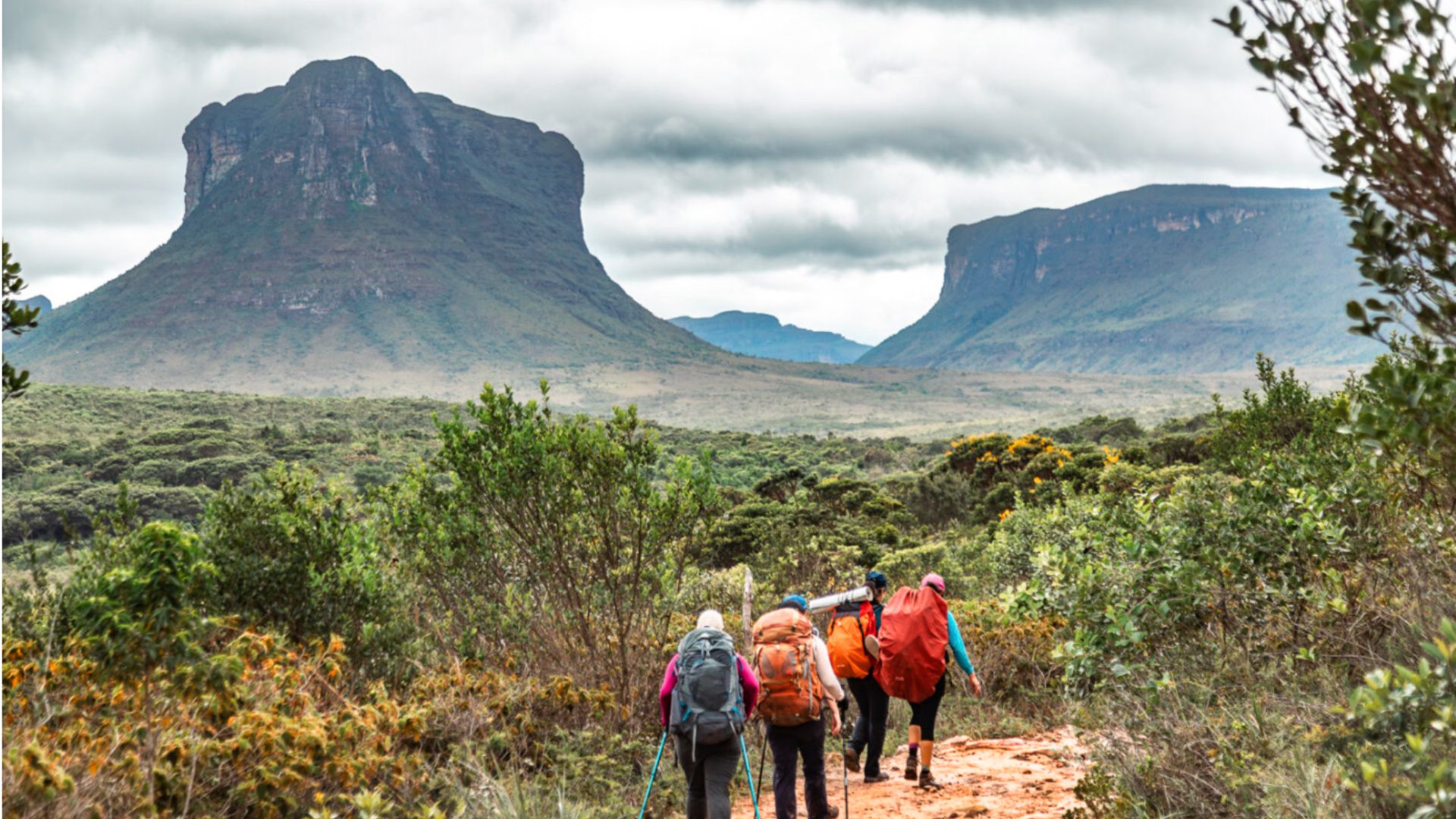
First All-Female Expedition Crosses the Serra do Sincorá Autonomously and Redefines Mountaineering in Bahia
Transsincorá has just made history in Brazilian trekking. For the first time, an all-female group traversed the 130 kilometers of the crossing completely independently, crossing the Chapada Diamantina from south to north in seven consecutive days. In addition, the 21 women came from eight different nationalities: Argentina, Brazil, Chile, Colombia, Puerto Rico, El Salvador, Panama, and Mexico.
Although Chapada Diamantina boasts some of the most stunning landscapes in Brazil, Transsincorá is still not listed among the region’s more classic crossings. Unlike the Vale do Pati, which has established itself as a reference, this trek remains poorly marked, technically demanding, and physically challenging. For this reason, the achievement gains even more significance.
At the beginning of 2026, the Brazilian project Women and Mountains joined forces with the Latin American collective Mujer Montaña. From this partnership, the expedition Hermanas en Travessia was born. The name perfectly encapsulates the spirit of the journey: unity, autonomy, and female empowerment in the mountains.
-
Friends have been building a small “town” for 30 years to grow old together, with compact houses, a common area, nature surrounding it, and a collective life project designed for friendship, coexistence, and simplicity.

-
This small town in Germany created its own currency 24 years ago, today it circulates millions per year, is accepted in over 300 stores, and the German government allowed all of this to happen under one condition.

-
Curitiba is shrinking and is expected to lose 97,000 residents by 2050, while inland cities in Paraná such as Sarandi, Araucária, and Toledo are experiencing accelerated growth that is changing the entire state’s map.

-
Tourists were poisoned on Everest in a million-dollar fraud scheme involving helicopters that diverted over $19 million and shocked international authorities.


The information was shared by “Women and Mountains” in collaboration with the international collective “Mujer Montaña,” as reported by the organizers and guides from the Associação Rainhas da Serra, responsible for the technical leadership of the crossing in Chapada Diamantina.
130 Km with Total Autonomy: Wild Camping and Minimal Contact with Civilization

Unlike guided tours with pre-established structures, the group conducted the crossing autonomously. During the seven days, the mountaineers carried everything they needed in their backpacks: food, shelter, and essential gear. Additionally, they maintained contact only with small villages like Mucugê and Vale do Capão.
Transsincorá follows the Serra do Sincorá, the main mountain range in the region. The route crosses the Parque Nacional de Ibicoara to Lençóis and ends at the top of Morro do Pai Inácio, the most emblematic postcard of Chapada Diamantina. Therefore, in addition to physical demand, the route carries a strong symbolic weight.
The guides Bel and Bete, members of Rainhas da Serra — the first association of female guides in Brazil — technically led the group. More than providing practical guidance, they ensured safety on a long, uneven, and poorly marked terrain.
The Women and Mountains project emerged in 2019 as an independent initiative among friends. Initially, the goal was to inspire other women through high mountain expeditions and short documentaries. However, the movement grew rapidly. Many women began to inquire about how they could participate.
In response to this demand, Amanda Alvernaz left the corporate market, became a guide, and restructured the project alongside Kellyns Cristina and Joanna Dorini. Today, the focus is clear: to strengthen autonomy, self-confidence, and female leadership through mountaineering and climbing.
On the other hand, the collective Mujeres Montaña, created in 2020 by Griselda Moreno (Argentina) and Denys Sanjinés (Bolivia), shares a similar purpose. Six years after the first contact, the leaders were able to realize the collaboration in Bahia.
Chapada Diamantina, Diamond Territory and Collective Transformation
Transsincorá traverses a vast territory historically marked by diamond mining. Centuries ago, explorers scoured the Serra do Sincorá in search of mineral wealth. Today, however, the crossing delivers another type of discovery: personal transformation.
During the 130 kilometers covered in seven days, the group faced intense heat, rain, and poorly marked stretches. Still, the unity among the 21 women made a difference. As Amanda reports, the technical challenge can evoke fear; however, it also strengthens confidence. Furthermore, when one looks to the side and finds support, the weight of the backpack seems lighter.
The testimony of Mexican María Marentes reinforces this impact. In describing the experience, she likened the journey to a ritual. The rain erased paths. The terrain required constant sweat. Inner voices questioned limits. Yet, the group advanced united. On the last dawn, she said, she was no longer the same person.
Besides the sporting achievement, the expedition left a concrete legacy. During the crossing, Samanta Chu, from Wilderness Medical Associates International Brazil, taught the Wilderness First Aid (WFA) course. In total, 11 female guides from the region received certification. In this way, the initiative expanded local competencies and strengthened safety in female mountaineering in Chapada Diamantina.
Thus, Transsincorá has ceased to be just a little-known trek. It has established itself as a symbol of international collaboration, female empowerment, and territorial strengthening. Moreover, it has demonstrated that alliances between projects reduce risks and broaden horizons.
In the end, the crossing represented not just 130 kilometers of hiking. It represented the confirmation that the mountain is also female territory.
Would you have the courage to tackle 130 km of wild trekking in Chapada Diamantina to experience such a transformation?










-

3 pessoas reagiram a isso.