





 Portuguese
  English
  Spanish
  5 min of reading
  1 comment


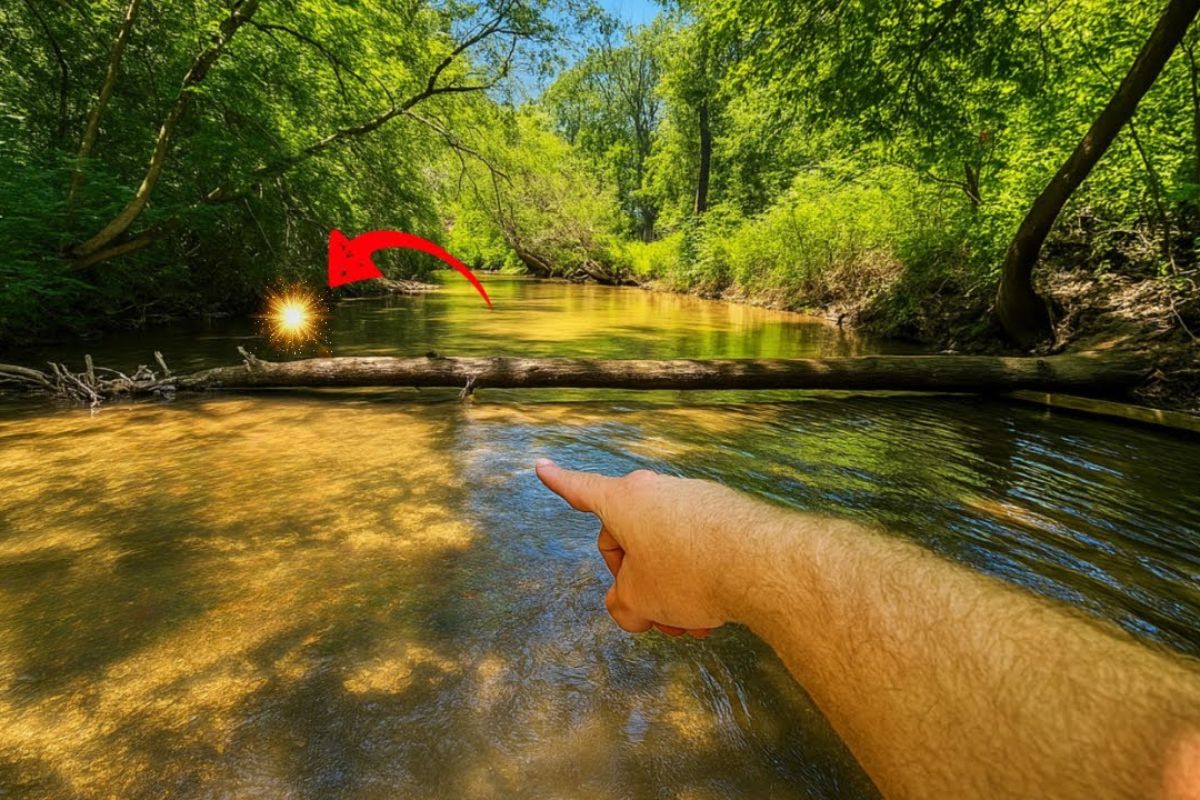


In An Alabama Creek, A Historical Relic Appears Rare, But Mutilated, Among Soda Bottles, Bricks With Fingerprints And Whiskey Glass. The Find Shows How Floods, Erosion And Neglect Transform Heritage Into Fragment, And Why Ghost Towns Still Leave Clues Beneath The Mud For Years On End.
What seemed like just another routine sweep turned into an uncomfortable record. A treasure hunter entered the river in Alabama after the water level dropped and, in the first stretch of mud and debris, found a historical relic that should have been intact, but came broken, with the cork still stuck and the top part missing.
The scene exposed a recurring dilemma in ghost towns: the past often reappears when the current stirs the bed, but the same movement that reveals also destroys. Among dated bottles, shards of glass and household items, the find reinforced that material loss is often final, even when archaeological value still exists.
The Scenario Of The Find In Alabama And The Role Of Erosion

The treasure hunter described the site as a fast-flowing creek, with an accumulation of logs and debris forming a retention point.
-
Friends have been building a small “town” for 30 years to grow old together, with compact houses, a common area, nature surrounding it, and a collective life project designed for friendship, coexistence, and simplicity.

-
This small town in Germany created its own currency 24 years ago, today it circulates millions per year, is accepted in over 300 stores, and the German government allowed all of this to happen under one condition.

-
Curitiba is shrinking and is expected to lose 97,000 residents by 2050, while inland cities in Paraná such as Sarandi, Araucária, and Toledo are experiencing accelerated growth that is changing the entire state’s map.

-
Tourists were poisoned on Everest in a million-dollar fraud scheme involving helicopters that diverted over $19 million and shocked international authorities.

The drop in the river’s level allowed for walking along previously covered stretches and observing, with the naked eye, objects shining under the murky water and beneath the darker mud typical of churned-up bottoms.
The decisive factor was the dynamics of the previous flood. When the current changes direction and stirs the bed, the mud shifts and exposes previously sealed layers, bringing ancient items to the surface.
It is precisely this mechanism that makes ghost towns “speak” without words: erosion acts like accidental excavation, but without the control of archaeological work.
The Historical Relic That Came Broken And What This Says About Losses

The historical relic that provoked the strongest reaction was not the most “beautiful,” but the most frustrating. It was a rare hutch-type bottle, identified by its shape and the presence of the cork still stuck in the neck.
The problem was evident: the top part had vanished, leaving an irregular cut that prevents the original integrity.
The treasure hunter spoke of “wanting to cry” upon realizing the damage, and the emotion has a technical basis.
When an object of this type loses its rim and complete neck, part of its material reading is lost forever: micro-fractures, manufacturing marks, and even signs of use can disappear with the impact.
In ghost towns, where mud can preserve glass for decades, one single shock changes the fate of a historical relic.
Glass, Marks And Dates: When The River Becomes A Consumption Archive

Before the broken historical relic, the treasure hunter had already found a soda bottle with an embossed mark from Pioneer Bottling Works, associated with an approximate date of 1910, interpreted as about 115 years old.
The state of preservation drew attention because there were no visible chips, something rare in a river, where collisions between rocks and logs are constant.
Along the route, clues from different decades appeared in the same stretch of mud.
Bottles with applied labels, patent marks on the base, medicine jars with cork tops, amber glass associated with old disinfectant, and household perfume containers surfaced.
In terms of historical reading, this indicates prolonged use of the surroundings and repeated disposal, typical of areas near old routes and working points in ghost towns.
Between Collection And Archaeology: What Is Lost When The Piece Leaves The River
The impulse to salvage is understandable, but what defines archaeological value is not just the rarity of the object. The position in the riverbed, the depth in the mud, and the association with other items form a context.
When the historical relic is removed without detailed recording, part of the scientific data is lost, even if the item is physically preserved.
This appears in the treasure hunter’s own account when he mentions the difficulty of “dating” certain jars just by shape.
Without context, interpretation becomes approximation, and approximation can become myth.
In ghost towns, where the past is already fragmented, the difference between find and evidence depends on minimal documentation, photos of where it was found, notes of the river stretch, and the type of mud that covered it.
Ghost Towns, Mining And The Mud As A Time Capsule
The path of glass is not random. The treasure hunter connected the creek to a nearby area of old coal mines, suggesting an environment of movement among workers and families.
Soda bottles, whiskey glasses, and medicine jars make sense in this type of landscape, where everyday consumption and disposal follow the routes of work and supply.
The mud, in this scenario, functions as a time capsule and an agent of wear. It can protect by reducing exposure to oxygen and light, but it can also abrade when the current accelerates, turning an entire piece into shards.
The very iridescence observed in some bottles was associated with reactions in the soil and the passage of time. In ghost towns, the river is an archive but also a grinder, and the mud decides, without warning, what survives.
Transport, Preservation And The Line Between Repair And Memory
When explaining how he avoids breaking finds, the treasure hunter mentioned using cushioned protection to prevent shocks between bottles during removal from the river.
The logic is simple: old glass suffers from repeated micro-impacts, and accumulated damage may appear later, out of the water, when the piece already seems “safe”.
However, the decision to “repair” the broken historical relic opens a sensitive debate. Reconstructing with parts from other bottles may restore appearance, but it also creates a hybrid piece that needs to be identified as such to avoid confusing future interpretations.
In terms of heritage, repair does not erase the damage, and the fracture remains part of the material history of that river, that mud, and the trajectory of ghost towns.
The account of the treasure hunter in Alabama shows how the mud and the river can return objects from 100 years in minutes while simultaneously delivering a mutilated historical relic, impossible to recover completely.
Between intact bottles and broken finds, the central message is harsh: the past is fragile, and ghost towns preserve nothing by their own will.
If you found a broken historical relic in the river, would you try to restore it to “see how it was,” or would you keep the visible fracture as part of the memory? And, in your city, is there any spot of mud or river associated with ghost towns that might still be holding stories that no one else remembers?










Não, em Seara S/C Brasil cidade estruturada a 100 anos não foram achados ainda relíquias históricas no rio Caçador.