





 Portuguese
  English
  Spanish
  5 min of reading
  0 comments


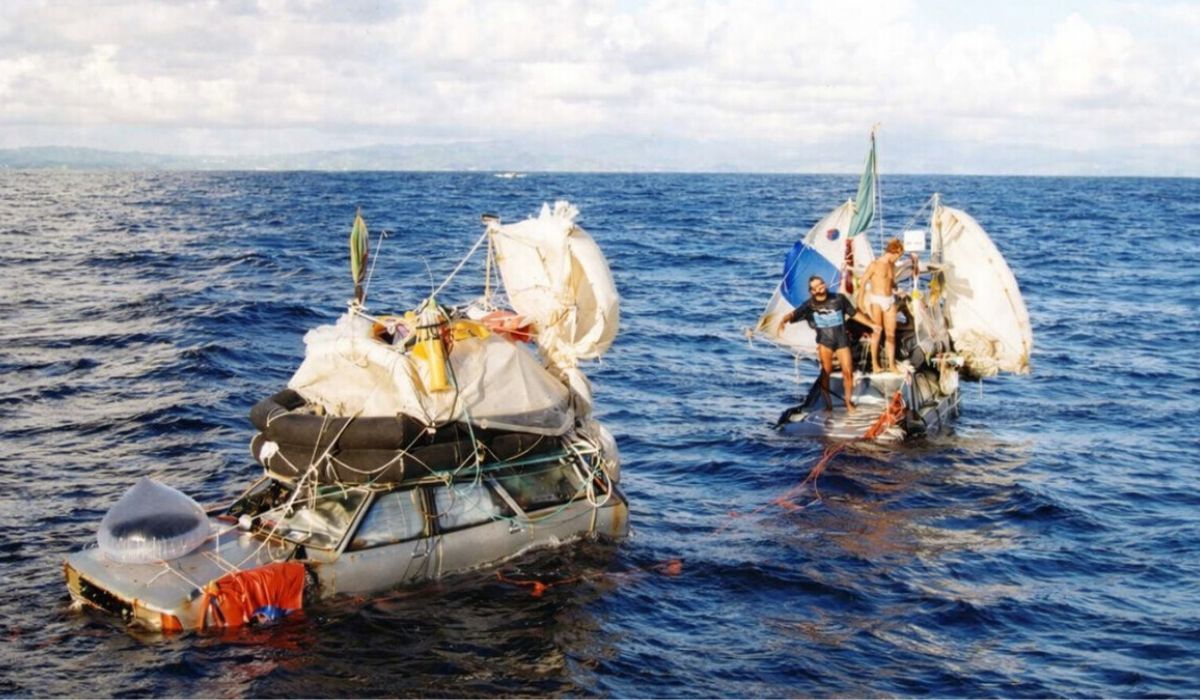
In 1999, four Italians adapted two cars to float and set sail from the Canaries to the Caribbean on an unauthorized crossing, marked by technical improvisation, family losses, and nearly four months of survival at sea.
In the early hours of May 4, 1999, on the Spanish island of La Palma, in the Canary Islands, four Italians launched two adapted cars into the sea and began a crossing toward the other side of the Atlantic. Aboard a Volkswagen Passat and a Ford Taunus, brothers Marco, Fabio, and Mauro Amoretti, accompanied by family friend Marcolino De Candia, set off with a clear goal: to complete the project envisioned by Giorgio Amoretti, father of the three brothers, who was no longer able to realize it.
Almost four months later, on August 31, 1999, the two vehicles reached the coast of Martinique in the Caribbean, after approximately 4,700 kilometers in open sea. The initial plan was to continue to Cuba and then to the United States, but the expedition was ended there due to physical and material limitations accumulated along the way.
The Origin of a Project Interrupted in the 1970s
The crossing had roots in an idea conceived more than two decades earlier. Since the 1970s, Giorgio Amoretti, a photojournalist and explorer, had nurtured the plan to cross the Atlantic in an adapted automobile. In 1978, he attempted to put it into practice with a modified Volkswagen Beetle, known as “Automare.”
-
While Brazil wants to end the 6×1 work shift, the president of Argentina wants 12 hours for his workers, increasing political tension in the country.

-
The village where two rivers run side by side without mixing in Santarém and Alter do Chão reveals some of the most beautiful freshwater beaches on the planet.
-
Mars is accelerating, and scientists have discovered that the planet’s day is getting shorter, revealing surprising signs of internal activity.

-
Artemis 2 is set to launch on April 1 at 7:24 PM to orbit the Moon with four astronauts, but a class X solar flare and coronal mass ejection could interfere with communications and threaten the launch.


At that time, the initiative was halted upon reaching the Canaries after Spanish authorities prevented the continuation due to safety concerns. The project was ultimately suspended and remained incomplete for years, without new attempts.
In 1999, with Giorgio in the terminal stages of cancer, the family assessed that there would be no other opportunity for him to resume the crossing. In this context, the children decided to continue the journey, taking on the execution of the plan that had been interrupted.
How the Cars Were Adapted to Float in the Ocean
To make the vehicles capable of floating, the group carried out a series of technical adaptations. The cars were fitted with large blocks of polystyrene, responsible for providing buoyancy in the water, as well as sealing in parts of the structure to reduce leaks.
Boat engines were also installed and were mainly used in the first days of navigation. The interior was adjusted to function as makeshift shelter, with limited space for water jugs, dehydrated food, and basic equipment.
On the roof, the travelers transported an inflatable raft, which allowed them to enter and exit the car in open waters, as well as makeshift structures to catch the trade winds when fuel ran out. Since their departure, the two vehicles remained <strong;tied together with ropes, as a way to prevent them from separating during the crossing.
The Departure Without Authorization and the First Days at Sea
The decision to depart without formal authorization appears in later accounts as a strategy to avoid blocking the expedition while still on land. In the initial days, movement was ensured by the motors installed in the vehicles.
With the fuel running out, progress became solely dependent on ocean currents and winds, which increased the unpredictability of navigation and reduced control over the route.
Health Problems and the Rescue of Two Crew Members
Soon after departure, the physical effects of the crossing began to manifest. Fabio and Mauro Amoretti began to experience dizziness and intense fatigue, which hindered the execution of basic daily tasks.
About ten days after the trip began, the two requested rescue and were airlifted in an evacuation operation, ending their participation in the expedition. From that moment on, Marco Amoretti and Marcolino De Candia continued alone in the Atlantic.
With the reduction in crew, the cars were tied together by a single rope. This change required immediate adjustments to their routine and increased the responsibility of keeping the vehicles operational and connected in open waters.
The Death of Giorgio and the Interruption of Contact with Land
As the crossing continued, Giorgio Amoretti passed away on May 28, 1999, in Italy. According to later reconstructions made by the family, the decision was made not to inform Marco at that time, for fear that the news would compromise his ability to continue navigating, as there were no safe conditions for return.

Shortly after, the satellite phone stopped working, cutting off contact with land for weeks. Without communication, there was no precise information about the location of the two travelers, which increased worry among family members and those who were following the project from a distance.
The Minimum Routine Inside the Cars at Sea
At sea, the routine became restricted to the essentials. Marco and Marcolino had to ration water and food, in addition to trying to fish whenever possible to supplement their meals.
The constant entry of moisture required regular care for the interior of the cars.
At the same time, maintaining the ties became a critical task, as on several occasions the ropes broke, forcing the two to enter the water to reestablish the connection between the vehicles.
During the crossing, part of the experience was recorded in diary notes, which were later used to reconstruct the journey. Over time, the group began to identify themselves as “Autonauts”, a designation adopted in materials and presentations that recounted the story in the following years.
The Arrival in the Caribbean and the Closure of the Expedition
After 119 days in the Atlantic, on August 31, 1999, the two cars reached the coast of Martinique still floating. Accounts from that time indicate that their arrival caught the attention of residents and onlookers, surprised by the presence of vehicles that had crossed the ocean starting from the Canaries.
From this point, the continuation of the plan to Cuba and the United States was discarded. The physical exhaustion accumulated and the limited resources led to the decision to end the expedition in the Caribbean, concluding the crossing there.
Only after disembarking did Marco learn about his father’s death, which occurred while he was still at sea. In the following years, the experience began to be documented in books, lectures, and audiovisual records organized by the participants themselves.

More recently, those involved mentioned attempts to adapt the story for audiovisual productions, such as documentaries, based on the materials collected over time.
More than two decades later, the episode continues to be cited as an unusual case of ocean crossing with unconventional means, articulating technical improvisation, limited planning, and a family motivation defined since departure.









Seja o primeiro a reagir!