





 Portuguese
  English
  Spanish
  5 min of reading
  0 comments


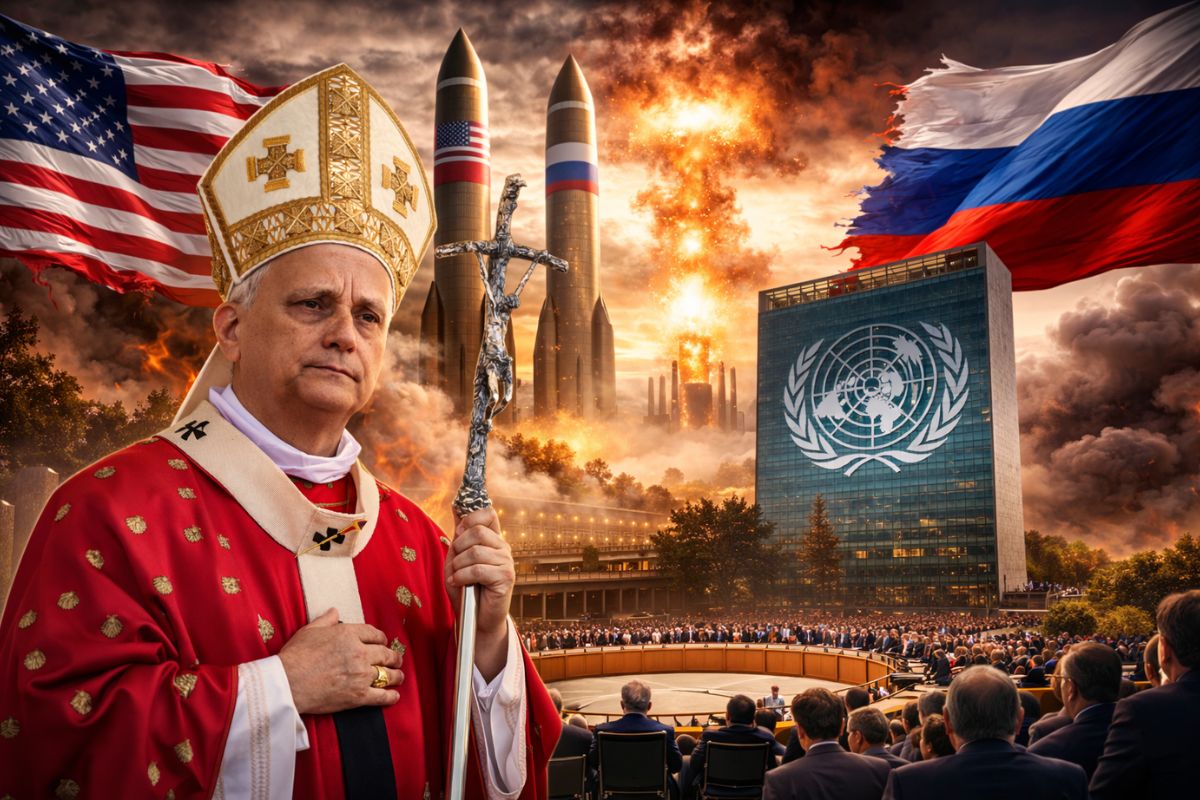
With the Expiration of the Nuclear Agreement Between the US and Russia, the New START Leaves Behind Formal Limits and the UN Warns of the Regulatory Vacuum. China Refuses to Expand Negotiations Due to Having a Smaller Arsenal. The Fear is an Arms Race Without Verification, With Immediate Political Costs in the Short Term.
The nuclear agreement between the US and Russia expired on February 5, 2026, ending a cycle of formal limits between the two powers and leaving diplomacy under pressure. The New START, signed in 2010, served as a central reference for strategic predictability and for controlling the public discourse on risks.
The reaction came from outside the military axis. The UN classified the scenario as serious for international peace and security, and Pope Leo XIV urged the US and Russia to resume understanding and avoid an arms race. The immediate effect is the uncertainty about who will lead the next design and where verification will return to exist.
What Was the New START and What Changes With Its End
The New START established limits for the strategic arsenals of the United States and Russia, with a ceiling of 1,550 strategic nuclear warheads.
-
Motorola launched the Signature with a gold seal from DxOMark, tying with the iPhone 17 Pro in camera performance, Snapdragon 8 Gen 5 that surpassed 3 million in benchmarks, and a zoom that impresses even at night.

-
Satellites reveal beneath the Sahara a giant river buried for thousands of kilometers: study shows that the largest hot desert on the planet was once traversed by a river system comparable to the largest on Earth.

-
Scientists have captured something never seen in space: newly born stars are creating gigantic rings of light a thousand times larger than the distance between the Earth and the Sun, and this changes everything we knew about stellar birth.

-
Geologists find traces of a continent that disappeared 155 million years ago after separating from Australia and reveal that it did not sink, but broke into fragments scattered across Southeast Asia.
In practice, this type of agreement creates predictability because it reduces space for rapid expansion and facilitates monitoring. Without this, the nuclear agreement between the US and Russia leaves a vacuum where numbers, deadlines, and transparency start to depend on unilateral decisions.
The most sensitive technical point is the loss of verification safeguards and a clear obligation regime.
Even before expiration, trust was already under tension, and now the absence of an active instrument increases uncertainty about military planning, political signaling, and escalation costs.
It is in this environment that the expression arms race returns to the center of the debate, as the logic of response and counter-response gains speed.
UN and the Political Weight of António Guterres in Risk Assessment
The UN framed the closure of the treaty as a negative milestone for international peace and security.
António Guterres pointed out that the end of the New START represents a serious moment, not because it automatically creates conflict, but because it removes an institutional limit that sustained stability between the two largest nuclear powers.
In the UN’s assessment, the relevant risk is not only the increase in warheads but the elevated risk of use and miscalculation in already tense scenarios.
The call to return to the negotiating table appears as an attempt to rebuild a control regime with verifiable rules, reducing the chance of an arms race due to lack of transparency and strategic prestige competition.
China at the Center of Discussions and the Dispute Over Who Joins the Next Agreement
With the New START closed, the United States indicated interest in discussing a format that includes China.
The logic presented is to expand the scope of arms control and reduce the asymmetry of commitments.
However, China did not accept this inclusion, citing the smaller size of its arsenal compared to the US and Russia.
This divergence is a political and technical knot at the same time. Politically, it involves who sets the agenda and under what conditions. Technically, it involves ceiling models, counting, and verification suited to arsenals of different scales.
Without a consensus on China’s participation, the nuclear agreement between the US and Russia tends to be replaced by partial arrangements, which increases the risk of an arms race due to a lack of a common standard.
The Request of Pope Leo XIV and the Space for Symbolic Mediation
Pope Leo XIV requested, on the eve of expiration, that the US and Russia renew understanding and do everything possible to avoid a new arms race.
In diplomatic terms, this type of intervention does not define clauses, but it can reinforce reputational costs of an escalation and support the pressure for dialogue.
The practical utility of this speech lies in reminding that the cost of the deadlock is not abstract.
When the nuclear agreement between the US and Russia disappears, the feeling grows that the planet is entering a more unstable phase, with power disputes becoming harder to moderate.
The central message is that strategic security depends on limits and verifications, not just on promises.
What to Observe Now in the Short Term
The first indicator is whether there will be an announcement of the official US posture, as Russia has signaled a willingness to act without the limits of the treaty.
The second is whether any technical verification channel will be maintained through alternative means, even if informally, to reduce noise.
In this transition, New START becomes a historical reference and also a parameter for comparison of what has been lost.
The third indicator is public language: when terms like arms race begin to be normalized in statements, this influences budgets, doctrines, and expectations.
The UN tends to insist on negotiation, and China will remain a decisive piece in any expanded architecture.
Without a new nuclear agreement between the US and Russia, stability becomes more dependent on self-restraint and consistent signals, precisely what has been more scarce.
The end of the New START shifts the arms control debate to a more opaque terrain, where political trust and verification mechanisms cease to be guarantees and become disputes.
With the UN reinforcing the alert, the security dynamics begins to depend more on public signals and less on stable rules.
If the nuclear agreement between the US and Russia were to cease to exist again in the future, what would be the first effect you would feel as the most dangerous, more military spending, less transparency or more risk of miscalculation? And what role should China play to prevent an uncontrolled arms race?







Seja o primeiro a reagir!