





 Portuguese
  English
  Spanish
  5 min of reading
  0 comments


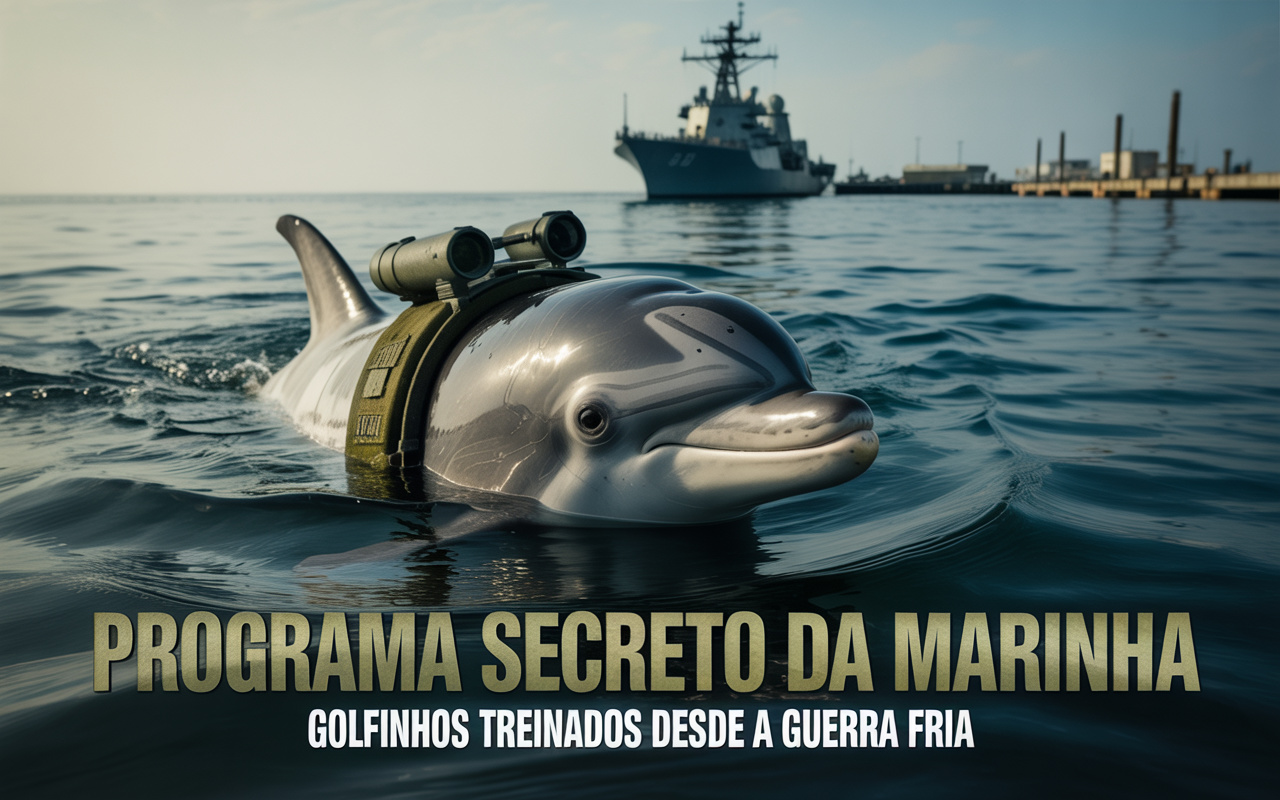
U.S. Navy Program Active Since the Cold War Trains Dolphins to Detect Mines, Divers, and Intruders; System Remains Operational to This Day.
Few people realize that one of the longest-lasting and most effective defense systems ever used by the United States does not involve radars, satellites, or artificial intelligence. It involves dolphins. Since the 1960s, during the height of the Cold War, the United States Navy has officially operated the U.S. Navy Marine Mammal Program (NMMP), a real, documented, and still active military program that utilizes trained marine mammals for surveillance, detection, and naval security tasks. The project was born in the context of a technological race with the Soviet Union and continues to operate today, adapted to new threats and strategic environments.
The U.S. Navy Marine Mammal Program and Its Origin in the Cold War
The NMMP was created in 1959 in San Diego, California, under the coordination of the U.S. Navy and with support from universities and oceanographic research centers. The initial goal was to study how dolphins and sea lions managed to swim with extreme efficiency, but the military quickly realized that these animals had sensory capabilities impossible to replicate with the technology of the time. In particular, the dolphins’ echolocation system, capable of identifying submerged objects with millimeter accuracy, even in murky water or noisy environments, drew attention.

During the 1960s and 1970s, with the advancement of submarine warfare and the growing risk of naval mines, the program evolved from being merely experimental to integrating actual defense strategies. Documents now made public show that the NMMP was classified for decades as a sensitive project, with information released only partially.
-
Friends have been building a small “town” for 30 years to grow old together, with compact houses, a common area, nature surrounding it, and a collective life project designed for friendship, coexistence, and simplicity.

-
This small town in Germany created its own currency 24 years ago, today it circulates millions per year, is accepted in over 300 stores, and the German government allowed all of this to happen under one condition.

-
Curitiba is shrinking and is expected to lose 97,000 residents by 2050, while inland cities in Paraná such as Sarandi, Araucária, and Toledo are experiencing accelerated growth that is changing the entire state’s map.

-
Tourists were poisoned on Everest in a million-dollar fraud scheme involving helicopters that diverted over $19 million and shocked international authorities.


How Dolphins Detect Mines and Underwater Threats
The scientific basis of the program lies in biology. Bottlenose dolphins (Tursiops truncatus) emit high-frequency clicks that bounce off submerged objects and return as detailed echoes. The animal’s brain transforms these echoes into extremely precise three-dimensional images. Studies conducted by the Navy itself and by affiliated universities show that dolphins can differentiate a naval mine from a rock or debris with success rates exceeding those of many artificial sonars.
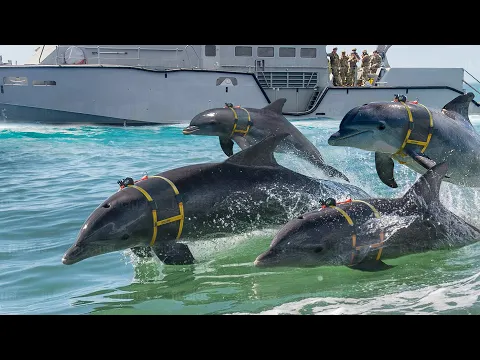
In military training, the animals are not taught to “attack” targets. They learn to locate mines, intruders, or suspicious objects and signal their discovery by returning to the surface or activating devices attached to their bodies, marking the exact point for human intervention. This reduces risks for divers and increases the speed of sweep operations.
Detection of Enemy Divers and Port Defense
In addition to mines, the NMMP has been adapted to detect combat divers and underwater intruders. In wartime scenarios or for protecting naval bases, dolphins patrol areas near strategic ports, identifying unusual movements underwater. Upon locating a diver, the animal returns to the trainer, indicating the exact position of the intruder.
This type of mission gained relevance after historical episodes of naval sabotage, especially during the Cold War, when submarine commandos were trained to infiltrate ports and damage enemy vessels. The U.S. Navy officially acknowledges that dolphins have been used in real security missions during conflicts and sensitive operations.
Where the Program Operates and How It Is Structured Today
Currently, the U.S. Navy Marine Mammal Program is based in San Diego, but its units can be deployed to different regions of the world as strategic needs arise. The program primarily utilizes bottlenose dolphins and California sea lions (Zalophus californianus), each with specific roles. While dolphins excel in echolocation, sea lions are used for recovering objects from the seabed and for visual surveillance in shallow waters.
According to official information released by the U.S. Navy, the program has dozens of trained animals and adheres to strict welfare standards, with permanent veterinary oversight. The exact cost of the NMMP is not fully detailed, but public reports indicate annual investments in the tens of millions of dollars, a figure considered low when compared to equivalent technological systems.
Real Operations and Confirmed Use in Modern Conflicts
Although many details remain classified, there are confirmations that the NMMP has been employed in real operations. One of the most well-known cases occurred during the Vietnam War when dolphins were used to protect allied ports from underwater sabotage. Decades later, during the Gulf War, program units were mobilized to detect naval mines in the Persian Gulf, speeding up the clearance of strategic maritime routes.

More recently, the U.S. Navy confirmed that the program continues to be used for base protection, area scanning in ports, and supporting military exercises. Even with advancements in underwater drones and autonomous sensors, the military admits that, under certain environmental conditions, marine mammals still outperform any available technology.
Controversies, Ethics, and Limits of Military Use of Animals
The use of animals in military activities has always sparked debate. Animal welfare organizations question the ethics of employing dolphins in potentially dangerous environments, while the Navy maintains that the animals are not exposed to direct combat and that their missions do not involve deliberate injury. Since the 1990s, the program has undergone greater public scrutiny, resulting in stricter rules for transparency and veterinary care.
Despite criticisms, the U.S. government maintains that the NMMP follows recognized scientific and ethical standards, and that the animals involved live longer and receive better care than many individuals in the wild.
Why an Old Program Remains Relevant in the 21st Century
In a world dominated by artificial intelligence, advanced sensors, and electronic warfare, the existence of a program based on dolphins may seem anachronistic. However, the U.S. Navy recognizes that the ocean still presents challenges that technology cannot fully resolve. Acoustic noise, unpredictable currents, and complex coastal environments reduce the efficiency of artificial sensors, while marine mammals operate naturally in these scenarios.
The NMMP is, therefore, a rare example of how biology and military defense intersect practically and continuously. A program started over six decades ago, conceived at the height of the Cold War, that has endured geopolitical changes, technological advances, and ethical debates — and still remains active as a silent yet strategic part of the naval security of the United States.










-

-

-

-

-

19 pessoas reagiram a isso.