





 Portuguese
  English
  Spanish
  4 min of reading
  0 comments


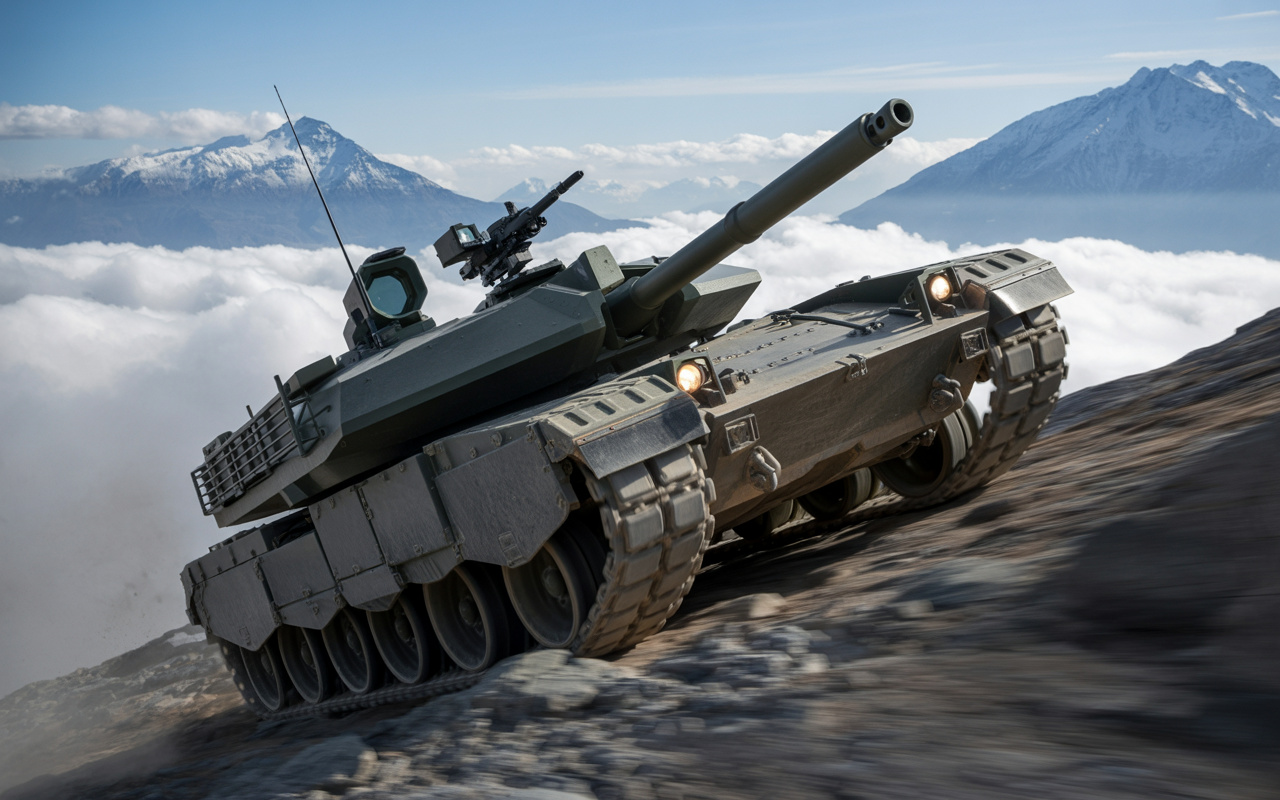
US Light Tank Tested Above 4,000 Meters With Turbo-Diesel Engine, Guided Missiles, and Reinforced Suspension for Extreme Altitude Military Operations.
The scene looks like something out of a modern military fiction exercise: a light armored vehicle climbs narrow roads in the high mountains, ascending to altitudes where the air is thin, the weather changes without warning, and the terrain collapses under heavy loads. But the setting is real, and the protagonist has a name and manufacturer: the Mobile Protected Firepower (MPF) or M10 Booker, the new light armored vehicle of the United States Army developed to fill a historical gap — direct firepower in mountainous, remote, and urban regions where heavy tanks simply cannot operate.
The platform is undergoing tests for a type of warfare that is often overlooked: high-altitude combat, a reality present in strategic scenarios like the Himalayas, Andes, Caucasus, and other mountain ranges. It is in this context that the MPF has been studied as an alternative for air assault missions, rapid operations, and fire support in restricted terrain, complementing the infantry brigades that today operate with little heavy mobility in extreme environments.
Why Is the M10 Booker Being Tested at Altitude?
The reason is simple: geopolitics is migrating upwards. Disputes involving mountainous borders have attracted analysts’ attention, and the United States, China, and India are among the countries investing in doctrines for combat above 3,000–4,000 meters of altitude.
-
With a cost per shot close to zero, the DragonFire laser could change naval warfare in 2027 and provide British ships with nearly unlimited defense against drones.

-
A British startup creates tires that generate electricity in electric vehicles when passing over potholes, speed bumps, and cracks.

-
Scientists have created robots made with living cells that have their own nervous system, swim on their own, explore the environment, and self-organize without any genetic engineering, and now they want to do the same with human cells.

-
Students create a solar-powered ambulance that operates without a plug, without fuel, and still keeps medical equipment running in remote areas.




The thin air in this type of environment reduces engine efficiency, alters ballistics, affects communications, and requires vehicles with specific suspension, cooling, and traction — something that heavy tanks like the M1 Abrams, weighing over 60 tons, cannot meet in all situations.
The M10 Booker has a key advantage: significantly lower weight, allowing for air transport, crossing fragile bridges, maneuvering on slopes, and simplified logistics.
Platform, Weaponry, and Propulsion
Although the final details are still being adjusted before full entry into service, the main characteristics include:
- Approximate Weight: ~38 tons (varies by configuration);
- Main Armament: 105 mm gun with stabilization;
- Secondary Armament: coaxial machine guns;
- Engine: high-power turbo-diesel with adjustments for high-altitude operation;
- Guided Missiles: compatibility for smart munitions and precise firing;
- Modular Armor: adjustable reinforcements according to the theater of operations;
- Reinforced Suspension: adaptation for uneven terrain and steep slopes;
- Air Transportable Capacity: integration with rapid mobility doctrine.
This composition allows the MPF to act as a kind of “light armored mobile artillery,” a middle ground between an infantry fighting vehicle and a main battle tank.
What Do the US Want With This?
The American doctrine points to three clear objectives:
- Provide Direct Fire Support to Infantry Brigades
Enables the destruction of bunkers, fortifications, and light armor. - Operate Where the Abrams Cannot
Mountains, historic urban centers, weak bridges, and remote areas. - Respond to Geopolitical Changes
Altitude disputes, like India vs. China in the Himalayas, have shown the relevance of this tactical dimension.
According to analysts from the Congressional Research Service, the MPF is a direct response to the so-called “mobility gap” that has existed for decades in the US Army.
Combat at Altitude: Much More Than Just Taking a Tank Up the Hill
The tests do not involve just “climbing mountains,” but assessing:
- Engine thermal performance in thin air
- Recoil and absorption capability on inclines
- Stability of aim at extreme angles
- Ballistic behavior with reduced air density
- Chassis response to vibrations and dynamic loads
- Communication and sensors in vertical geography
In recent exercises, light tanks and drones were tested together, simulating the use of target designation by UAVs on peaks, something previously underexplored by the US Army.
The MPF Is Not a “Mini Abrams” — and That Is Intentional
It is not designed to face heavy tanks head-on. Its function is to provide decisive support to infantry, and for that, it needs to be: faster to deploy, lighter, less demanding in logistics, and capable of crossing bridges that an Abrams would destroy.

This niche makes sense especially in a world where mobile and vertical combat (combining drones, sensors, and artillery) is gaining prominence.
Does This Change the Future of War?
If the tests are successful, it opens up space for a new category within the armed forces: light tanks specialized in difficult geography, something historically seen in conflicts such as:
• Second War in the Alps (Italy vs. Germany)
• Sino-Indian War in Ladakh (1962)
• Conflicts in the Caucasus
Now, however, with sensors, smart munitions, and air transportable vehicles, the concept gains an unprecedented dimension.








-

-

-

-

-

-

37 pessoas reagiram a isso.