





 Portuguese
  English
  Spanish
  4 min of reading
  0 comments


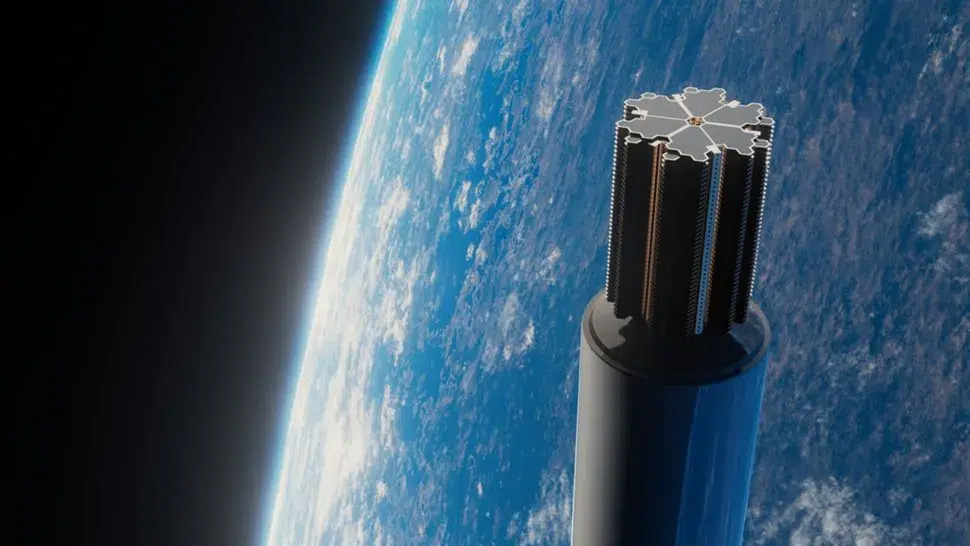
SpinLaunch Aims to Launch Microsatellites with a Rotating Cannon Instead of Rockets. The First Orbital Test Is Set to Occur Next Year
A company from California is about to challenge traditional methods of accessing space. With a giant centrifugal cannon, SpinLaunch plans to launch hundreds of satellites into low Earth orbit. The idea is simple yet bold: replace traditional rockets with a system that fires payloads like projectiles.
The plan is to put a batch of flat satellites into orbit as early as next year. If the launch goes as planned, the mission could set a new world record: the largest number of spacecraft launched at once. Currently, the record belongs to SpaceX, which launched 143 satellites in 2021.
Technology That Spins and Fires
SpinLaunch has developed equipment that resembles a massive cannon. But instead of gunpowder, the system uses rotating arms inside a vacuum-sealed chamber. The speed achieved is greater than that of a bullet. The rocket is then launched upward through a tube.
-
Motorola launched the Signature with a gold seal from DxOMark, tying with the iPhone 17 Pro in camera performance, Snapdragon 8 Gen 5 that surpassed 3 million in benchmarks, and a zoom that impresses even at night.

-
Satellites reveal beneath the Sahara a giant river buried for thousands of kilometers: study shows that the largest hot desert on the planet was once traversed by a river system comparable to the largest on Earth.

-
Scientists have captured something never seen in space: newly born stars are creating gigantic rings of light a thousand times larger than the distance between the Earth and the Sun, and this changes everything we knew about stellar birth.

-
Geologists find traces of a continent that disappeared 155 million years ago after separating from Australia and reveal that it did not sink, but broke into fragments scattered across Southeast Asia.

This method aims to reduce the costs of space launches. It also promises a more sustainable alternative. The launches do not use chemical fuel and do not generate greenhouse gases.
The company also wants to form its own constellation of satellites called Meridian Space. The idea is to compete with services like SpaceX’s Starlink by offering a cheaper alternative.
Financial Support and Production of the Satellites
On April 3, SpinLaunch announced that it received new funding. It was US$ 12 million from the Norwegian company Kongsberg Defence and Aerospace (KDA). With this, the total amount raised by SpinLaunch is nearing US$ 150 million.
With the announcement, it was revealed that NanoAvionics, a subsidiary of KDA, will be responsible for building the first 250 satellites of the Meridian constellation. The production will focus on lightweight, flat-shaped models.
Each satellite will be about 2.2 meters wide and weigh 70 kilograms. This makes them significantly smaller than the current models used by competing companies. Starlink’s V2 satellites, for example, weigh approximately 800 kilograms.
According to NanoAvionics, the satellites will be stacked in a “launch bus,” like a stack of pancakes. This compact configuration helps to reduce space and increase launch efficiency.
Previous Launches and Plans for 2026
SpinLaunch has already made 10 launches using its Suborbital Accelerator installed in New Mexico. The machine used in these tests is 33 meters wide and can spin objects at speeds up to 8,000 km/h.
The most recent launch occurred in September 2022. At that time, payloads were successfully launched suborbitally. During these tests, the acceleration process lasted up to 30 minutes. The payloads experienced forces of up to 10,000 Gs.
The company has not yet revealed all the details about the planned orbital test for 2026. However, it is likely that it will use the same machine from previous tests. The rocket will be launched to the upper atmosphere and then activate its own engines to reach low Earth orbit.
Advantages of the New Method
The main attraction of SpinLaunch’s system is cost. The company estimates that it can launch payloads into space for between US$ 1,250 and US$ 2,500 per kilogram. This is less than half the price charged by SpaceX’s Falcon 9 rockets, which cost about US$ 6,000 per kilogram.
In addition to price, sustainability is another strong point. The method does not release polluting gases during launch. It also avoids the disposal of boosters in space, reducing the risk of generating orbital debris.
Another benefit is agility. If everything goes as expected, the company may be able to conduct up to five commercial launches per day in the future. To achieve this, it plans to build a new Orbital Accelerator, with a chamber 100 meters in diameter.
Potential Impacts in Space
Despite the advantages, SpinLaunch’s plan raises concerns. A significant increase in the number of launches could exacerbate existing problems in low Earth orbit.
Experts warn of collision risks between satellites, increased light pollution, and interference with radio signals. These effects are already being observed with current constellations. A larger number of satellites could make these impacts even more intense.
Another issue would be the re-entry of these devices into the atmosphere. When this occurs, metals are released, which also contributes to atmospheric pollution.
The Meridian constellation is expected to have a maximum of 1,200 satellites. However, even so, SpinLaunch could have an impact if the launch pace accelerates in the future.
The demonstration focused on low Earth orbit planned for 2026 will be a decisive step. The success of the launch could mark a new era in accessing space — cheaper, cleaner, but also more challenging.
With information from Live Science.







Seja o primeiro a reagir!