





 Portuguese
  English
  Spanish
  3 min of reading
  0 comments


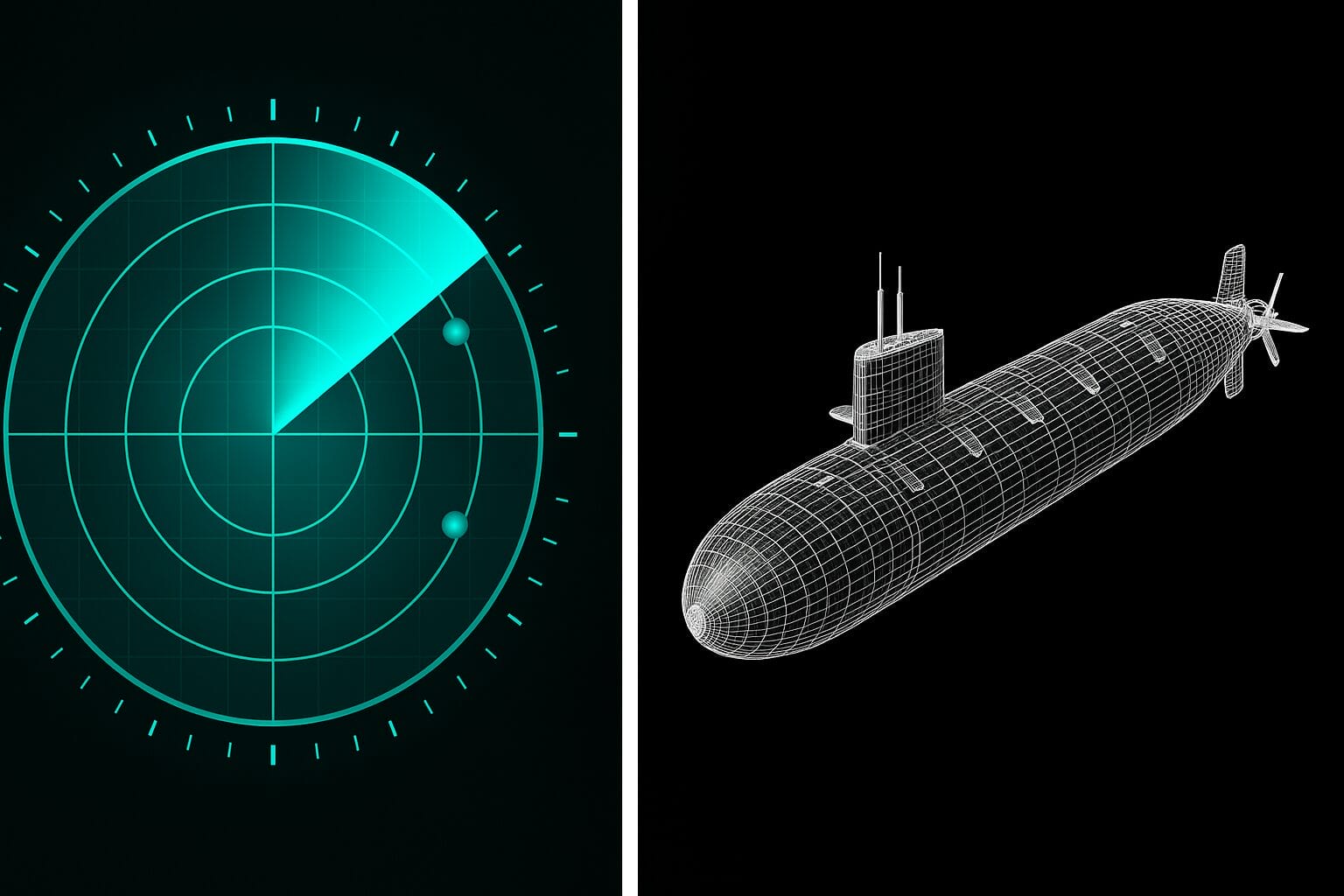
Partnership Between General Atomics and Ultra Maritime Creates Technology Capable of Tracking Enemy Submarines Without GPS, Reinforcing U.S. Superiority in Maritime Warfare.
The United States will soon dominate a new front in maritime warfare: tracking submarines in areas without GPS.
The promise comes from the union of two American companies seeking to change the game in underwater combat.
Partnership Between Giants of the Military Sector
General Atomics Aeronautical Systems and Ultra Maritime announced a strategic partnership to combine exclusive technologies.
-
What if the Sun disappeared suddenly? Simulation shows Earth in darkness within minutes, extreme cold, and rapid collapse of life on the planet.

-
A 2,400-year-old iron foundry has been discovered in Senegal with 100 tons of slag, 35 furnace bases, and signs of nearly eight centuries of continuous metallurgical activity.

-
Four humans are flying towards the Moon inside the Orion capsule launched by the SLS rocket, and on April 6, Artemis II will disappear behind the far side of the Moon without communication with Earth for nearly an hour.

-
Worlds covered by water, atmospheres filled with hydrogen, and the possibility of life beyond Earth: ocean planets are rewriting the map of cosmic search and forcing scientists to rethink where to look.


The idea is to integrate the unmanned aerial system MQ-9B SeaGuardian with sonobuoys and miniaturized, low-power receivers manufactured by Ultra Maritime.
With this, the U.S. and its allies will be able to track enemy submarines even in hostile environments where GPS does not work.
According to the companies, this technology offers an affordable and effective solution for anti-submarine warfare, an increasing challenge in the current military landscape.
Advantage in a Sea of Growing Threats
With the rise of stealth submarines and unmanned underwater vehicles, underwater threats have become more complex.
Additionally, GPS signal jamming has advanced, creating a more challenging environment for traditional military operations.
In light of this, unmanned technologies are gaining prominence.
The MQ-9B SeaGuardian system, already recognized for its intelligence, surveillance, reconnaissance, and targeting functions (ISR&T), gains even more strength with the addition of the new sonobuoys from Ultra Maritime.
These sonobuoys are half the size of traditional ones and offer active multi-static capabilities (MSA), allowing searches across wide areas.
Combined with the SeaGuardian, they double the aircraft’s capacity in low-cost autonomous missions.
Technology Ready for Testing in the Indo-Pacific
The acoustic receivers from Ultra Maritime, also in a reduced format, will enable the MQ-9B to monitor more sonobuoys per mission. This will be possible thanks to the advanced communication technology developed internally by the companies.
According to a joint statement, this solution is already fully funded with the companies’ own research and development resources.
An integrated operational demonstration will take place starting in 2025, in theaters of operation in the Indo-Pacific and other strategic regions.
Sonobuoys with Over 60 Years of Tradition
Sonobuoys are small disposable sonar buoys used to detect sounds generated by submarines or ships. They function as acoustic sensors and can be launched from aircraft or vessels.
Ultra Maritime has more than six decades of experience in this field and claims to be the only qualified manufacturer of next-generation sonobuoys. The company operates in the United States, United Kingdom, and Canada, with total production exceeding 11 million units.
In a statement, Ultra Maritime stated that it is the only global supplier with a complete line of type A (normal size) and G (half size) sonobuoys, in addition to the receivers.
The company also highlighted its largest investment in history to modernize its production line and meet the growing demand in the sector.
With this structure, the expectation is that the new integrated solution can provide a significant advantage in anti-submarine warfare in the coming years.










Seja o primeiro a reagir!