





 Portuguese
  English
  Spanish
  8 min of reading
  1 comment


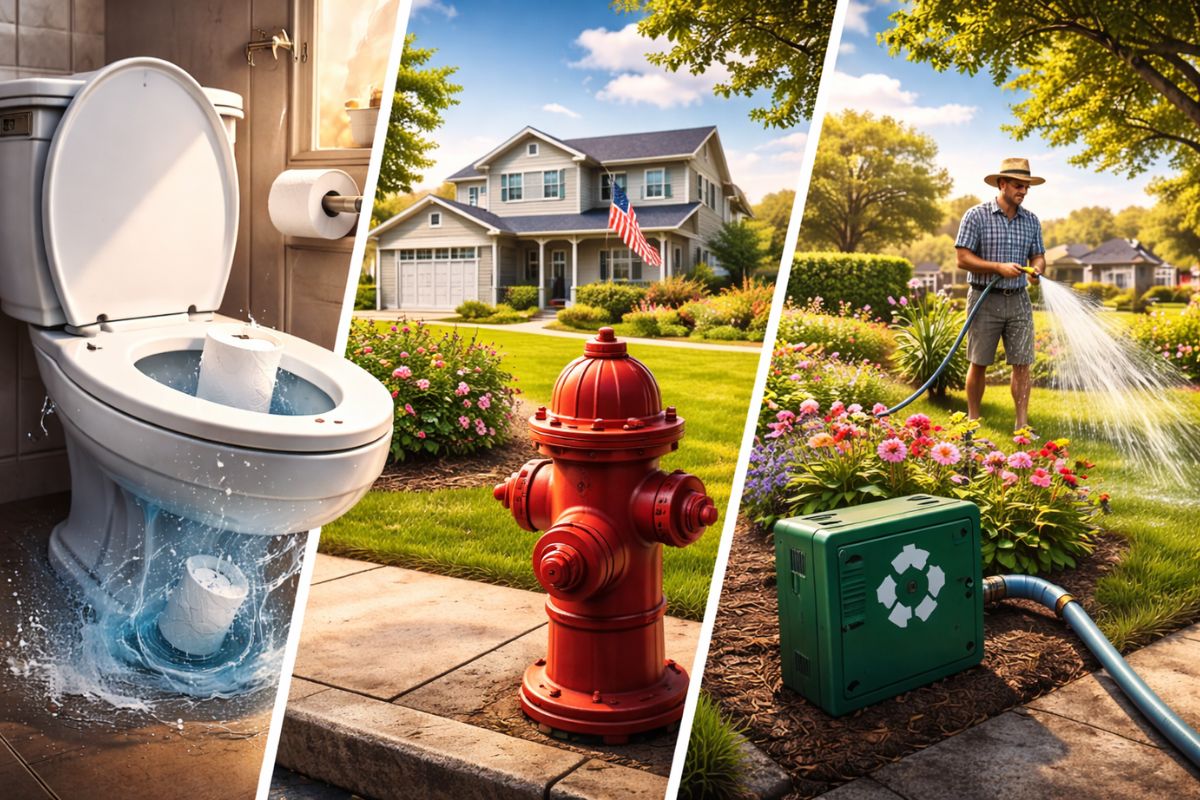


In Homes in the USA, Water Comes Directly from the Street, Without Water Tanks on the Roof, Flushing Toilet Paper Down the Toilet is Standard, Fire Hydrants Appear on Almost Every Corner, and Recycled Water and Sewage are Part of Daily Life for These Families.
In homes in the USA, water comes directly from the street, with no water tanks on the roof, toilet paper goes directly down the toilet without a wastebasket in the bathroom, fire hydrants appear on almost every corner, and there is even a secondary network solely for irrigating gardens with recycled water. For those who grew up in Brazil, this seems like a movie story, but it is part of the daily routine for millions of people.
More than just travel curiosities, these differences show how the way of building and living in homes in the USA depends on a much more stable water and sewage system, designed from the start to combat fires, avoid shortages, and make the best use of every liter of water. Comparing this model with the Brazilian one helps to understand why daily life inside a home varies so much from country to country.
Why Homes in the USA Do Not Have Water Tanks

The question that often arises is simple. If in Brazil a house without a water tank is synonymous with problems, how do homes in the USA manage to live comfortably without that individual reservoir on top?
-
Friends have been building a small “town” for 30 years to grow old together, with compact houses, a common area, nature surrounding it, and a collective life project designed for friendship, coexistence, and simplicity.

-
This small town in Germany created its own currency 24 years ago, today it circulates millions per year, is accepted in over 300 stores, and the German government allowed all of this to happen under one condition.

-
Curitiba is shrinking and is expected to lose 97,000 residents by 2050, while inland cities in Paraná such as Sarandi, Araucária, and Toledo are experiencing accelerated growth that is changing the entire state’s map.

-
Tourists were poisoned on Everest in a million-dollar fraud scheme involving helicopters that diverted over $19 million and shocked international authorities.


The basis of the answer lies in the reliability of the public system and the construction standard. The water supply in American cities is planned to be constant, with stable pressure and few interruptions.
Because of this, homes in the USA do not need to store backup water at the top of the structure, as is the case in most Brazilian homes.
There is also a structural difference. A large part of homes in the USA is built with wood frame, featuring lightweight wooden structures. A water tank of one thousand liters concentrates about one ton in a small space.
Safely supporting this weight requires slabs, pillars, and robust beams, something typical of concrete houses in Brazil, but uncommon in more traditional American residences.
In practice, the country chose another path. Instead of each resident setting up their small water security system, the cities take care of the supply and pressure for everyone at the same time.
The urban system ensures what a water tank guarantees in Brazil, which completely changes the way homes in the USA are designed.
The Power of Water Towers, the “Giant Water Tank” of the City
If each house does not have its own reservoir, someone else needs to fill that role. This function primarily falls to the water towers that mark the horizon in many American cities. In various places, they even become tourist attractions, with logos, slogans, and colors that represent the municipality.
In addition to being photogenic, these water towers are the true “giant water tanks” that serve entire blocks of homes in the USA. The height is not just aesthetic. They typically range from ten to twenty meters precisely to ensure gravity-fed pressure.
The column of water inside the tower pushes the liquid through the pipes, maintaining the minimum required pressure in the network, even if something fluctuates at the source of the system.
While the water is up there, the network continues supplying the homes. If there is some temporary failure at the treatment station or the intake, the volume stored in the tower holds the supply for a while.
Instead of each house relying on its own reservoir, the entire neighborhood leans on this central reservoir, which does the pressure and storage that the water tank does in a Brazilian home.
Fire Hydrants on Every Corner and a City Designed to Fight Fires
Another detail that stands out in residential areas is the number of fire hydrants on the sidewalks. On a quick walk, it’s common to pass several. This is not an exaggeration; it’s a priority.
The history of the water distribution system in the United States began very much linked to the need to fight fires in neighborhoods filled with wooden houses.
Instead of relying on carts fetching water from the river, cities began bringing piped water close to homes and creating fixed points for firefighters to draw from.
Today, the fire hydrants are part of the same network that supplies homes in the USA. The fire truck arrives, connects the hose there, and uses water from the municipal network itself. That’s why the area around the hydrant is usually well marked and cannot be used as a parking space.
If a car blocks this access and a fire occurs, the priority is clear. In extreme cases, the vehicle’s window can be broken to pass the hose.
Even minor details, like blue reflectors on the pavement, help. They indicate to firefighters where there is a nearby hydrant, even at night or during heavy rain. All of this reveals that the infrastructure serving homes in the USA was born with fire-fighting at the center of the urban project.
Why Toilet Paper Goes in the Toilet and Not in the Trash


In many Brazilian homes, having a trash can in the bathroom is still the norm. However, in homes in the USA, the rule is to throw toilet paper directly into the toilet. This doesn’t happen only out of habit, but because of how the sewage system has been designed in many planned neighborhoods.
In several of these areas, sewage does not rely solely on gravity flowing through sloped pipes. It is pushed under pressure by pumps installed at strategic points, making its way to the treatment station.
To withstand this type of flow, the sewage pipes are thicker and more durable than those seen in many Brazilian networks.
With reinforced piping, continuous flow, and design intended for long stretches, the system can handle toilet paper without major difficulties.
In this context, throwing toilet paper in the toilet becomes standard practice in many homes in the USA, rather than accumulating waste in small trash bins inside the bathroom.
Not All Homes in the USA Have Sewage Systems, the Role of the Septic Tank
Despite the image of a perfect and fully integrated network, a significant portion of homes in the USA still uses septic tanks.
This is more common in areas away from urban centers or in regions where the expansion of the network hasn’t been financially justified.
The logic, however, typically follows a more controlled pattern. The sewage first reaches a septic tank, where solid waste accumulates at the bottom and forms thick sludge.
The partially treated liquid is distributed over a drain field in the home’s own yard, known as a drainfield, where it infiltrates slowly into the soil.
After some time, the tank needs to be emptied by a specialized truck that removes the accumulated solid waste.
Instead of simply dumping waste into an improvised hole, these homes in the USA operate a closed and planned system, which treats and returns the water to the soil in a more controlled manner.
Intense Cold, Pipes Freezing, and the “Winterization” of the House
In cold regions, another factor comes into play in the routine of homes in the USA. Water inside the pipes can freeze, expand, and burst the plumbing. When the ice melts, the result is leaks and a lot of headaches.
A simple way to reduce this risk is to leave the faucet slightly open during the coldest moments to keep the water flowing.
In vacation homes or properties that remain empty during the winter, there is even a specific concept for this preparation, called winterization.
In this process, the resident shuts the main valve, opens all the faucets, and lets all the water out of the internal network, avoiding any frozen sections from causing bursts.
This type of care illustrates how climate factors into the functioning of water in homes in the USA, from plumbing design to the day-to-day life of those living there.
Recycled Water Just for Watering the Garden
In states like Florida, the difference becomes even more evident. In many neighborhoods, homes in the USA receive two different water networks.
One of them is potable water, treated for drinking, cooking, and bathing. The other is recycled water, used exclusively for irrigating gardens and green areas.
Potable water is linked to the sewage system and undergoes complete treatment. Recycled water, often referred to as reclaimed water, is clean water but not safe for human consumption.
It does not receive the same level of treatment, is not chlorinated for drinking, and travels through a separate network to irrigation systems.
The household receives two meters. One records the consumption of potable water, generating charges for water and sewage.
The other solely accounts for the recycled water used for watering grass and plants, which usually does not include sewage charges. This allows gardens in homes in the USA to stay green and well-maintained, saving on sophisticated treatment for every liter applied to the lawn.
Signs indicating that non-potable water is flowing there reinforce the message. The water looks clean, but it was not made for drinking; it was made to keep the landscaping without wasting resources from the main system.
What Homes in the USA Reveal About the American Lifestyle
All these differences, from the absence of water tanks to the presence of recycled water for gardens, tell a larger story.
They show that homes in the USA are a direct result of an urban model that concentrates effort on the public network, with water towers, fire hydrants, pressurized piping, and drainage systems designed on a city scale.
In Brazil, the more common solution has been to reinforce each house individually with water tanks, adaptations for sewage, and unique ways of dealing with service failures.
In the United States, the logic has been to strengthen the collective system so that each residence can rely on a more uniform infrastructure.
In the end, homes in the USA and homes in Brazil are not just different architectural styles; they reveal distinct views on how to manage water, sewage, climate, and safety.
The routine of turning on the faucet, flushing the toilet, and activating the garden irrigation system depends much more on the city than just the plot of the house.
And you, if you could choose, would you prefer to live in the model of homes in the USA, without an individual water tank and with two different water networks, or do you still feel safer with the old tank on the roof taking care of your supply there in Brazil?









Com certeza morar nos EUA e outra qualidade de vida quem sabe um dia