





 Portuguese
  English
  Spanish
  4 min of reading
  0 comments


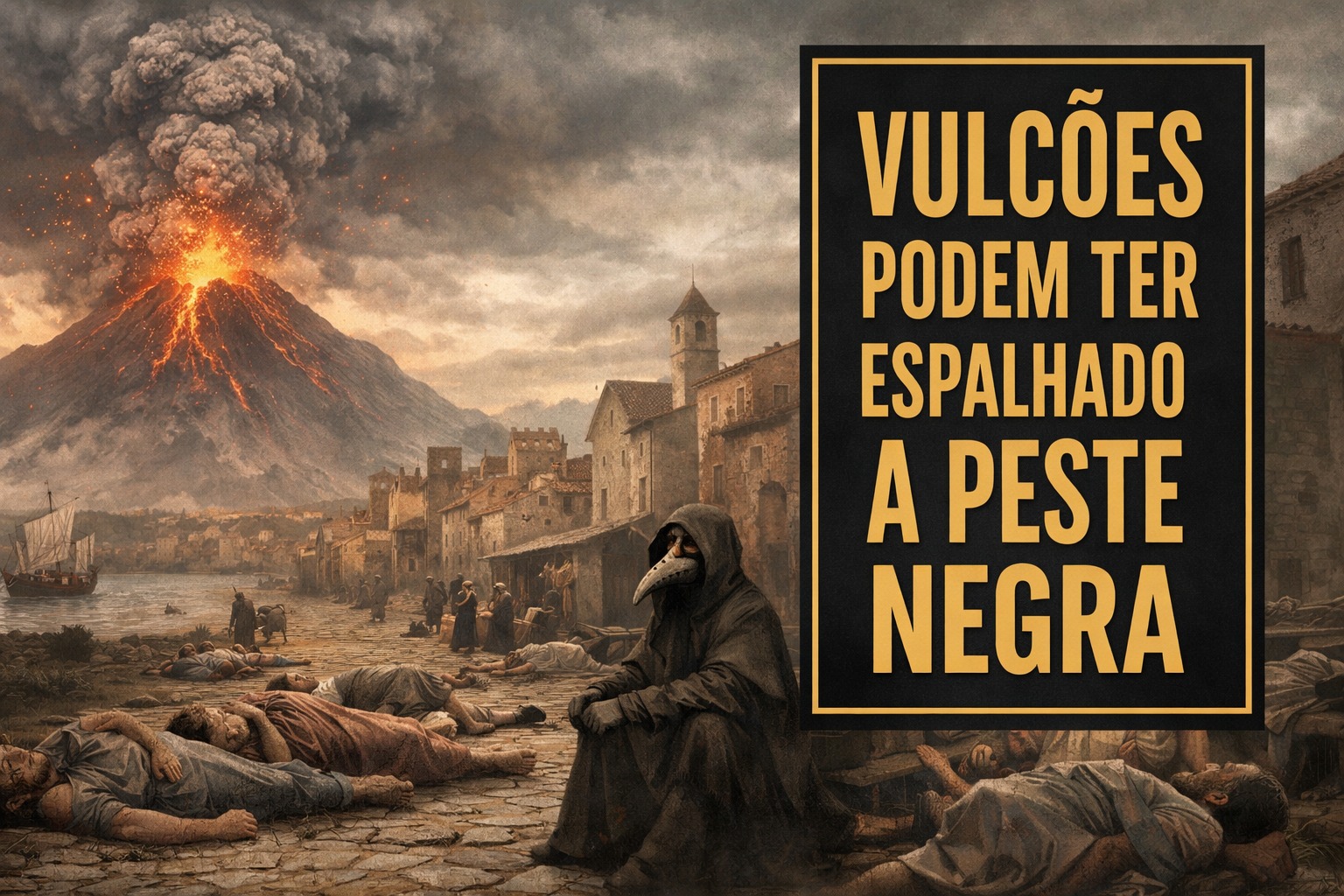
Research Suggests That Volcanic Eruptions in the Fourteenth Century Cooled the Climate, Pressured Food Systems, and Stimulated Grain Trade Routes That Helped Introduce the Black Death to the European Mediterranean
In 1347 A.D., the Black Death reached southern Europe and spread rapidly through the Italian peninsula, killing half the population in some areas and turning entire cities into scenes of enduring collective terror.
Eyewitness accounts describe entire families succumbing within days, mass graves hastily opened, and a social collapse that profoundly marked the memory of medieval Europe.
The devastating impact of the plague led scientists to extensively study the Yersinia pestis bacteria, as well as the rats and fleas involved in the transmission of the disease.
-
Motorola launched the Signature with a gold seal from DxOMark, tying with the iPhone 17 Pro in camera performance, Snapdragon 8 Gen 5 that surpassed 3 million in benchmarks, and a zoom that impresses even at night.

-
Satellites reveal beneath the Sahara a giant river buried for thousands of kilometers: study shows that the largest hot desert on the planet was once traversed by a river system comparable to the largest on Earth.

-
Scientists have captured something never seen in space: newly born stars are creating gigantic rings of light a thousand times larger than the distance between the Earth and the Sun, and this changes everything we knew about stellar birth.

-
Geologists find traces of a continent that disappeared 155 million years ago after separating from Australia and reveal that it did not sink, but broke into fragments scattered across Southeast Asia.

However, a new scientific analysis expands this picture by pointing to volcanic activity as a possible additional element in the chain of events that led to the pandemic.
The Late Arrival of the Plague in the Mediterranean
It is still unclear why the disease, which emerged in the early 1300s, only reached the Mediterranean in 1347, after devastating regions of Central Asia.
A study published in the journal Communications Earth & Environment links the advance of the plague to climate cooling caused by volcanic eruptions.
This cooling is thought to have caused food shortages and encouraged grain imports, creating trade routes that may also have transported the plague.
According to historian Hannah Barker, several factors had to coincide for the pandemic to consolidate in medieval Europe.
She states that climate changes, interactions between animals, and human decisions formed an unlikely but decisive combination for the spread of the disease.
Climatic Evidence in Tree Rings
Geographer Ulf Büntgen found new clues by analyzing a climate archive based on European tree rings.
These records allow for the reconstruction of temperature and precipitation over the last 2,000 years with extremely precise dating, according to the researcher himself.
Between 1345 and 1357, Mediterranean temperatures were slightly below average, a subtle but persistent cooling during the analyzed period.
Büntgen suspected that volcanic eruptions were behind the phenomenon and sought confirmation in records preserved in ice cores.
Signs of Eruptions at the Poles
Ice cores from Greenland and Antarctica revealed elevated sulfur levels in layers dated around 1345.
Sulfur is released by volcanic eruptions, and its aerosols reflect sunlight, contributing to global climate cooling.
The data suggest one or more eruptions, possibly in the tropics, occurred shortly before the arrival of the plague in the Mediterranean.
These findings reinforced the hypothesis that natural factors indirectly influenced the dynamics of the European pandemic.
Historical Records and Celestial Phenomena
To deepen social connections, Büntgen teamed up with medieval historian Martin Bauch.
Bauch identified historical accounts of lunar eclipses observed in China and Bohemia on dates inconsistent with known astronomical calculations.
The presence of volcanic particles in the atmosphere may have altered the appearance of the Moon, generating records deemed strange at the time.
These accounts reinforce the idea of a broad atmospheric disturbance, perceptible in different regions of the northern hemisphere.
Grain Trade and Human Decisions
The prolonged cold period affected Mediterranean harvests, heavily pressuring Italian city-states to prioritize food security, according to Bauch.
After previous famines, these cities had structured long-distance trade networks to import wheat from North Africa and the Black Sea.
Administrative records indicate a spike in grain prices between 1346 and 1347, accompanied by increasing political and social anxiety.
Even powers like Venice and Genoa began importing maximum volumes of wheat, seeking to avoid internal food collapse.
Trade Reopening and Dissemination of the Plague
Before this, a trade war with the Mongols had interrupted Black Sea routes, limiting European access to grain.
With Mongols dying from the plague and the Italian desperation for wheat, both sides reduced hostilities and reopened trade.
Ships laden with grain also transported rats, mice, and fleas carrying pathogens, facilitating the entry of the disease.
The fleas could survive in the grain dust and the blood of rodents, making the shipments an important transmission vector.
Regional Consequences and Final Expansion
The maritime cities avoided immediate famine but introduced a devastating health risk in their own territories, Bauch states.
Part of the imported grain was redistributed to cities like Padua and Trento, possibly triggering local outbreaks of plague.
By the end of 1348, much of Italy and areas of the Mediterranean had already been severely affected by the Black Death.
Scientific and Historical Lessons
In 2021, Barker had already linked grain trade to the plague, but the connection to volcanoes was unknown until now.
For Timothy Newfield, the collaboration between historians and paleoscientists raises the standard of this research.
Historian Kyle Harper assesses that studying these connections helps better understand diseases and climate.
Although today the mortality from Yersinia pestis is low, the past offers essential case studies on complex health risks.
According to Harper, impressive outbreaks require rare coincidences. The Black Death, he claims, was extremely unlikely, but it happened.
With information from Adventuras na História.







Seja o primeiro a reagir!