





 Portuguese
  English
  Spanish
  3 min of reading
  2 comments


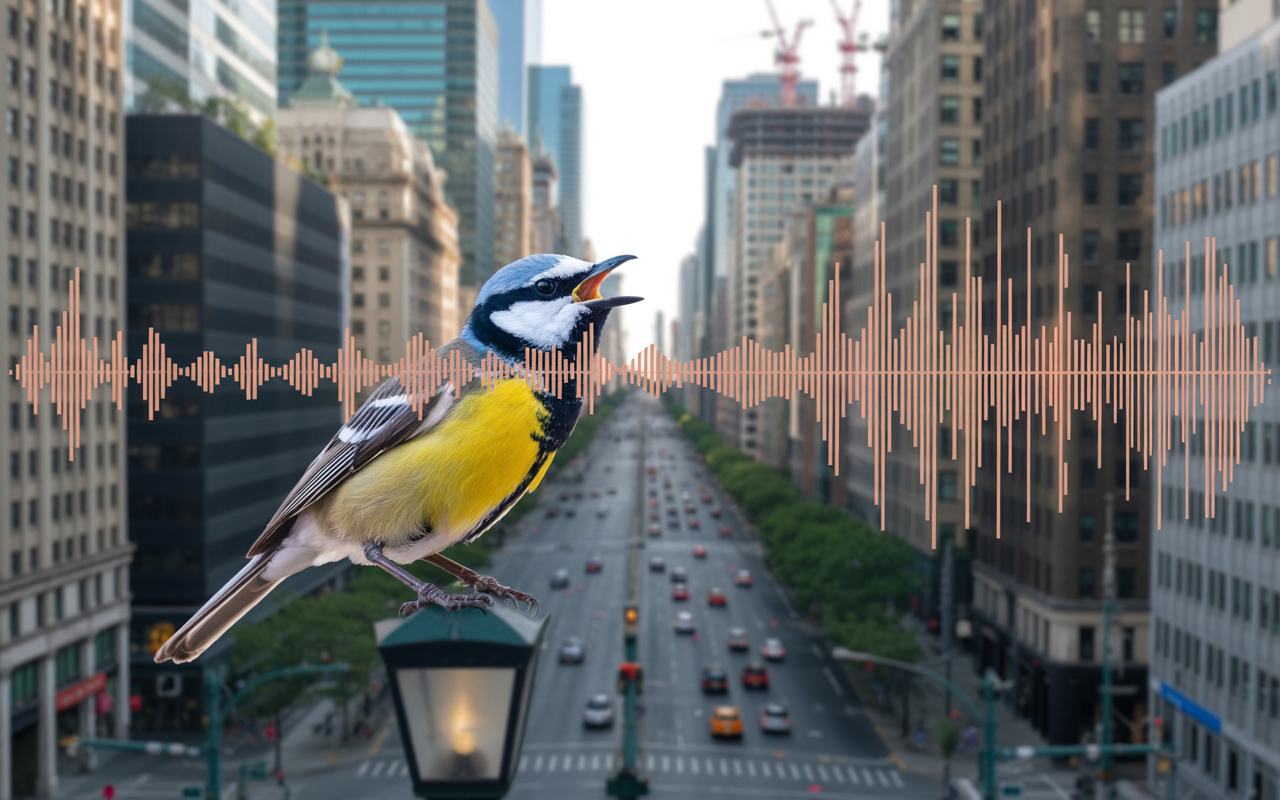


Traffic, Machines, and Sirens Are Altering Natural Communication Patterns. Scientists Observe Rapid Changes That Help Understand the Hidden Effects of Cities on Wildlife.
The growth of cities has brought a type of pollution that leaves no visible residues but profoundly alters the natural environment: constant noise. Engines, construction work, sirens, and traffic create a permanent sound backdrop that directly interferes with how animals communicate. Among the most affected are birds. In response, urban birds have started to sing louder, change pitch, and even alter the timing of their vocalizations, turning cities into a large natural experiment on behavioral adaptation.
The City Sound as Evolutionary Pressure
In natural environments, birds’ songs serve to attract mates, defend territory, and maintain social cohesion. In cities, however, these messages compete with low frequencies dominated by traffic. Studies show that many urban birds have shifted their songs to higher frequencies, less masked by human noise.
Others have increased their volume, an effect known as the Lombard effect, also common in humans speaking in noisy places.
-
With a cost per shot close to zero, the DragonFire laser could change naval warfare in 2027 and provide British ships with nearly unlimited defense against drones.

-
A British startup creates tires that generate electricity in electric vehicles when passing over potholes, speed bumps, and cracks.

-
Scientists have created robots made with living cells that have their own nervous system, swim on their own, explore the environment, and self-organize without any genetic engineering, and now they want to do the same with human cells.

-
Students create a solar-powered ambulance that operates without a plug, without fuel, and still keeps medical equipment running in remote areas.


This change is not random. It reflects a continuous environmental pressure that selects individuals capable of being heard. In some species, males that cannot adapt their song simply fail to mate, turning urban noise into a biological filter.
Unprecedented Frequencies and Rewritten Songs
Research comparing urban and rural populations of the same species has revealed consistent differences. In cities, birds sing with shorter notes, repeated more frequently, and in higher pitches. In quieter areas, songs tend to be longer and deeper. These differences appear even among populations separated by just a few kilometers, suggesting a rapid adaptation to the urban environment.
In some cases, scientists have observed regional variations within the same city. Noisier neighborhoods produce even higher-pitched songs than relatively quiet urban parks, demonstrating how the sound landscape shapes behavior on a very fine scale.
Timing Change: Singing Before Dawn
In addition to changing pitch, many urban birds have begun to anticipate their singing into the early morning, when traffic is lower. This phenomenon, known as “early dawn singing,” allows sound messages to propagate with less interference.
This alteration of routine has costs. Singing earlier requires additional energy expenditure and may expose birds to nocturnal predators. Still, the benefit of being heard outweighs the risks, reinforcing how human noise reorganizes biological priorities.
Affected Communication, Mating at Risk
The impact of noise is not limited to volume. Changes in song can affect communication quality. Females of some species prefer specific songs associated with the male’s health and vigor. When the song is altered to compete with urban noise, this information may be lost.
This creates a paradoxical scenario: birds that adapt to noise survive better in the cities but may face new reproductive challenges. For scientists, this conflict is an important clue about how artificial environments can generate rapid but not always perfect adaptations.
Cities as Sound Laboratories
Researchers use automatic recorders spread across neighborhoods, parks, and industrial areas to map urban soundscapes. By cross-referencing this data with recordings of birds’ songs, it is possible to observe how each species responds to different noise levels.
- These studies help answer bigger questions:
- How does noise pollution influence urban biodiversity?
- Which species are able to adapt?
- And which ones end up disappearing silently?
The answers have direct implications for urban planning, indicating that reducing noise is not just a matter of human comfort, but also of conserving wildlife.
What Birds’ Songs Say About the Urban Future
The transformation of birds’ songs is a clear sign that urbanization does not only alter visual landscapes but also acoustic landscapes. By changing the way animals communicate, human noise redefines social relationships, reproduction, and survival.
When we hear a bird singing louder or in a higher pitch in the middle of the city, we are witnessing something larger than a simple behavioral adjustment. We are hearing evolution in action, shaped by the sound of the streets.









Vivendo e Aprendendo com a Natureza 👏🏾👏🏾👏🏾👏🏾☘️🍀🍀🍀🌼🌹🌷🍄🪻🌿🪺🏜️🏞️🌥️⛈️🌩️⚡🌪️🌏🌛🌜🌝🌟⭐🙉🙈🦁🐯🐼🐨🐻🦊🐰🐶🦓🐗🐷🐮🐊🐢🦖🦮🐕🦺🦏🐒🐅🐆🦫🐔🐓🐦⬛🐦🐧🦃🦚🦆
Reportagem mto interessante, mto instrutiva. Não só as aves , os ratos tbem se adaptam a ambientes hostis e estão sendo estudados nos EUA. Parabéns!