





 Portuguese
  English
  Spanish
  5 min of reading


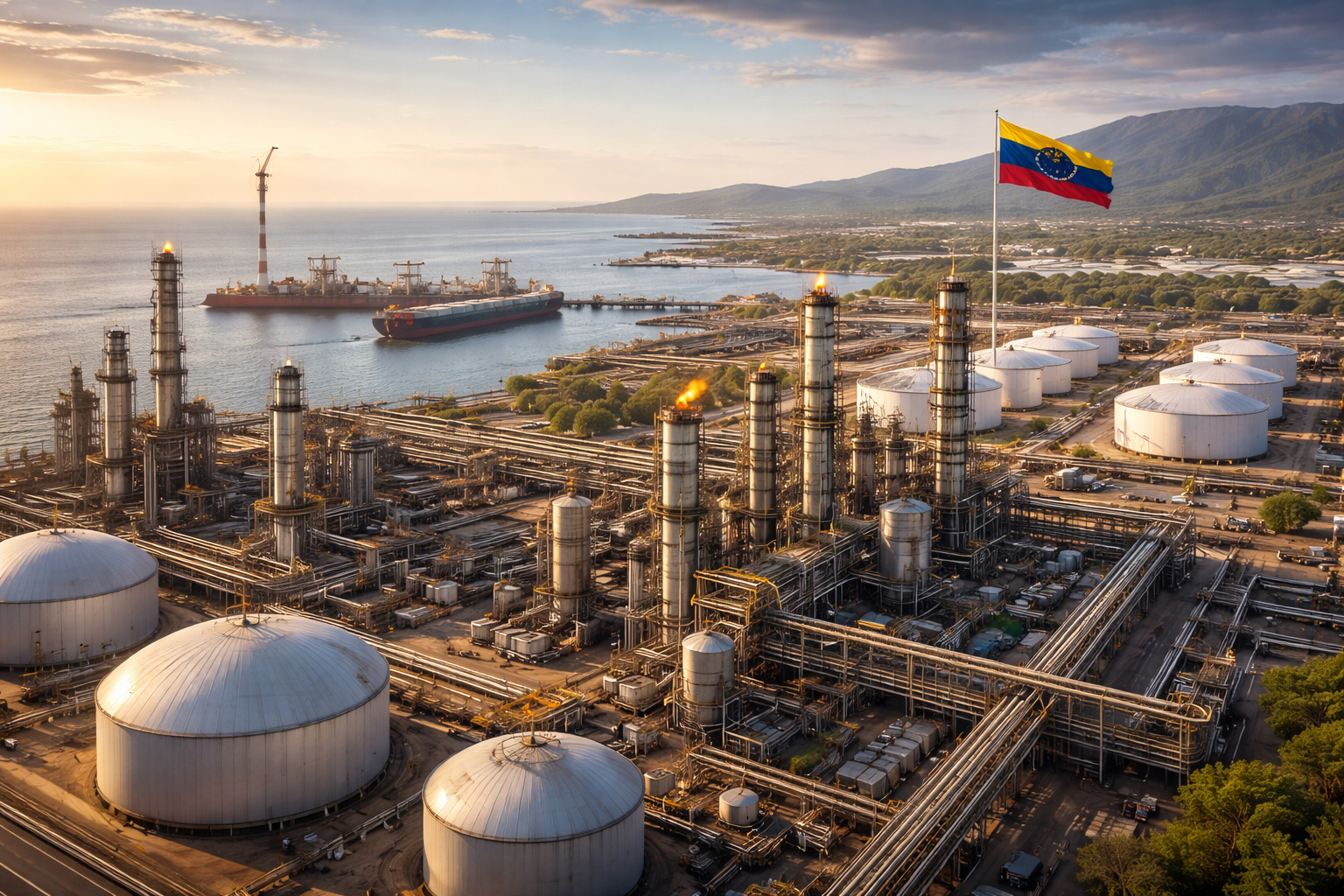
Throughout recent history, oil has always occupied a central position in Venezuela’s economic and political strategy. Therefore, when President Nicolás Maduro claims that the country will continue to export oil, even in the face of external threats, the statement goes far beyond a mere diplomatic positioning. It reinforces a historical logic in which the commodity is intertwined with sovereignty, economic survival, and international projection.
According to public statements made by Maduro, the Venezuelan government does not intend to back down in the face of pressures from U.S. President Donald Trump. Even as the global political context transforms, oil exports remain a structuring axis of the South American country’s economy. Thus, the Venezuelan leader’s words echo a strategy built over decades.
Moreover, this stance arises at a time when the international market watches closely any movement involving oil supply and flow. Therefore, even political speeches have an influence on economic expectations and investment decisions.
-
Lula reveals a masterstroke by Petrobras to undo a deal made by Bolsonaro, which involves the return of an important refinery that currently produces less than half of what was expected and makes Brazil dependent on international diesel.
-
A study confirms that the natural gas sector will reduce greenhouse gas emissions in Brazil by 0.5% and accelerate the energy transition by 2026.

-
Petrobras implements a severe adjustment and confirms a 55% increase in the price of aviation kerosene with a proposal for installment payments for the companies.

-
The rise in oil prices could ensure an extra revenue of R$ 100 billion for the Federal Government, indicates a recent economic study.

Oil As A Historical Basis Of The Venezuelan Economy
Since the discovery of large reserves in the early 20th century, oil has profoundly transformed Venezuela. According to historical records from the Venezuelan government and international organizations, the commodity began to account for the majority of the country’s exports as early as the 1920s. From that moment, the national economy became heavily dependent on oil production.
Over time, this dependency intensified. During the 20th century, revenues from oil financed public policies, infrastructure, and social programs. Consequently, the energy sector came to play a central role in Venezuela’s relationship with the international market.
Even after processes of nationalization and political changes, oil remained the main source of foreign exchange. Thus, any threat to exports represents not only an economic challenge but also a significant political risk for the Venezuelan government.
In this way, by stating that he will continue exporting oil, Maduro reaffirms a deeply rooted historical logic in the structure of the State.
Tensions With The United States And The Geopolitical Factor
The relations between Venezuela and the United States have deteriorated significantly over the past decades. However, according to the U.S. government, especially during the Trump administration, economic sanctions have been used as a tool of political pressure.
These measures have had a direct impact on the Venezuelan oil sector. Financial restrictions, trade limitations, and logistical difficulties have reduced the country’s production and export capacity. Nevertheless, even in adverse scenarios, Venezuela has maintained oil flows to alternative markets.
In this context, the threats mentioned by Trump reinforce a historical pattern. Whenever oil enters the center of political debate, diplomatic tensions tend to intensify. Thus, the commodity takes on a role as a strategic tool, both for producers and for those attempting to influence the market.
Therefore, Maduro’s statement should be interpreted as a direct response to this geopolitical game.
Exporting As An Economic Survival Strategy
From an economic perspective, the continuity of oil exports is vital for Venezuela. According to data released by multilateral organizations over the past few years, oil revenue represents a significant share of the country’s foreign exchange earnings.
Without this flow, it becomes difficult to finance essential imports, maintain social programs, and stabilize the domestic economy. Therefore, even under sanctions, the Venezuelan government seeks alternatives to keep oil circulating in the international market.
Additionally, partnerships with Asian countries and bilateral agreements have helped reduce reliance on traditional markets. In this way, Venezuela has begun to diversify destinations and marketing mechanisms, adapting to imposed restrictions.
Thus, exporting oil has become not just an option but a strategic necessity.
Impacts On The International Oil Market
Although Venezuelan production is far from historical peak levels, any sign of continuity or interruption influences the market. According to analysts in the energy sector, the global oil supply reacts not only to actual volumes but also to future expectations.
In this sense, political statements carry weight. By stating that he will continue exporting, Maduro signals to the market that Venezuela will remain present, albeit in limited conditions. This helps reduce uncertainties related to supply, especially in times of geopolitical instability.
Furthermore, in a global scenario marked by conflicts, sanctions, and trade disputes, each producer plays a relevant role in the balance between supply and demand.
Therefore, Venezuela’s position contributes to the broader shaping of the international oil market.
Oil, Sovereignty, And Political Discourse
For the Venezuelan government, oil also serves a symbolic function. Over the years, the official discourse has associated the exploration of the commodity with national sovereignty and resistance to external pressures. Thus, maintaining exports has become a political act, in addition to an economic one.
According to statements from Maduro himself, Venezuela will not abandon its natural resources nor allow external threats to determine its energy policy. This discourse aligns with a historical narrative constructed since the 20th century, especially after the nationalization of the sector.
In this way, oil surpasses the economic field and becomes ingrained in the political identity of the regime.
An Unresolved Scenario
Despite the strong statements, the future of Venezuelan oil exports remains conditioned by external and internal factors. Sanctions, production capacity, investments, and political stability continue to influence the sector.
Still, by reaffirming the continuity of exports, Maduro sends a clear message to the market and the international community. Venezuela intends to maintain oil as a central axis of its economy and as a tool of geopolitical negotiation.
Thus, once again, oil confirms its historical role as a strategic asset, capable of shaping international relations, supporting economies, and intensifying power disputes. In the case of Venezuela, this reality remains as current as it was at the beginning of the last century.




-

Uma pessoa reagiu a isso.