





 Portuguese
  English
  Spanish
  4 min of reading
  0 comments


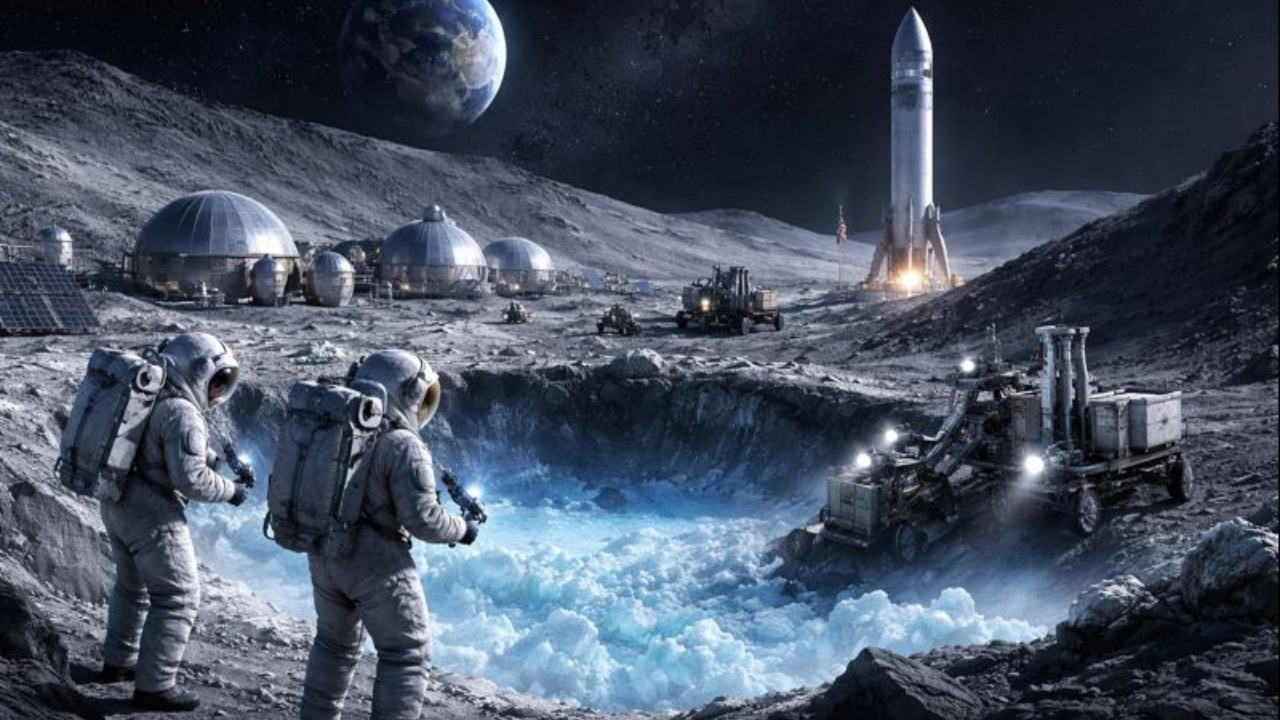
Lunar Ice Reserves at the South Pole of the Moon Could Generate Fuel for Rockets and Make Lunar Bases Self-Sufficient.
Water on the Moon has transitioned from a scientific hypothesis to the centerpiece of the new space race.
The United States and China plan to establish lunar bases at the south pole of the Moon in the coming years, a strategic region where orbital missions have already identified significant indications of lunar ice.
This bet is made because water can be used for human consumption, food cultivation, and rocket fuel production, drastically reducing the costs of space missions and paving the way for longer journeys, including to Mars.
-
With a cost per shot close to zero, the DragonFire laser could change naval warfare in 2027 and provide British ships with nearly unlimited defense against drones.

-
A British startup creates tires that generate electricity in electric vehicles when passing over potholes, speed bumps, and cracks.

-
Scientists have created robots made with living cells that have their own nervous system, swim on their own, explore the environment, and self-organize without any genetic engineering, and now they want to do the same with human cells.
-
Students create a solar-powered ambulance that operates without a plug, without fuel, and still keeps medical equipment running in remote areas.


The choice of the lunar south pole is not coincidental.
Moreover, unlike other areas of the Moon, this region hosts permanently shadowed craters, where extremely low temperatures allow for the preservation of water in solid form or mixed with soil.
Thus, the location could become much more than a temporary scientific outpost.
Why the South Pole of the Moon Is Considered the “White Gold” of Space
The lunar surface faces severe thermal extremes.
When illuminated, it can exceed 120 °C; in darkness, it plummets to around −245 °C. Without an atmosphere to retain vapor, any exposed water would quickly disappear.
On the other hand, in the craters that never receive sunlight, the environment remains stable and cold enough to conserve lunar ice for millions of years.
According to scientist Julie Stopar from the Lunar and Planetary Institute, these areas offer “the best chances of finding large quantities of water that could be utilized as a resource.”
Even so, frozen lakes are not expected to be found. “The water is not exactly exposed as if it were an ice rink.
It is mixed in with the soil,” explains Stopar. This requires specific technologies for location and extraction.
Water on the Moon as a Base for Rocket Fuel
In addition to sustaining astronauts, water on the Moon has an even greater strategic role.
When subjected to electrolysis—a process that separates hydrogen and oxygen through electric current—it becomes the basis for rocket fuel.
“When liquefied, both elements can ignite and be used to effectively propel spacecraft,” explains engineer George Sowers from the Colorado School of Mines. For him, the impact is comparable to that of oil on Earth.
“Water is the oil of space.”
If produced locally, water would eliminate the need to transport large volumes from Earth, which is extremely costly due to Earth’s gravity.
Thus, because the Moon has reduced gravity and no atmosphere, launching rockets from there is much cheaper.
How Scientists Plan to Extract Lunar Ice
The first challenge is to locate the water accurately. So far, no crewed mission has directly explored the lunar south pole.
The evidence comes from probes from NASA and the Indian space agency.
Once the presence of lunar ice in sufficient quantity is confirmed, extraction methods based on heating the soil come into play.
The central idea is simple: heat the rock to release the trapped water.
“If there’s enough ice close to the surface, we can apply heat directly and capture the vapor,” Sowers states.
After that, the system cools the vapor and transforms it back into usable ice or water.
European Technology Bets on Intelligent Water Mining on the Moon
Among the most advanced solutions is the LUWEX (Lunar Water Extraction) project from the European Space Agency.
The system uses a rotary crucible that efficiently heats the lunar soil, even in extreme vacuum.
The absence of atmosphere makes heating very difficult,” explains Paul Zabel, a researcher at the Institute of Space Systems in Germany.
After extraction, the water goes through a cold chamber and then through a purification process, as it becomes contaminated by fine lunar dust particles. “We can make drinking water,” assures Zabel.
Lunar Bases and the Future of Mars Missions
In the short term, the first lunar bases will heavily depend on supplies sent from Earth. However, over time, self-sufficiency will be essential to reduce costs and risks.
In addition to fueling rockets, the fuel derived from lunar water could power unmanned vehicles and high-energy machines.
“A human mission to Mars could cost up to $12 billion using lunar fuel,” estimates Sowers.
Moreover, according to Stopar, the entire interplanetary exploration strategy depends on the success of these tests. “The whole Moon-to-Mars plan depends on something being demonstrated on the lunar surface.”
Disputes Over Resources Could Generate Conflicts in Space
Despite the optimism, there are concerns.
Water on the Moon is not infinite, and the concentration of lunar ice in specific areas could generate geopolitical disputes.
“There could be a conflict at some point,” warns Zabel, mentioning the possibility of simultaneous extraction by rival powers in the same sector of the lunar south pole.
Still, experts agree that lunar water will be the key resource that defines the pace of the next era of space exploration and could transform the Moon into humanity’s first true outpost beyond Earth.







-

-

-

-

11 pessoas reagiram a isso.