





 Portuguese
  English
  Spanish
  4 min of reading
  1 comment


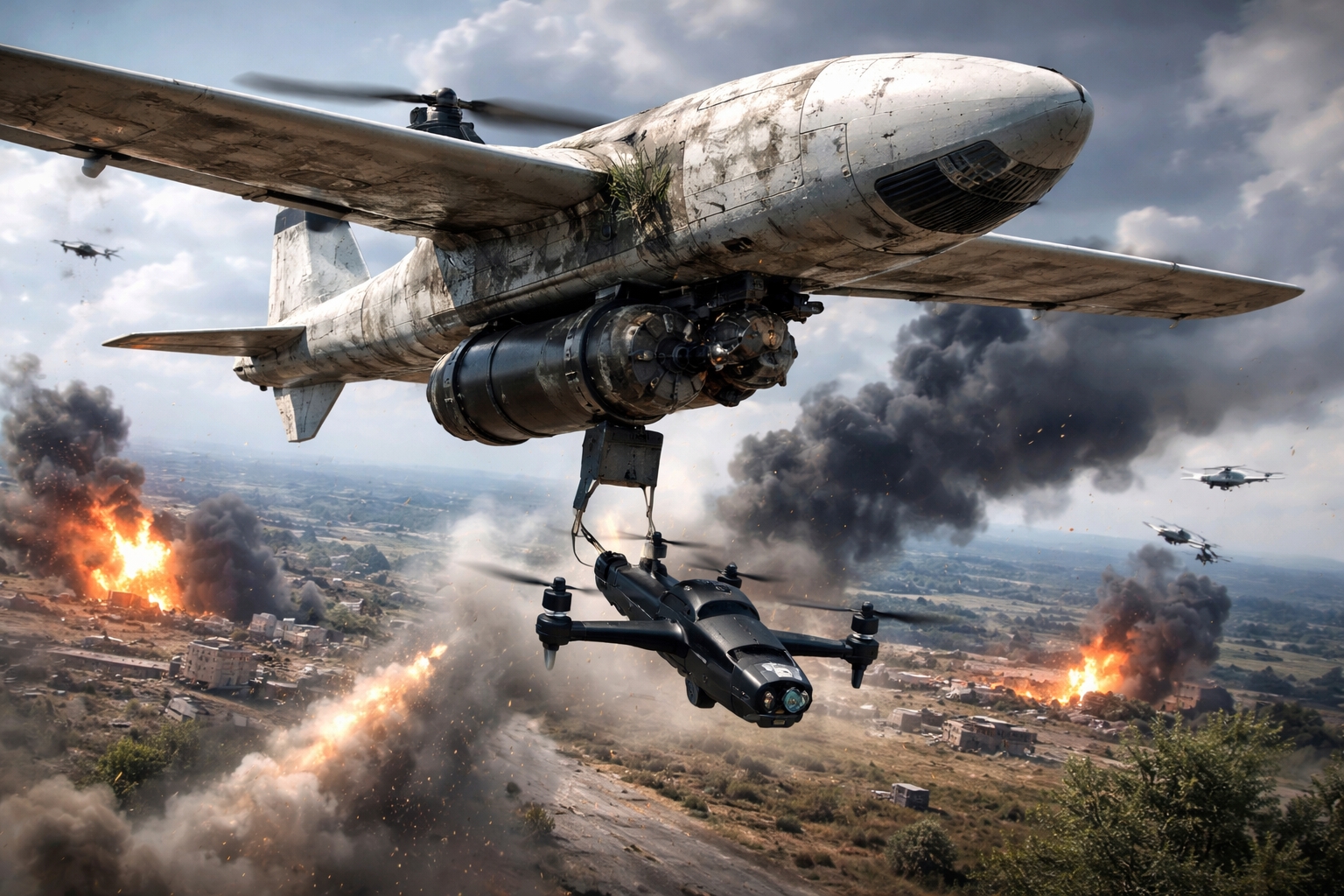


Ukraine Sees A Strange and Dangerous Turn: Russia Stops Using Only Common Drones and Starts Launching 1 FPV from a Gerbera in the Air, Creating an Improvised Hybrid That Extends Attack Range
The war in Ukraine has already been shaped by drones that have moved from surveillance to real impact weapons. First, reconnaissance. Then, armed drones. Next, swarming and long-range attack munitions. Frankenstein is not just a rarity in the war in Ukraine, it is a disturbing preview of the future of conflicts.
Now, the conflict has entered a phase that changes how these machines are viewed on the battlefield. The logic is no longer just one drone doing everything alone. It has become a drone carrying another to complete the attack.
What seemed like mere improvisation has become method. And when that becomes method, the change is not confined to one sector of the front. It influences the entire defense and the way to plan attacks.
-
Motorola launched the Signature with a gold seal from DxOMark, tying with the iPhone 17 Pro in camera performance, Snapdragon 8 Gen 5 that surpassed 3 million in benchmarks, and a zoom that impresses even at night.

-
Satellites reveal beneath the Sahara a giant river buried for thousands of kilometers: study shows that the largest hot desert on the planet was once traversed by a river system comparable to the largest on Earth.

-
Scientists have captured something never seen in space: newly born stars are creating gigantic rings of light a thousand times larger than the distance between the Earth and the Sun, and this changes everything we knew about stellar birth.

-
Geologists find traces of a continent that disappeared 155 million years ago after separating from Australia and reveal that it did not sink, but broke into fragments scattered across Southeast Asia.

Drones with Drones Take the War to the Frankenstein Phase and Break the Short-Range Label
The most concerning threshold appears when larger drones begin to act as mother ships. They transport and launch FPVs from great distances from the front line.
The consequence is clear: the idea that FPVs are merely tactical short-range weapons begins to diminish. A new strategic layer enters the scene, constructed with battlefield logic, not laboratory logic.
The most striking detail is that the FPV remains the precise hunter, but now it can reach further before the hunt even begins. This changes the risk calculation and alters the map of potential targets.
Gerbera Moves from the Role of Cheap Decoy to a Platform That Releases 1 FPV in the Air
In this scenario, the Gerbera becomes a central character. Lightweight, rudimentary, and cheap, it was created as a decoy to saturate defenses in Shahed-type attacks.
Over time, it began to carry small explosive payloads. And now it has been adapted to something even more unsettling: transporting a suspended FPV and launching it in mid-air.
In early February, photos and videos began to circulate showing this evolution. The most sensitive point is that this does not appear as an isolated curiosity. It emerges as an emerging pattern, something that could be repeated.
The Combination Adds Weaknesses and Creates Strength: Fixed Wing Travels Far and FPV Finishes with Precision
The reason for this combination isn’t just technical. It is operational. A fixed-wing drone can fly long distances, including hundreds of kilometers, but it does not have the ideal agility to hunt small or moving targets.
The FPV does the opposite. It enters through a window, follows a target, and hits an exact point. However, historically, it suffers from one limitation: range.
When the FPV is launched from a drone in mid-flight, this limitation loses weight. One’s weakness becomes support for the other. One brings the attack closer. The other executes with precision. It is here that the improvised hybrid ceases to appear as improvisation and starts to look like strategy.
The Shadow of the Shahed Points to the Next Step: Larger Platforms Can Carry Multiple Attack Drones
For now, the Gerbera seems to carry one FPV, at least at this moment. Nonetheless, the model suggests something larger on the horizon.
The industrial and military logic indicates that larger platforms, such as the Shahed, can transport multiple attack drones. This would increase the impact chances and allow for hitting more than one target in the same mission.
The concept resembles a bomber that does not drop traditional bombs. It releases small hunters. Frankenstein is just beginning, but the final form is already showing signs, and these signs are unsettling because they depend more on scale than on rare invention.
Communication Web Enters the Game with Chinese Mesh Radios and Opens Up Space for More Autonomy and AI
In addition to the physical combination, a communication component has emerged that changed the landscape. Faced with limitations caused by the Starlink blockage by SpaceX a few days ago, Russia turned to Chinese-origin mesh radio sets.
The idea is to enable drones to communicate with each other and extend control in successive jumps. This is described as an expensive system but reduces dependence on satellites and can pave the way for deeper operations.
Russian experts point out that the trend is for this mutation to advance. FPVs with greater autonomy and more capability for self-decision-making are entering the radar as the next step. This reduces reliance on the human operator and simultaneously makes neutralization more difficult. In the background, more AI.
The question that lingers is simple yet heavy: when communication and autonomy increase, the time to react diminishes.
The Frankenstein phase draws attention because it mixes improvisation, scale, and real effect. The Gerbera launched as a decoy now appears as a tool to extend the range of precise attacks, and this changes what was expected of an FPV. The result is an uncomfortable preview of the future of conflicts, with innovation stitched to the rhythm of necessity and devastating consequences.

If this type of hybrid becomes the standard, which part seems more dangerous to you: the Gerbera launching FPV in the air, the chance that larger platforms carry several drones, or the mesh communication web reducing satellite dependence?








Idealizados por acadêmicos das universidades, não pela elite militar. Já pensou?