





 Portuguese
  English
  Spanish
  5 min of reading
  0 comments


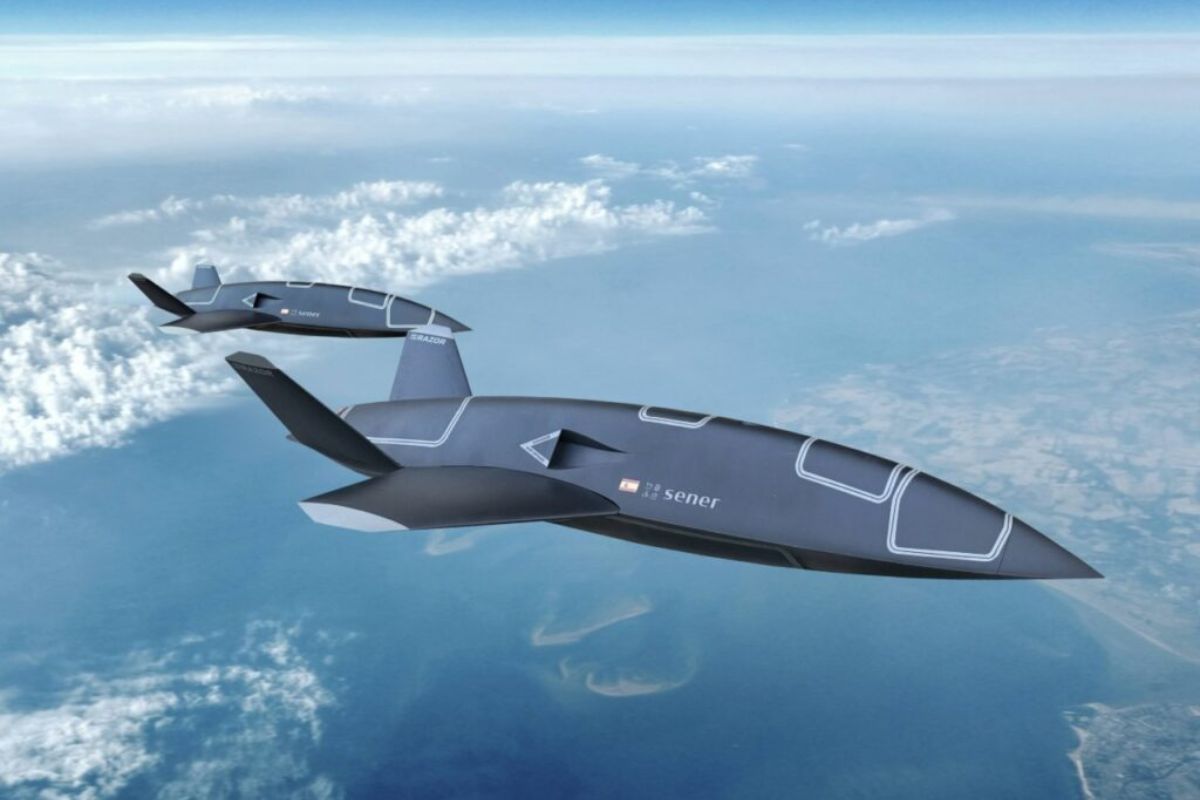
The SRC 100 Razor, revealed by Sener at the World Defense Show, combines low observability, autonomy in GNSS-denied scenarios, parachute recovery, and dual-use as an ISR platform or advanced aerial target, proposing mass launch for high-risk operations with attritable logic and controlled costs in contemporary defense.
The SRC 100 Razor takes center stage in the discussion about unmanned systems by bringing together, in a single architecture, structural lightweight, low signature, and parachute return after the mission. At the World Defense Show in Riyadh, the platform was presented by the Spanish company Sener as a solution for operational environments with high demands and significant friction.
The announcement also consolidates a broader industrial movement: a few months after acquiring SCR (Remote Control Systems), Sener now integrates drone-target capabilities, autonomous systems, and scalable production into a single portfolio. In practice, the proposal combines rapid response, flexibility, and mass employment logic, without compromising recovery when possible.
Who Deploys the Platform and What This Origin Signals
The SRC 100 Razor was presented by Sener during one of the most relevant events in the defense sector in the Middle East, with a clear focus on contemporary requirements of armed forces. This point matters because it is not an abstract concept: the platform emerges with a discourse aimed at immediate operational use, rather than remaining only in the technological demonstration stage.
-
Friends have been building a small “town” for 30 years to grow old together, with compact houses, a common area, nature surrounding it, and a collective life project designed for friendship, coexistence, and simplicity.

-
This small town in Germany created its own currency 24 years ago, today it circulates millions per year, is accepted in over 300 stores, and the German government allowed all of this to happen under one condition.

-
Curitiba is shrinking and is expected to lose 97,000 residents by 2050, while inland cities in Paraná such as Sarandi, Araucária, and Toledo are experiencing accelerated growth that is changing the entire state’s map.

-
Tourists were poisoned on Everest in a million-dollar fraud scheme involving helicopters that diverted over $19 million and shocked international authorities.


In its official positioning, the company states it is reinforcing its international presence in the development and production of autonomous systems and remote control vehicles. This industrial framing is decisive: when a platform is born already linked to scale and integration of capabilities, it tends to influence not only one-off purchases, but also the design of doctrine and medium-term force planning.
150 Kg, Low Observability and Recovery: The Balance Between Risk and Return
At 150 kg, the SRC 100 Razor occupies a relevant tactical space for operations that require logistical agility and a smaller deployment footprint. Reduced weight, by itself, does not define performance, but alters the operational calculus regarding transport, launch, and resupply in high-pressure scenarios. In modern operations, reducing logistical friction can be as strategic as extending range.
Low observability and the parachute recovery system create a highly valuable combination: the former enhances survival in contested environments, while the latter reduces total loss when the mission allows for return. The result is a platform designed to “go and return” when possible, without denying that, in certain situations, planning already considers the real probability of non-recovery.
Operating Without GNSS and Maintaining Secure Connectivity: Why This Matters in the Field
One of the most sensitive points of the SRC 100 Razor is its ability to operate fully autonomously in scenarios without access to GNSS. In current conflicts, absolute dependence on satellite navigation has become a known vulnerability. In this context, autonomy without GNSS ceases to be a marketing differentiator and becomes an operational survival requirement.
At the same time, Sener highlights robust and secure communications to maintain reliable connectivity in demanding environments. This combination — navigation autonomy and link resilience — answers a central question for any force: how to keep the mission active when the environment tries to blind, confuse, or disrupt the system? The SRC 100 Razor was specifically presented to operate in this type of degraded scenario.
ISR and Advanced Aerial Target in the Same System: Versatility with Tactical Focus
The SRC 100 Razor was designed to perform ISR (intelligence, surveillance, and reconnaissance) missions, positioning it as a data collection vector in risk areas. Practically, this means enhancing situational awareness with less direct exposure of manned assets. Useful information at the right time remains one of the most valuable assets in modern combat.
At the same time, the use as an advanced aerial target adds a second layer of utility. Instead of a single-function platform, the presented concept is of multifunctionality oriented towards preparation and operational cycles. For armed forces, this duality can represent fleet rationalization, training more aligned with contemporary threats, and greater flexibility of use according to the mission.
Mass Launch and Attritable Strategy: When Loss is Also Part of the Plan
The SRC 100 Razor was designed for mass deployment, and this detail changes the cost-benefit debate in attrition operations. In attritable strategies, the logic is not to preserve every unit at any cost, but to sustain continuous operational effect with viable resupply. It is a change of mindset: from the “untouchable” platform to “sustainable” capability.
In this model, the parachute functions as an economic and tactical multiplier: recovery is pursued when possible, loss is accepted when necessary, without jeopardizing the campaign. The proposal of the SRC 100 Razor dialogues with this balance between risk and continuity, especially in missions with a high probability of attrition, where insisting on expensive and scarce assets can limit the operational tempo itself.
Acquisition of SCR and Industrial Scale: What May Accelerate From Here
The launch of the SRC 100 Razor occurs a few months after Sener’s acquisition of SCR, a move that expanded capabilities in autonomous systems, drone-targets, and unmanned platforms. This chain between acquisition and product suggests rapid integration of competencies, with a direct impact on the speed of portfolio maturation.
In strategic reading, production scale and technological integration now go hand in hand. This does not eliminate typical challenges of any continuous validation program, doctrinal adaptation, integration with other layers of defense, but places the SRC 100 Razor in a relevant position in the debate about how armed forces should combine volume, resilience, and flexibility in the coming years.
The SRC 100 Razor appears as a clear response to a scenario where operating under signal denial, reducing signature, launching in quantity and recovering when possible has ceased to be the exception and has become routine. More than an isolated piece, it represents a type of architecture that tries to balance tactical effectiveness, planned attrition, and operational sustainability.
Considering real-world application, what factor would weigh most in your assessment of the SRC 100 Razor: autonomy without GNSS, parachute recovery, or mass launch capability? And why would this point, in your view, make the most difference in a high-risk operation?










Seja o primeiro a reagir!