





 Portuguese
  English
  Spanish
  4 min of reading
  0 comments


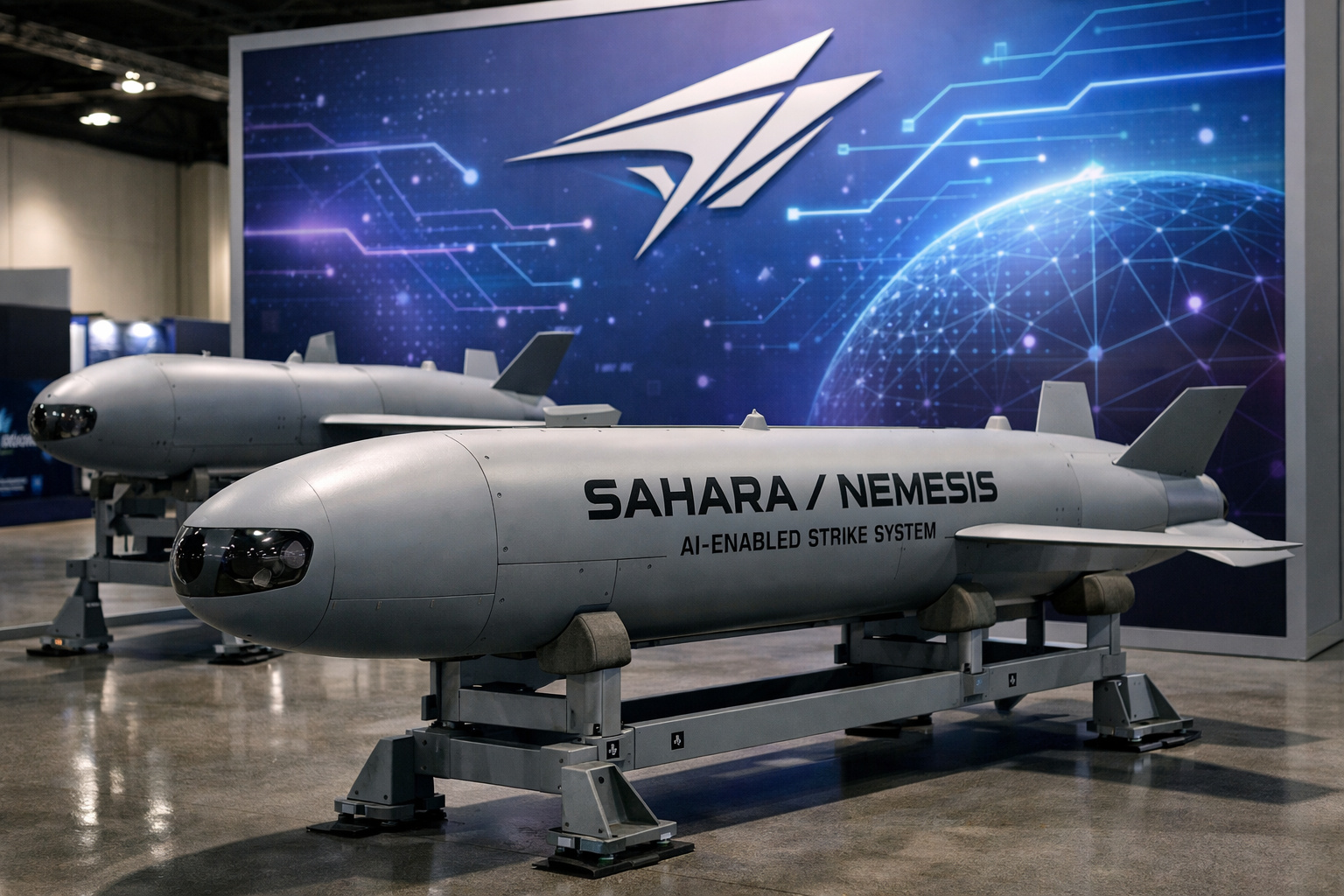
Developed By A Technology Company Outside The Traditional Defense Industry, The Romanian Cruise Missile Bets On AI, Low Cost And Reduced Payload To Fit Into The New Logic Of Modern Conflicts
Romania has taken a significant step — albeit a quiet one — by joining the select group of European countries seeking to develop national long-range strike capabilities. The move is being made through OVES Enterprise, a company previously known for digital solutions and artificial intelligence, which has decided to advance into one of the most sensitive domains of modern defense: missile development.
The project, named Sahara, began to take public form in 2025 and, according to its developers, has already reached an advanced stage, with successful initial tests. Although far from a classic cruise missile in terms of destructive power, the Sahara symbolizes a paradigm shift: less explosive, more intelligent, cheaper, and potentially more scalable.
Lightweight Architecture, Embedded AI, And Electronic Warfare Resistance
The Sahara was conceived as an integrated system, where the missile relies not only on its aerodynamics or propulsion but mainly on advanced software. According to Defense Romania, which obtained information directly from the developers, the project incorporates Nemesis AI, an artificial intelligence module responsible for adapting the flight profile to the mission in real time.
-
Motorola launched the Signature with a gold seal from DxOMark, tying with the iPhone 17 Pro in camera performance, Snapdragon 8 Gen 5 that surpassed 3 million in benchmarks, and a zoom that impresses even at night.

-
Satellites reveal beneath the Sahara a giant river buried for thousands of kilometers: study shows that the largest hot desert on the planet was once traversed by a river system comparable to the largest on Earth.

-
Scientists have captured something never seen in space: newly born stars are creating gigantic rings of light a thousand times larger than the distance between the Earth and the Sun, and this changes everything we knew about stellar birth.

-
Geologists find traces of a continent that disappeared 155 million years ago after separating from Australia and reveal that it did not sink, but broke into fragments scattered across Southeast Asia.

This system analyzes data from satellites and embedded sensors every 200 milliseconds, seeking to identify attempts at spoofing, electronic interference, or navigation signal jamming. If anomalies are detected, the algorithm automatically abandons satellite navigation and switches to operating with an inertial system, reducing vulnerability to electronic countermeasures — a critical point in recent conflicts.
Physically, the missile weighs 55 kg, with up to 10 kg allocated for the warhead or other types of payload. Propulsion is provided by a microturbofan capable of generating 310 N of thrust, while fuel accounts for 20 kg of the total mass, allowing for an estimated range of 200 km. The declared cruise speed is Mach 0.85, suitable for low and stealthy flight profiles.


What The Sahara Missile Really Represents In The European Military Landscape
While the numbers impress with their efficiency, the Sahara does not qualify as a conventional cruise missile. Its warhead weighing only 10 kg distances it from classic strategic weapons and brings it closer to an emerging category often referred to as “missile-drones” — hybrid systems between missiles and attack drones.
According to analysis by Defense Express, the Romanian project more directly engages with trends observed in the United States, where the Marine Corps selected the Red Wolf from L3Harris. This missile carries a similar explosive payload of up to 10 kg, but reaches 370 km, reinforcing the logic of low cost, scalable production, and flexible tactical application.
In this context, the Sahara seems less focused on mass destruction and more on area denial, precision strikes against sensitive targets, and defensive saturation. Additionally, OVES Enterprise has already announced plans for extended range versions, with projections between 500 and 600 km and, eventually, between 900 and 1,100 km, which would significantly enhance the strategic weight of the project.
Current Limitations And The Void Of A Broader National Program
Despite technological advancements, Romania still does not have a public national long-range missile program. Today, the country’s independent strike capability mainly relies on coastal systems armed with the NSM, developed by Kongsberg. These missiles, in addition to anti-ship capabilities, have land attack capacity.
As of 2025, the officially reported range of the NSM was 185 km, but more recent numbers point to over 300 km, highlighting a relevant evolution. Still, the Sahara emerges as the only known Romanian long-range strike development, particularly significant for being conducted outside the traditional military-industrial complex.
An official presentation of the missile is scheduled for May 2026, while a full operational capability demonstration is expected to occur at the end of that year. So far, investments have totaled €1 million, with an additional €2 million allocated for testing, refinement, and optimizations, modest amounts when compared to conventional missile programs.
In summary, the Sahara does not redefine Romania’s firepower but signals a clear strategic shift: a focus on smart, lightweight, and economically viable weapons, aligned with the reality of electronic warfare, defense saturation, and asymmetric conflicts that dominate the 21st century.
With information from: Defense Romania







-

Uma pessoa reagiu a isso.