





 Portuguese
  English
  Spanish
  5 min of reading
  0 comments


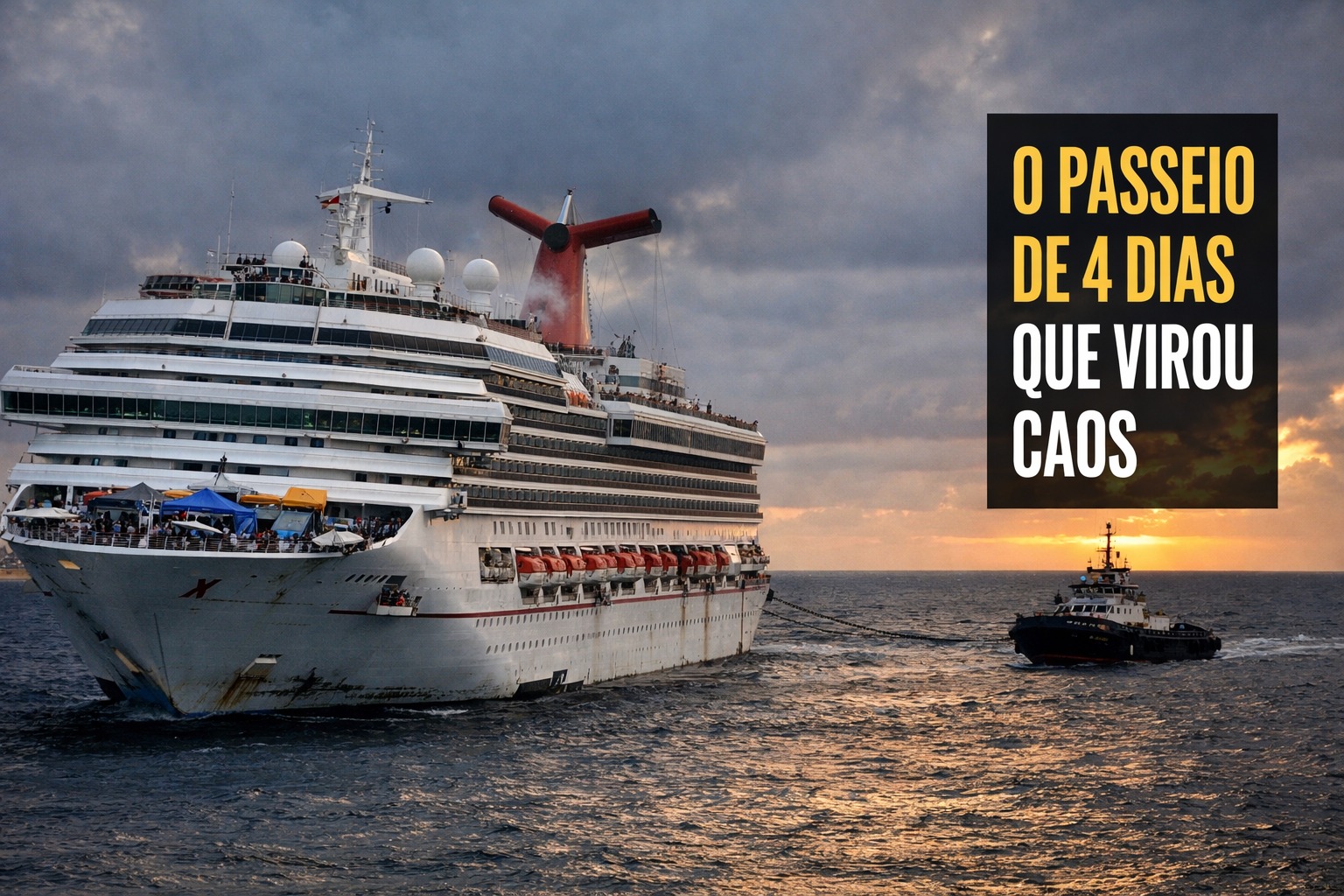
What Was Supposed to Be a Leisure Trip Turned Into a Nightmare at Sea, with Blackouts, Unused Restrooms, Increasing Tension, Global Coverage, and an Outcome That Marked Passengers and Crew
Just relax and you will hear a story. It’s not an ordinary maritime narrative, nor a soft recall of sunny vacations. It is the account of a cruise that started as leisure and ended as an extreme test of patience, resilience, and dignity.
On February 7, 2013, the Carnival Triumph departed from Galveston, Texas, heading to Cozumel, Mexico. The plan was simple: four days of rest and fun before the return.
But what was supposed to be a routine trip turned into an eight-day nightmare for 4,229 passengers and crew members.
-
Friends have been building a small “town” for 30 years to grow old together, with compact houses, a common area, nature surrounding it, and a collective life project designed for friendship, coexistence, and simplicity.

-
This small town in Germany created its own currency 24 years ago, today it circulates millions per year, is accepted in over 300 stores, and the German government allowed all of this to happen under one condition.

-
Curitiba is shrinking and is expected to lose 97,000 residents by 2050, while inland cities in Paraná such as Sarandi, Araucária, and Toledo are experiencing accelerated growth that is changing the entire state’s map.

-
Tourists were poisoned on Everest in a million-dollar fraud scheme involving helicopters that diverted over $19 million and shocked international authorities.


The Beginning of the Crisis at Sea
On February 10, 2013, on what would be the last day of the trip, the ship was returning from Cozumel to Galveston with 3,143 passengers and 1,086 crew members on board. Just before 5:30 a.m., a fire started in the engine room.
The automatic system quickly extinguished the flames. There were no injuries. At 6:15 a.m., after the emergency alarm, passengers were instructed to return to their cabins or get breakfast. Apparently, everything was under control.
But It Was Not Under Control
The power was interrupted. Without electricity, the Triumph lost propulsion. Emergency lights were activated. Air conditioning, kitchens, and sanitation systems ceased to function.
“Technically, we are just adrift, without power,” recalled Jen Baxter, cruise director, in the Netflix documentary Trainwreck: Poop Cruise.
Unused Restrooms and Unthinkable Decisions
When the crew managed to access the engine room, they found that the fire had destroyed the main electrical cables. There was no hope of restoring power.
The Restrooms Stopped
Jen Baxter stated that, amid the chaos, she tried to relieve the tension with humor. She suggested that “number one” could be done in the shower. However, “number two” required another solution.
The answer was to distribute red bags for biological waste. Passengers were instructed to use them and dispose of them in the hallway trash cans. The reaction was immediate.
“What the hell is this?” recalled Ashley, a bachelorette passenger with her friends Kalin and Jayme, in the Netflix documentary.
Devin Marble also described the shock: “You want me to do what?”
Even crew members felt the weight of the situation. Abhi, the onboard chef, admitted that he never imagined living through something like this.
Heat, Discomfort, and Increasing Tension
Without air conditioning, the cabins became stuffy. On the first night, passengers dragged mattresses onto the deck in search of fresh air.
On February 11, the kitchen staff discarded perishable food and began preparing sandwiches for 3,000 people.
Hanna, a bartender on the Triumph, recalled observing the crowd searching for food and reflecting on the contrast with her childhood in what was then the Soviet Union.
At the same time, Wi-Fi and cell signal were unavailable. When the Carnival Legend appeared to deliver supplies, passengers ran to the deck trying to catch a signal on their phones.
When the System Collapses
The makeshift sanitation quickly reached its limit. Kalin described the nearly surreal struggle to use the shower in the dark, even triggering an emergency light with a flare.
Ashley reported that, by the afternoon of February 11, the water mixed with urine no longer drained. Yet many still insisted on using the toilets.
Abhi found a public restroom and described the scene as the most disgusting he had ever witnessed. Successive layers of waste covered with toilet paper.
The Environment Became Unhealthy
Stephen, guest services manager, stated that he saw passengers urinating over the side of the ship. Abhi witnessed bags of feces being thrown into lifeboats.
The Tilt That Aggravated Everything
On February 11, a tugboat began the rescue. But the weather worsened.
With the ship’s angle changing, liquids began to run down the hallways. Devin Marble summarized the horror: “You know where you’re stepping.”
Larry Poret said everything overflowed onto the floor. Toby Barlow told CNN that his wife reported sewage running down the walls.
The World Discovers the Drama on the Ship
Initially, Buck Banks, public relations representative of Carnival, issued a brief statement mentioning only the lack of propulsion. Nothing was said about the restrooms.
The next day, Gerry Cahill, the company’s CEO, stated that the guests were safe and expressed regret for the discomfort.
But on February 11, families began contacting media outlets. Brooke Baldwin, former CNN anchor, recalled the moment they realized: “This is news.” Coverage intensified.
Why the Rescue Took So Long
The original plan was to tow the ship to Texas. At 12:17 p.m., Stephen received information that the Triumph had drifted more than 100 nautical miles. The new route would be to Mobile, Alabama, and would take two or three days.
As they approached Mobile on February 14, passengers just wanted to return home, take a warm shower, and sleep in a comfortable bed.
Carnival informed CNN that it would offer a full refund, transportation at no additional cost, and reimbursement for expenses, except for purchases in the casino and gift shop. It also granted credit for future travel.
Buck Banks anticipated a media massacre. But many passengers recognized the crew’s efforts.
Kalin stated that she would never take a private restroom for granted again.
Subsequently, several lawsuits were filed. The company claimed that passengers had accepted the contractual terms when purchasing tickets.
According to Carnival, an investigation identified a design vulnerability. The company claimed to have invested more than US$ 500 million in safety improvements.
The Triumph was cleaned, repaired, and refurbished for 115 million dollars. In 2019, it was reborn with a new name: Carnival Sunrise.
The data for this article is from Eonline.









-

-

-

5 pessoas reagiram a isso.