





 Portuguese
  English
  Spanish
  4 min of reading
  1 comment


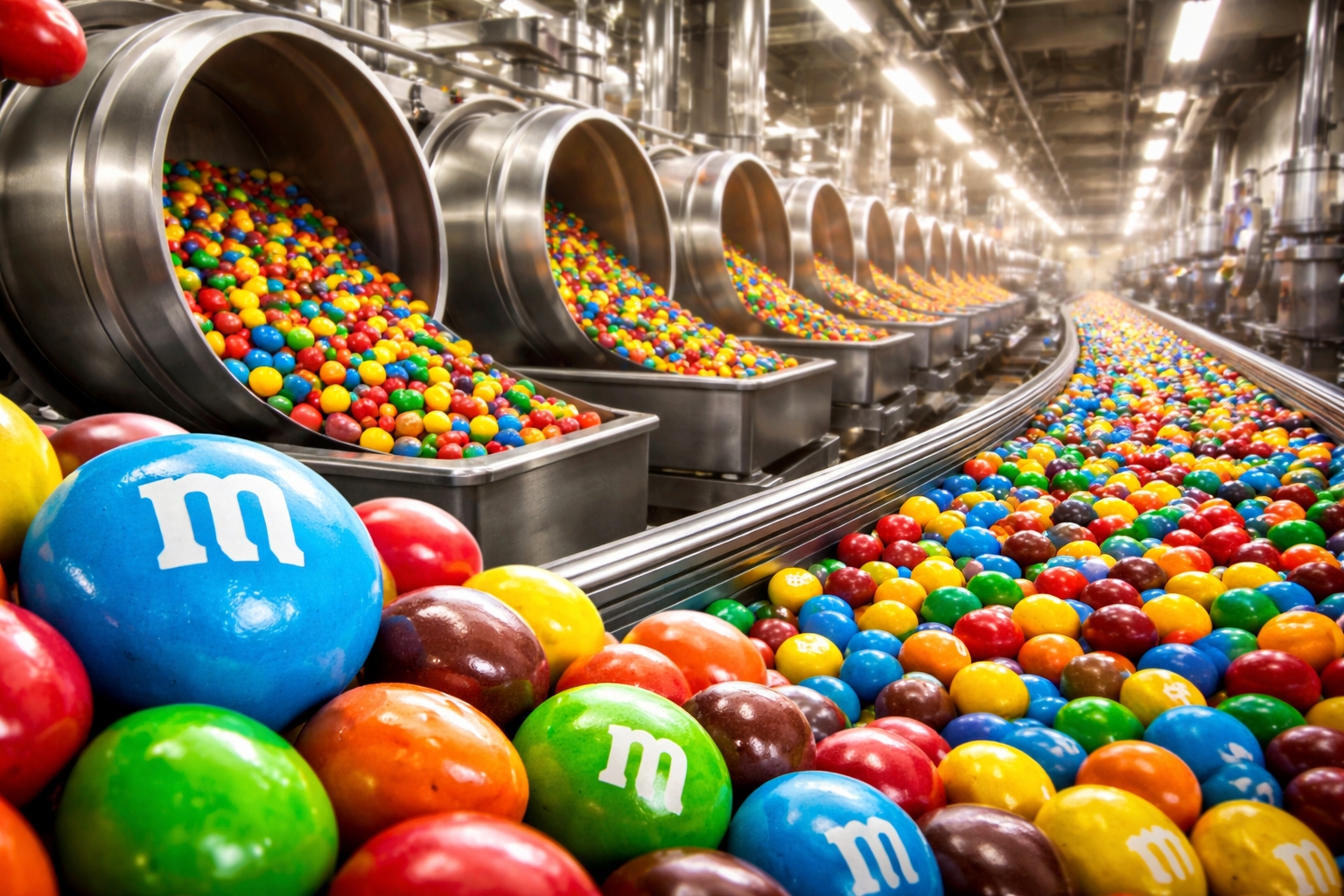


The Production of M&M’s on an Industrial Scale Turns Tons of Inputs into Standardized Colored Candies, Using Constant Rolling, Closed Tunnels, and Sequential Packaging to Maintain Rhythm and Control.
Almost nothing stays still inside the M&M’s factory. The sensation is that of being in front of a machine that cannot fail. Huge bags come in, sealed packages come out, and in the middle of this pathway, there is engineering that attracts more attention than the chocolate itself.
What seems simple in the supermarket hides a continuous operation, organized in flow. There is no room for improvisation. Each step depends on the previous one, and any deviation compromises shine, shell, and even the clarity of the white lettering.
The question that remains is straightforward: how to keep millions of units rolling without tangling, breaking, or losing the visual standard?
-
Friends have been building a small “town” for 30 years to grow old together, with compact houses, a common area, nature surrounding it, and a collective life project designed for friendship, coexistence, and simplicity.

-
This small town in Germany created its own currency 24 years ago, today it circulates millions per year, is accepted in over 300 stores, and the German government allowed all of this to happen under one condition.

-
Curitiba is shrinking and is expected to lose 97,000 residents by 2050, while inland cities in Paraná such as Sarandi, Araucária, and Toledo are experiencing accelerated growth that is changing the entire state’s map.

-
Tourists were poisoned on Everest in a million-dollar fraud scheme involving helicopters that diverted over $19 million and shocked international authorities.




The Industrial Challenge of Keeping Tons of Inputs Flowing Without Stopping the Production Line
Everything begins before the line gains speed. In the supply area, voluminous bags rest on organized pallets, with clear aisles and planned circulation.
Machines with forks reposition the pallets and bring the load closer to the point of use. The focus is to avoid interruption. The greater the concentrated volume, the lower the risk of unexpected stops.
This logic sustains the production rhythm. With inputs in large units, the factory reduces constant exchanges and maintains cadence. The impact shows in the final result, where the standardization depends on stable flow from the very first minute.
The Secret of the Backstage, Funnels, Ducts, and Metal Channels That Control White Powder and Dark Granules Without Losing Efficiency
When the light powder descends by gravity to a metal reservoir, a fine cloud rises and reveals one of the less visible challenges of the food industry. Light material requires precise containment.
Shortly after, dark granules travel along conveyor belts and chutes with different behaviors. While the powder spreads easily, the granules flow more predictably.
There is no official number released about exact volumes, but the contrast between the materials explains why funnels, ducts, and loading mouths need to be designed with precision. Flow control reduces waste and prevents stops for manual cleaning.
Further along, small yellowish cores descend through parallel metal channels. The separation in lines prevents clumping. If it jams here, it compromises the entire finishing that will come after.
Giant Stainless Steel Drums Spin Nonstop and Reveal the Engineering Behind the Smooth Chocolate Coating and Uniform Shine
The heart of the operation lies in the stainless steel drums. They are structures with circular openings at the front, where the candies rise and fall in continuous waves.
The movement follows a repetitive cycle. The drum spins, gravity pulls the product, and the rolling distributes material around each unit. It is at this point that the shell takes shape.
The scale is impressive. Rows of drums work side by side, creating an industrial scene that resembles heavy processing lines. Only instead of raw steel or oil, there are colorful candies circulating.
This constant rolling method is the technical detail that determines the outcome. Without this dynamic, there isn’t enough uniform surface to support intense shine and sharp printing.
The Closed Tunnel and the Printing of the White Letter, the Stage That Exposes Any Invisible Flaw in the Chocolate
After the drums, the conveyor leads the candies into a closed tunnel. The change of environment indicates a new phase in the process.
When they return, the units exhibit a more homogeneous finish. Only then do they receive the white letter, printed on the colored shell.
This heightened contrast does not forgive imperfections. Any irregularity appears immediately. For this reason, specialists emphasize the importance of cleanliness and waste control on lines that work with printing on curved surfaces.
This is where precision ceases to be just an aesthetic detail and becomes a manufacturing requirement.
Separation of Chocolates by Color and Sealed Packaging Keeps Production in a Continuous Line Until the Consumer
After printing, the flow moves on to color separation and grouping. The conveyor does not stop.
Gloved hands perform spot checks, opening packages and verifying intact shell and color variation within the expected range. It is a practical validation, done close to the batch.
Next, already sealed packages advance in sequence, aligned at high cadence. The continuous line ensures that from initial supply to final packaging, everything remains in motion.
In the end, the manufacturing of M&M’s rests on a clear principle: keep the product rolling.
The combination of funnels, conveyors, drums, and tunnels creates a long, coordinated chain, where scale and care walk together to deliver the smooth chocolate shell, intense shine, and well-defined lettering.
It is impressive to see how a small candy demands such a complex industrial structure.
Are You a Fan of M&M’s? What Is Your Favorite Color, Do You Prefer the Traditional Milk Chocolate or the Versions with Peanuts, Crispy, or Different Fillings? Do You Think the Flavor Has Changed Over the Years or Remains the Same as Always? Leave Your Opinion in the Comments and Share with Those Who Enjoy Discovering the Backstage of the Industry.










Amei a matéria sobre os M&M , gostaria de saber se aqui no Brasil tem tdas as versões, pois nunca vi o do saquinho azul cor do céu