





 Portuguese
  English
  Spanish
  5 min of reading
  0 comments


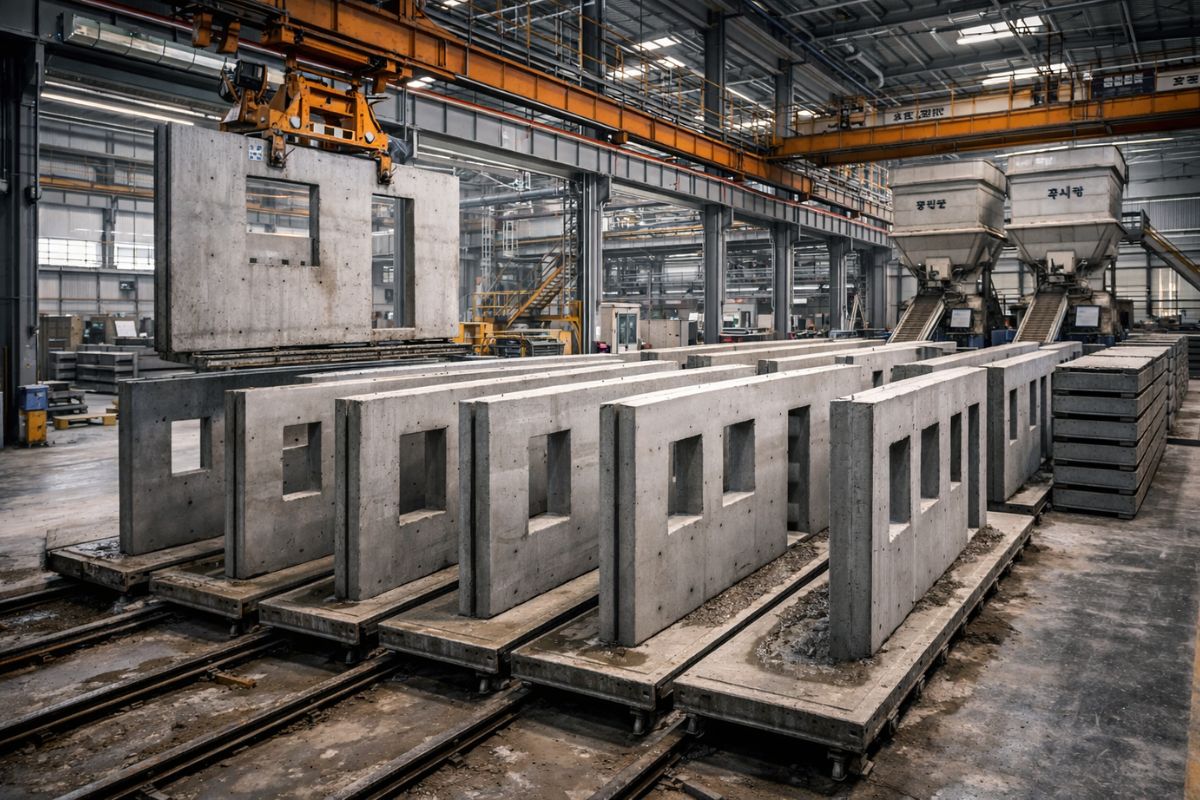
In Icheon, South Korea, the industrial production of bulk concrete uses rigorous mold cleaning, controlled oil application, and a long curing time to deliver manhole blocks and retaining walls. The critical point, however, is invisible: expelling air before separation that defines density, strength, and surface.
The concrete enters the line as pre-mixed raw material, arrives by truck, and turns into a structural piece in minutes, but only appears as a block after a sequence of simple and repetitive controls. The contrast is that the final result depends more on what is not seen than on what is filmed.
In a factory, those who decide the pace are not just the concrete mixer or the dumping bucket. It is the curing time, the availability of the mold, and the separation cycle, because any failure there halts production and returns as defects on the site.
From The Arrival of Concrete to The Closure of The Mold

The flow begins with pre-mixed concrete brought by truck and transferred to a dumping bucket.
-
Friends have been building a small “town” for 30 years to grow old together, with compact houses, a common area, nature surrounding it, and a collective life project designed for friendship, coexistence, and simplicity.

-
This small town in Germany created its own currency 24 years ago, today it circulates millions per year, is accepted in over 300 stores, and the German government allowed all of this to happen under one condition.

-
Curitiba is shrinking and is expected to lose 97,000 residents by 2050, while inland cities in Paraná such as Sarandi, Araucária, and Toledo are experiencing accelerated growth that is changing the entire state’s map.

-
Tourists were poisoned on Everest in a million-dollar fraud scheme involving helicopters that diverted over $19 million and shocked international authorities.


Before this, there is a step that seems domestic but is industrial: washing, cleaning, and drying the mold surface, removing residues that prevent fitting and generate marks on the block.
With the mold clean, assembly closes the volume and defines geometry, whether in a manhole mold or a retaining wall mold.
In some pieces, a steel core enters the center of the mold, creating the cavity and ensuring that the concrete hardens with the correct space for the intended function.
The pouring of concrete occurs in layers, following the volume and shape of the mold.
The operator does not just fill: he needs to distribute the material to avoid creating pockets that later appear as internal flaws.
From this point, the silent race against time begins.
The concrete that is already in the mold does not wait for the line to organize; it begins the hardening process and forces the factory to maintain rhythm until curing and separation.
Oil In The Mold: What Looks Like Spray Becomes A Parameter

The oil spray is presented as a quick gesture, but it acts as an interface between the mold and the concrete.
Without oil, separation becomes a mechanical effort, increasing the risk of chipping corners and leaving the surface uneven.
With excess oil, the piece may acquire stains and lose adhesion in critical points.
The detail is that oil is not an extra.
In practice, it defines how the concrete will behave during demolding and how preserved the mold’s surface will be for the next cycle.
This explains why the line returns to the beginning with mold washing, oil application, and new mold assembly in almost a ritual manner.
This is also why the mold becomes a strategic asset: the more intact it is, the more stable the finishing standard.
It is at this point that the discourse of bulk concrete changes, because the real operational cost is in the control of mold, oil, curing, and separation, and not just in the purchase of the material.
The Invisible Detail Between Dumping And Separation
Between dumping and separating, there is an interval where the concrete is still plastic enough to fail and rigid enough to hold those failures.
It is here that the invisible detail comes in: venting air, expelling bubbles before they turn into porosity and fragility.
This air relief can be done with controlled vibration techniques and impact on the assembly, but the goal is the same: pushing air out of the concrete inside the mold.
When air remains, the piece may even look normal on the outside, but carries internal voids that compromise strength and edges.
The effect appears precisely at the separation stage.
A block with trapped air tends to break at stress points, especially at corners and thin regions of the mold’s design.
In contrast, when the concrete settles well, separation occurs cleanly, with less rework and a more homogeneous surface.
This is the point that changes the weight of the process: the bottleneck is not in the dumping, but in the quality of what happens immediately after dumping, before curing begins.
What is invisible in minute zero becomes visible the next day.
Long Curing And Dismantling: The Piece Only Exists After Time
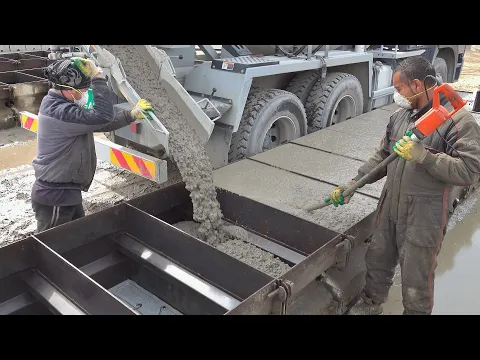

After being filled and stabilized, the assembly continues to harden for more than a day.
The long curing is not a luxury; it is an operational condition so that separation does not tear material from the block and for the concrete to reach sufficient consistency for handling.
When the curing ends, dismantling the mold is almost a practical audit of the cycle.
If the piece comes out stuck, the investigation returns to two points: oil application and the quality of air expulsion. If the piece comes out marked, the reading goes back to mold cleaning and the way of dumping.
The completed concrete manhole block is, therefore, the result of repetition.
The factory relies on the same sequence: mold cleaning, oil, mold assembly, concrete dumping, air expulsion, curing, and separation.
The industrial promise is predictability, and it only appears when the invisible detail is treated as a step.
In the end, the process becomes less about making blocks and more about controlling variables that seem small.
Concrete is abundant, but mold, oil, curing, and separation are the points where the line gains consistency or loses an entire day of production.
Concrete becomes a giant block when the mold is clean, the oil is in the right measure, the curing is respected, and the separation occurs without tearing material, but the invisible detail remains the expulsion of air immediately after dumping, because it defines porosity and strength.
If you could see a single step before trusting a concrete block in public works, would you choose to oversee the oil application on the mold, the curing time, or the moment of venting air before separation? What would weigh more, in your experience?










-

-

-

-

7 pessoas reagiram a isso.