





 Portuguese
  English
  Spanish
  4 min of reading
  0 comments


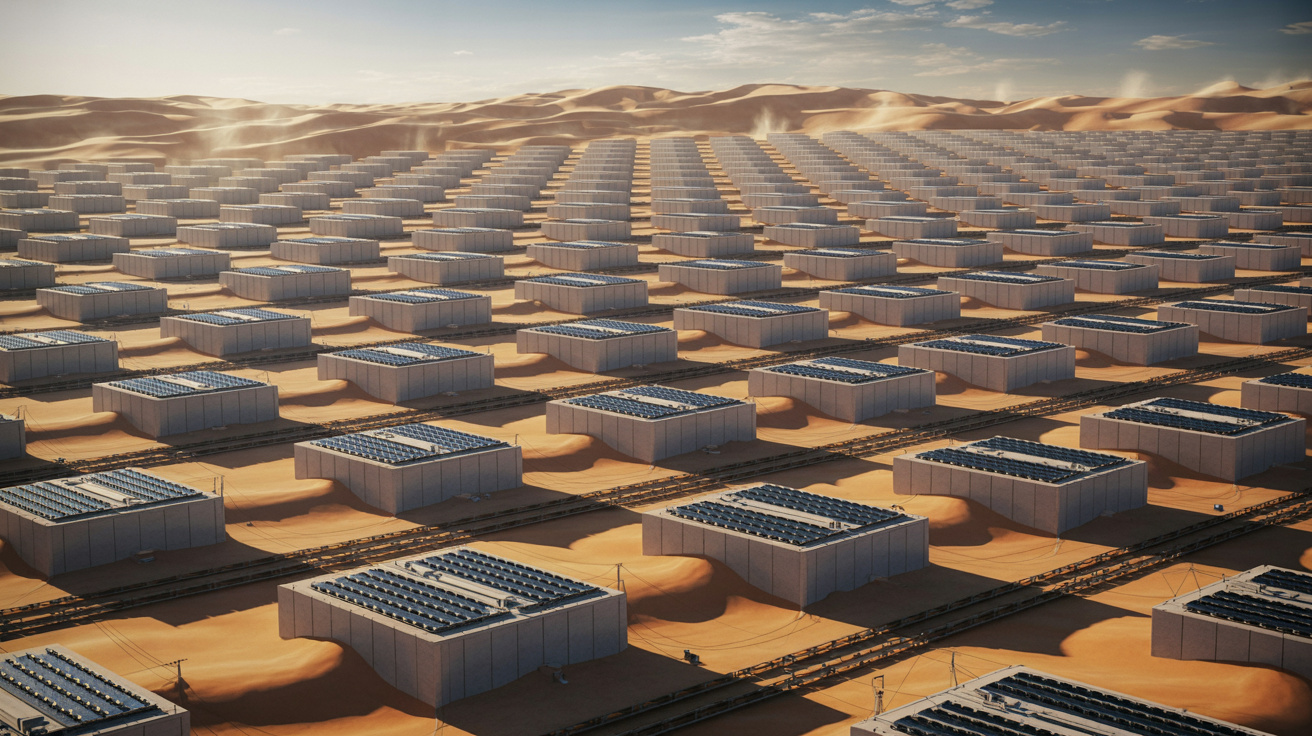
Data Centers In The Nevada Desert Operate 24 Hours A Day, Consume Energy Equivalent To Small Cities, And Support The Invisible Infrastructure Of The Global Internet.
While the average user scrolls the screen of their smartphone, watches high-definition videos, or uploads files to the cloud, there is a massive physical infrastructure silently working in the Nevada desert, in the United States. There, far from large metropolitan areas and surrounded by arid landscapes, some of the largest data centers on the planet — structures that consume energy and water in volumes comparable to small cities to keep the internet operational 24 hours a day. Global digitization has not eliminated the materiality of information. On the contrary, it has expanded it.
What Are Data Centers And Why Did The Desert Become A Strategic Hub?
Data centers are facilities that house thousands, sometimes hundreds of thousands — of servers responsible for storing, processing, and distributing data.


Large technology companies such as Switch, Google, Microsoft, and Amazon Web Services operate complexes in the state of Nevada. The region has become attractive for three main factors:
-
Motorola launched the Signature with a gold seal from DxOMark, tying with the iPhone 17 Pro in camera performance, Snapdragon 8 Gen 5 that surpassed 3 million in benchmarks, and a zoom that impresses even at night.

-
Satellites reveal beneath the Sahara a giant river buried for thousands of kilometers: study shows that the largest hot desert on the planet was once traversed by a river system comparable to the largest on Earth.

-
Scientists have captured something never seen in space: newly born stars are creating gigantic rings of light a thousand times larger than the distance between the Earth and the Sun, and this changes everything we knew about stellar birth.

-
Geologists find traces of a continent that disappeared 155 million years ago after separating from Australia and reveal that it did not sink, but broke into fragments scattered across Southeast Asia.

- Availability of large land areas
- Relatively stable energy costs
- Dry climate that facilitates certain cooling systems
The desert, which once symbolized isolation, now houses the backbone of the digital economy.
Energy Consumption: Scale Comparable To Small Cities
Electricity consumption is the most impressive element. A single hyperscale campus can demand hundreds of megawatts of power. For comparative purposes, a city with 50,000 inhabitants can consume something in the same order of magnitude, depending on industrial activity.
According to the U.S. Energy Information Administration (EIA), data centers in the United States already account for a significant share of national electricity consumption, and the trend is upward, especially with the advancement of artificial intelligence and cloud computing.
In Nevada, large-scale facilities operate with their own energy contracts and direct integration to the regional power grid.
Cooling: The Invisible Challenge
Servers continuously generate heat. The higher the computational density, the greater the need for cooling. In the desert, where external temperatures can exceed 40°C in the summer, thermal control becomes critical.
Some centers utilize evaporative cooling systems that take advantage of the dry air to dissipate heat with less use of compressors. Others invest in hybrid systems or renewable energy contracts to offset environmental impact.
Even so, the water demand for cooling is a recurring topic of public debate, especially in regions of scarcity.
The Explosion Of Demand: Streaming, Cloud, And Artificial Intelligence
The growth of data consumption is exponential. Streaming platforms broadcast billions of hours of video per month. Cloud services store global corporate data. Artificial intelligence applications require intensive processing.
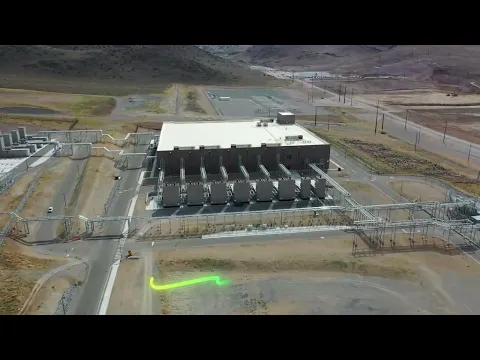
Every query, every upload, every video played is physically processed in racks of servers distributed across facilities like those in Nevada.
The internet does not “live in the cloud.” It lives in giant warehouses filled with cables, fiber optics, and machines operating continuously.
Critical Infrastructure And Security
These data centers are classified as critical infrastructure. They include:
- Redundant power systems
- Emergency generators
- Reinforced physical protection
- 24/7 monitoring
- Multiple connectivity through fiber optic cables
Service interruptions can affect everything from banking services to government communications. The global dependence on these structures has turned data centers into strategic assets.
Renewable Energy And Long-Term Contracts
Technology companies have announced commitments to carbon neutrality. In Nevada, part of the energy powering data centers comes from contracts with solar and wind farms. The state has strong solar potential, which favors the installation of large photovoltaic plants.
Nevertheless, continuous demand requires integration with the traditional power grid, especially during peak loads.
Environmental Impact And Public Debate
The presence of data centers in arid regions raises discussions about:
- Water consumption
- Land use
- Power grid capacity
- Pressure on local infrastructure
Although they generate jobs and tax revenue, they also require robust energy planning.
The balance between digital growth and energy sustainability has become a central topic in American energy policy.
International financial transactions, navigation systems, social networks, corporate videoconferences, e-commerce, everything depends on data centers. Without them, the digital economy simply stops.
The value of the space economy can be measured in hundreds of billions, but the terrestrial digital economy supported by data centers exceeds trillions of dollars in annual activity.
Continuous Growth And Future Challenges
With the advancement of generative artificial intelligence, the required computational density increases significantly.
Language models and deep learning systems require specialized infrastructure, including high-performance GPUs and more advanced cooling systems.
This can further increase energy consumption. Experts warn that expansion must be accompanied by innovation in energy efficiency and server architecture.
The Desert As A New Digital Frontier
Nevada is not the only hub. Arizona, Texas, and other arid regions have also become centers of data center concentration.
The pattern repeats: wide areas, available energy, robust connectivity. What was once remote territory is now the nerve center of the digital economy.
While billions browse, watch, send, and receive data without thinking about the infrastructure behind the screen, data centers in the desert work tirelessly.
They do not appear on tourist maps. They do not have flashy facades. They do not shine like skyscrapers.
But they sustain the internet.
And with every new video watched, every new algorithm trained, their importance grows — silently, massively, and absolutely essential for the functioning of the modern world.








-

-

-

-

-

8 pessoas reagiram a isso.