





 Portuguese
  English
  Spanish
  5 min of reading
  5 comments


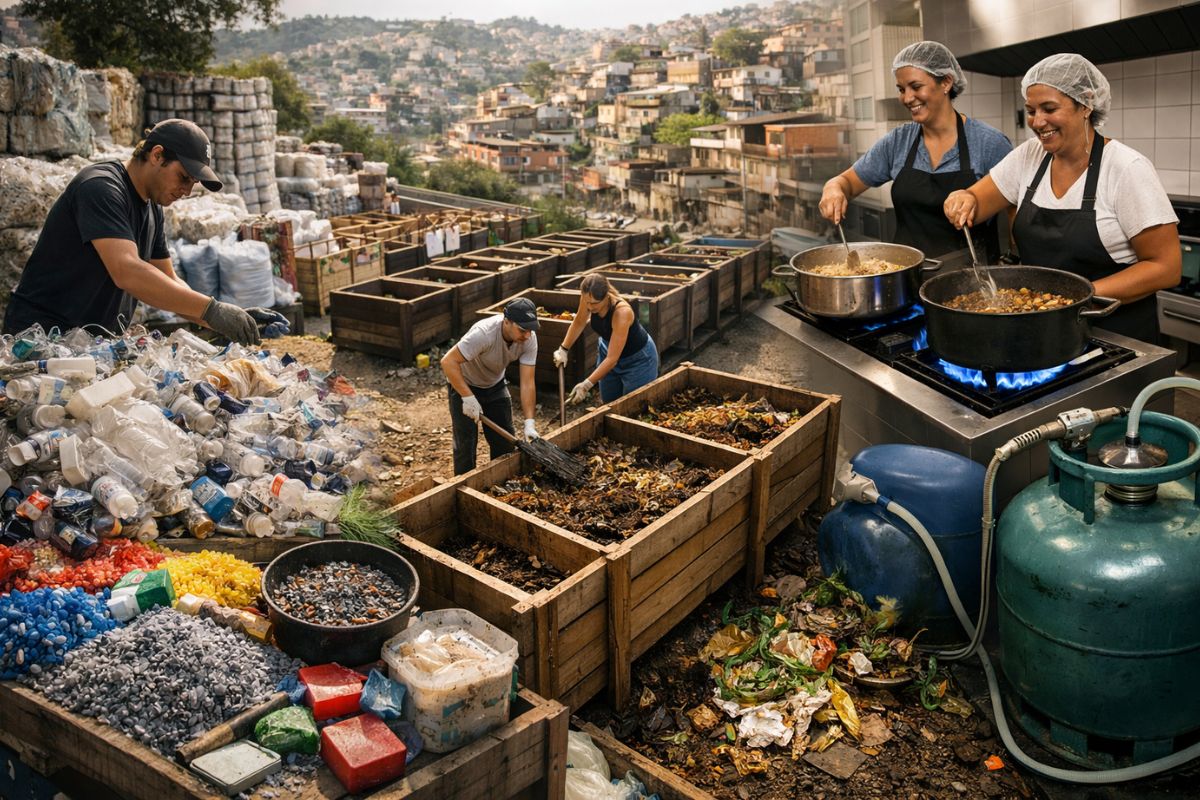


In Kasturba Nagar, Chennai, Community Waste Management Went from Talk to Routine: Families Sort at Source, Volunteers Supervise, Organic Waste Becomes Compost, Flexible Plastic Finds New Use, and a Public School Converts Kitchen Waste into Biogas, Reducing Pressure on Landfills and Local Energy Costs Daily.
In the Kasturba Nagar neighborhood of Adyar, the word waste has come to represent method, responsibility, and local organization rather than just disposal. Instead of waiting for a single solution from the public administration, residents have structured a collective routine of source segregation, with volunteers supervising and ongoing family participation.
The movement has gained practical scale: it covers four main streets, serves around 1,000 households, and connects homes, school, farm and government in a decentralized processing chain . What was once seen as a household problem has become neighborhood infrastructure, with direct impacts on the reduction of mixed waste sent to landfills and in the reuse of materials.
Who Sustains the System and Why It Works in Daily Life

The management of the model is in the hands of ROKA, the Residents’ Association of Kasturba Nagar, with volunteers such as Saranya, who also serves as a treasurer.
-
Friends have been building a small “town” for 30 years to grow old together, with compact houses, a common area, nature surrounding it, and a collective life project designed for friendship, coexistence, and simplicity.

-
This small town in Germany created its own currency 24 years ago, today it circulates millions per year, is accepted in over 300 stores, and the German government allowed all of this to happen under one condition.

-
Curitiba is shrinking and is expected to lose 97,000 residents by 2050, while inland cities in Paraná such as Sarandi, Araucária, and Toledo are experiencing accelerated growth that is changing the entire state’s map.

-
Tourists were poisoned on Everest in a million-dollar fraud scheme involving helicopters that diverted over $19 million and shocked international authorities.


The organization, founded in 2018, emerged from in-person visits to apartments and houses to convince residents to adopt source segregation. The central logic is simple yet demanding: each household takes on its share of responsibility for the waste it generates.
Instead of sporadic campaigns, the adopted strategy is one of continuous routine: door-to-door awareness, supervision, fault correction, and training of other residents’ associations in the city. The participation was not built on impulse, but through repetition and local governance.
This format explains why the system endures: it distributes tasks, defines flows, and reduces the distance between those who discard and those who process.
From Houses to Streets: How Wet Waste Becomes Compost and Returns to the Soil
Regarding organic waste, the neighborhood operates three corridor composters (three-lane model) installed along the streets. The daily dynamic begins with about 25 kg of wet waste, mixed with coconut fiber and covered with dry leaves to control the process.

In a cycle of approximately 45 to 60 days, the material transforms into stable compost. It is a low-complexity engineering and high operational discipline.
The result is not limited to the collection point. Residents who deliver organics can repurchase the compost for gardens and rooftop farms, creating a local circular economy.
During the process, a liquid known as compost tea is also extracted, intended for farmers. In Kottivakkam, for example, the input is used in sandy soil to improve nutrient retention and support plant development.
Wet waste ceases to be an urban cost and becomes an agronomic resource.
Flexible Plastic: From Low-Value Waste to Useful Product

One of the more technical aspects of the project involves the treatment of flexible plastic, such as lightweight food wrappers and bags, which often end up in landfills due to inadequate sorting.
The collection was designed around the actual behavior of residents: hooks distributed in buildings and homes, home storage, and monthly pickup by an environmental conservation team. When the logistics are clear, participation increases.
After collection, the material goes to an aggregator, where it is transformed into usable items such as boards, pots, and paving blocks. The performance data already recorded by the project indicates a diversion of about 580 kg of flexible plastic.
It may seem like a modest volume given the urban scale, but it signals something strategic: there is feasibility in treating flows that typically remain outside of conventional recycling. The gain is less about “technological miracle” and more about smart process design.
Public School and Biodigester: When Food Waste Becomes Energy in the Kitchen

At the public school on Kamaraj Avenue in Adyar, ROKA supported the implementation of an on-site unit for food waste.
The daily operation receives about 20 kg of kitchen scraps: first, the material is shredded; then, it goes to the biological digestor.

The microbial action generates gas, which is stored and connected to the school’s stove. The chain closes within the space where the waste is produced.

In addition to the gas, the process generates a nutrient-rich fraction, applied in composting and in the rooftop garden.

In practice, biogas does not completely replace the main cooking system, but it does cover preparations like eggs and lentils, reducing the work time for the team.
In a span of seven to eight months, the school recorded savings of nearly seven gas cylinders. The model’s value lies in daily operational relief and environmental education integrated into students’ routines.
Where the Model Encounters Limits and Why Source Segregation Remains Critical

Chennai generates approximately 6,500 metric tons of waste per day, and around 4,000 tons still go to landfills. In this context, large centralized solutions often gain political prominence, including proposals for converting waste into energy.
The critical point, however, remains prior to the final technology: without efficient segregation at source, the efficiency of any plant decreases. Mixing in collection turns into value loss across the entire chain.
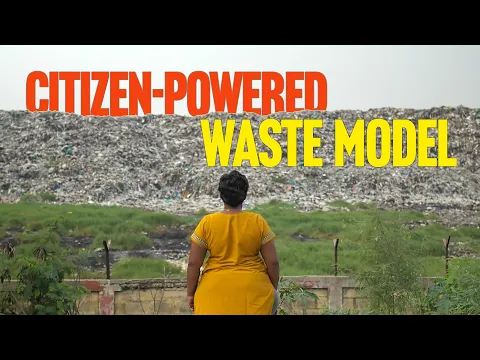

The city’s recent history reinforces this challenge: with the closure of part of the micro-composting and material recovery structures, decentralized processing loses support. It is precisely here that the experience of Kasturba Nagar is technically relevant: it shows that local governance, clear logistics, and continuous engagement can maintain performance even in a high-pressure urban environment.
The project’s numbers indicate approximately 9,200 kg of diverted wet waste and 3,000 kg of compost generated, demonstrating execution consistency, not just a publicity campaign. Scaling requires public policy but starts with effective household segregation.
The experience of Kasturba Nagar shows that the waste crisis is not merely a collection problem, nor just a final technology issue. It involves daily behavior, flow design, co-responsibility, and coordination between residents and local government.
What sets this case apart is the combination of community method, measurable results, and replicability capacity in schools and other associations.
If your neighborhood had to choose only one priority to start tomorrow, whether to segregate organics at home, create a system for flexible plastic, or install a biogas solution in a school/community kitchen, which step would be most viable in your reality and why?










Perfeito, so não entendo os fazedores de L de lixo contra isso colocando emote de bravo kkkk
Os fazedores do L são os maiores apoiadores.
Pra mim separar o lixo já é um grande desafio porque só tem um tipo de lixo e acaba indo tudo junto, mas mesmo assim eu tento colocar o plástico em uma sacola e orgânico em outra sacola pra melhorar a eficiência da coleta
Primeiro eu daria o exemplo, da minha separação do lixo depois convidava vizinhos para verem os resultados, daí formaria o início da ****